For every dollar spent making robots more capable, almost nothing goes toward proving they are safe to stand next to. That’s the gap SafeWorld is betting on. The Oakland, California startup came out of stealth this week with $12.2 million in seed funding to build simulation software for testing how AI-powered robots behave around humans — in the rare, dangerous situations nobody wants to encounter for real.
The round was co-led by Shine Capital and a16z Speedrun, with participation from Box Group, the Carnegie Mellon University Endowment, Innovation Endeavors and SV Angel.
Why safety testing suddenly needs a new category
Robots have been industrial fixtures for decades, and their safety story was simple: put them in a cage. Co-founder Ding Zhao, who directs the Safe AI Lab at Carnegie Mellon University, argues AI broke that model.
“We already have been using robots for maybe 100 years,” Zhao told The Robot Report. “The robots, for the first time, were allowed to go out of the cage and share the same space with humans.”
That’s not an abstract concern — it’s the direction the whole industry is moving. Agility’s Digit has been working without conventional safety cages, and as humanoids spread from pilot cells onto open warehouse floors, the old certification playbook — fixed standoff distances, fenced cells, physical interlocks — has less and less to point at. When the hazard is a learned model rather than a repeating motion path, you cannot exhaustively test your way to certainty on the factory floor.
Co-founder and CEO Kyle Wong — a repeat founder who previously built and sold the brand-content platform Pixlee and later ran Stanford’s StartX accelerator — frames it as an economics problem: “If you’re going to have more capable robots, it just makes sense that you need to have more capable ways to test and to validate those robots,” he told The Robot Report. “Otherwise, you’re not going to deploy those robots.”
What the platform actually does
SafeWorld’s software builds safety scenarios in a browser from three ingredients: past incident records, published safety standards, and a customer robot’s own logs. It then runs the robot through thousands of scenario variations with simulated reactive human motion and measures how safety performance holds up. Teams can re-run the suite with every software update — a meaningful shift from the once-before-launch mindset, since every model tweak can introduce new failure modes.
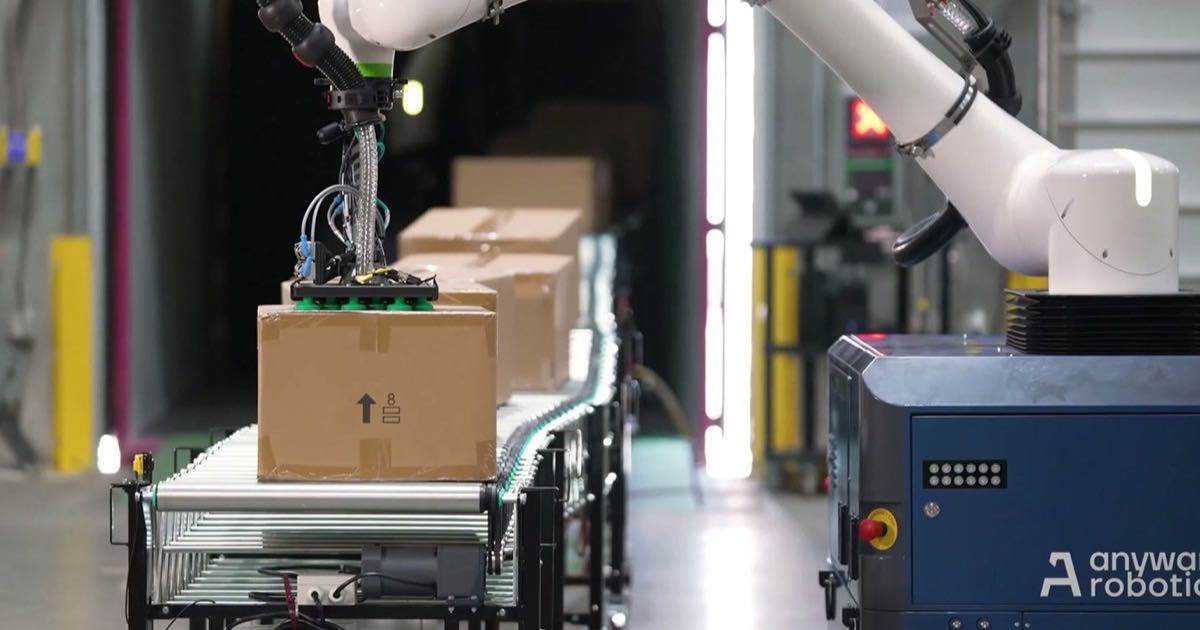
The company says it already has roughly half a dozen paying customers across industrial, manufacturing, logistics, construction and some home use cases, about two-thirds of them publicly traded. One of them, Anyware Robotics — whose box-handling system supplied the featured image on SafeWorld’s own announcement — is named in coverage by Robotics and Automation News and Robottoday, both of which reported the launch this week.
The credibility math
Two things make this worth watching rather than dismissing as another safety checkbox startup. The first is Zhao himself: CMU’s Safe AI Lab is one of the few academic groups that has spent years specifically on AI-era robot safety validation, and a university endowment showing up in the round signals the connection isn’t cosmetic. The second is the timing of the demand. SafeWorld launched because its customers are being asked to deploy robots that learned their behaviour rather than had it programmed — and those customers include publicly traded companies with shareholders, insurers and regulators all asking the same question: who verified this thing is safe?
TechCrunch’s profile of the launch put the harder question bluntly — can simulation evidence actually convince the public that AI-driven robots won’t hurt them? That’s the honest framing. Certification for learned behaviour is genuinely unsolved, and standards bodies are still working out how existing frameworks extend to robots whose actions come from a model. SafeWorld doesn’t solve that; it sells the evidence-gathering layer that any eventual solution will require.
There’s a New Zealand angle in the pattern, too. Local firms adopting warehouse automation in the next few years will import these systems wholesale, and the safety evidence trail — or the lack of one — arrives with the shipment. WorkSafe’s framework presumes deterministic machinery; it has little to say about a robot whose behaviour is a model output. The companies that can produce documented safety evidence for AI-driven machines will find the regulatory conversation much shorter.
The seed number itself is modest by robotics standards. That’s fitting. Safety is not a spectacle business — it’s the plumbing that determines whether any of the hundred-plus humanoid programmes actually make it out of the demo phase.
Sources: The Robot Report, Robotics and Automation News, Robottoday, TechCrunch