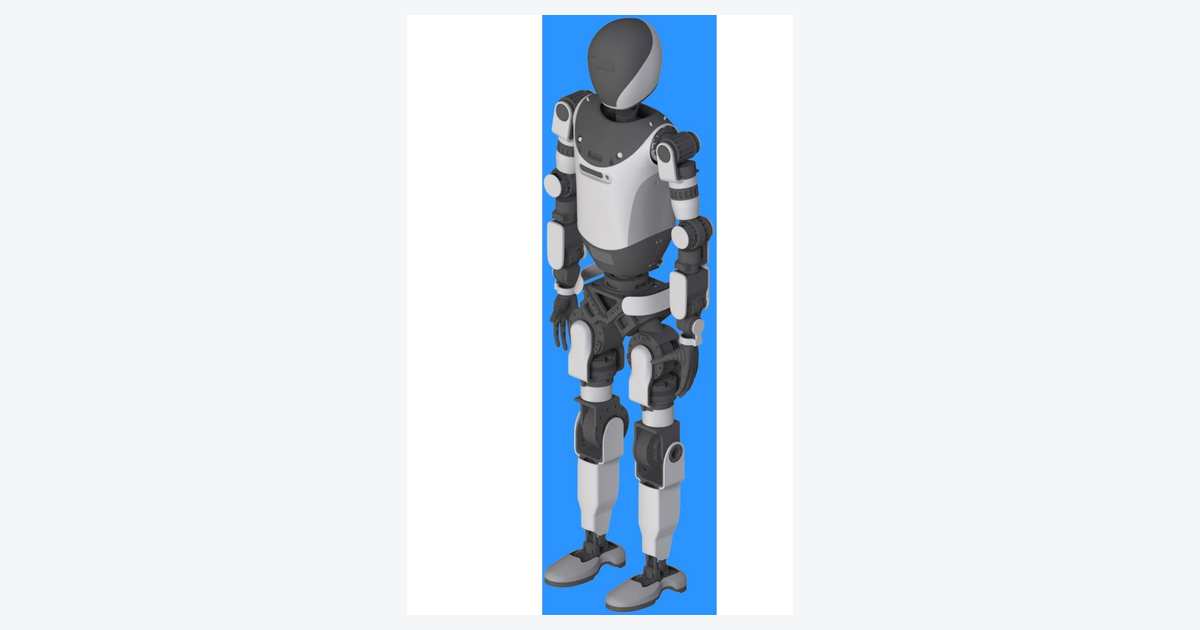
BYD’s long-teased humanoid robot finally has a public face — courtesy of China’s patent office rather than a stage. A design patent for an “embodied intelligent robot” naming BYD as holder was published by the China National Intellectual Property Administration on Friday October 9, and CnEVPost, which first reported the filing, notes the renderings offer the freshest clues yet to the automaker’s robotics ambitions.
The patent images show a bipedal robot with two arms and articulated fingers, an oval-shaped head with a dark face, and light-coloured panels across parts of the torso and limbs. Joints at the shoulders, elbows, hips and knees are deliberately exposed, with some mechanical structures visible around the waist and legs. The proportions are roughly human — closer to a workshop appliance than a sci-fi android. According to the patent description cited by CnEVPost, the design is intended for a machine capable of walking, balancing and interacting, with applications in service, education and industrial settings.
A design filing, not a debut
The timing matters, because BYD has already missed its own deadline. On July 28 the company confirmed to the China Securities Journal that it planned to unveil a humanoid robot in August at Di Space, its science and technology exhibition venue in Shenzhen. As of the patent’s October 9 publication, no formal unveiling has happened. CnEVPost is explicit on the point: the filing covers the robot’s appearance only, and establishes nothing about performance, mass-production progress, or whether the eventual product looks exactly like this. As of publication, the patent reveal had not been independently reported beyond CnEVPost and commentary aggregators — a gap worth keeping in mind when the images start circulating without context.
The strategy the filing fits is the one BYD’s leadership has described for months. Executive vice president Stella Li said in June that she hopes to deploy two to three humanoid robots at every BYD dealership to demonstrate vehicles to customers — our earlier coverage tracked that August plan, which has since slipped. Li has framed homes and the service sector as a huge market for the company, and suggested household robots could one day be sold through BYD’s existing car dealership network. She has also said BYD plans to build an open robotics platform accommodating both its own robots and products developed with other companies — an approach with echoes in Chery’s Aimoga robotics IPO, another Chinese automaker pushing robotics into its capital-markets story.
The carmaker-to-robot pipeline is now a pattern, not a bet
What makes the patent interesting is less the robot than the pipeline behind it. BYD is not a startup pivoting to robots; it is the world’s largest EV manufacturer applying its core competencies — manufacturing scale, electric actuation, batteries, and the software-hardware integration that Li says automotive AI shares with robotics. The exposed joints in the renderings read as manufacturing pragmatism, same as they do on Tesla’s Optimus line: parts you can stamp and assemble beat parts you need to costume.
For the robotics industry, the signal is that automaker entry has moved from announcement to artefact. Patents are cheap and companies file them defensively, but a design filing this late in a programme that already missed an unveiling suggests the industrialisation clock is running in Shenzhen whether or not the marketing clock has started. The West is also watching closely — Washington’s response to Chinese humanoids has already turned explicitly restrictive, so a BYD product that finally debuts will land in a market that is hardening against it.
Whether the real machine debuts this quarter at Di Space or slips further, the design is now out of the bag. New Zealand buyers and robotics watchers should expect the follow-up to arrive the same way the August plan did: via Bloomberg-quoted executives, dealership anecdotes, and the next patent filing.
Sources: CnEVPost · China National Intellectual Property Administration patent filing (credit via CnEVPost) · LinkedIn Pulse analysis