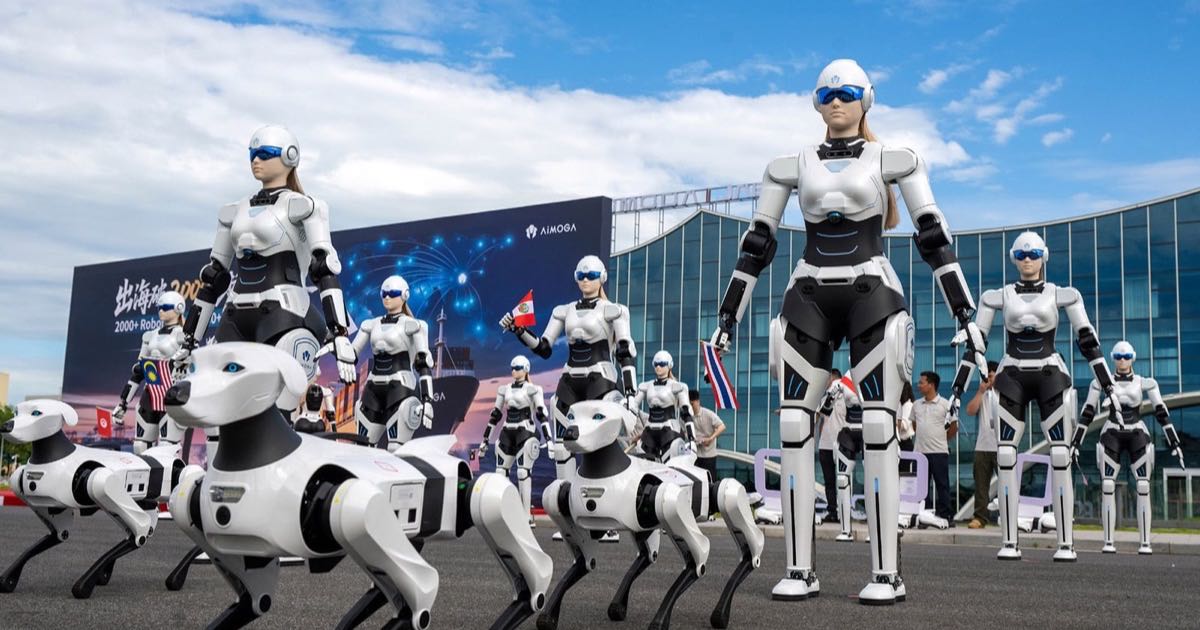
AiMOGA Robotics, the humanoid robot division of Chinese automaker Chery, is preparing for an initial public offering as it scales up production and pushes into overseas markets with police-grade humanoid robots.
Zhang Guibing, who heads the business and also serves as president of Chery International, told Reuters on the sidelines of the World Robot Conference in Beijing that the company is in talks with several potential listing venues. He declined to give a timetable.
What AiMOGA Actually Makes
The company, incubated by Chery in January 2025, builds humanoid robots for service, security, and policing applications. It has delivered more than 3,000 robots globally so far, with 2,000 of those shipped overseas to more than 60 countries, according to CnEVPost.
Its flagship deployment is in policing. AiMOGA has placed 110 humanoid police robots across multiple Chinese cities, where they handle traffic management, crowd guidance, and public-safety awareness campaigns. Think of them less as RoboCop and more as a robotic community support officer — they direct traffic in conditions that would test any human, from freezing winters to monsoon rain.
Zhang frames the policing use case as a labour shortage solution. Traffic police work in harsh conditions — extreme weather, vehicle emissions, accident risk. Robots fill the gap.
The IPO Timing
The decision to go public comes hot on the heels of Unitree’s spectacular Shanghai debut. Unitree, China’s most visible humanoid robot maker, surged 460 per cent on its first day of trading on the STAR Market, reaching a valuation of roughly US$66 billion — more than Figure AI’s US$39 billion valuation from September 2025.
AiMOGA is not in the same league as Unitree in terms of brand recognition. But it has something Unitree does not: a parent company that is China’s largest automobile exporter, with manufacturing infrastructure and global dealership networks already in place across Southeast Asia, the Middle East, and Latin America.
Chery has a track record of spinning off subsidiaries. Auto parts supplier Bethel Automotive listed on the Shanghai exchange in 2018, and robotics automation firm Efort went public on the STAR Market in 2020. TechNode notes that a separate AiMOGA listing would follow that pattern.
10,000 Robots Next Year
Zhang’s delivery target for 2027 is 10,000 robots globally. That is ambitious but not implausible given the current trajectory. China shipped more than 40,000 humanoid robots in the first half of 2026 alone, according to a development report released at the World Robot Conference, capturing 97 per cent of global shipments.
The question is whether those shipments translate into useful work or sit in demonstration halls. HSBC analysts flagged this concern in a mid-July report, warning that “the surge in shipments for robot makers could be illusionary” without significant improvements in AI model capability.
AiMOGA’s policing niche is one answer to that. Traffic management and crowd guidance are repetitive, structured tasks — exactly what current-generation humanoid robots can handle. They do not require the kind of open-ended reasoning that still eludes even the best AI models.
Where Overseas?
Zhang sees demand concentrated in the Middle East and Southeast Asia, where high temperatures and heavy rainfall make outdoor policing physically punishing. That aligns with Chery’s existing auto export markets — the company has a strong presence in the Gulf, Russia, and Southeast Asia.
The US market is effectively closed. Washington banned new foreign-made robots in late July, citing national security concerns, and the Pentagon has placed Unitree on its “Chinese military companies” list. AiMOGA has not been named on that list, but the broader restriction applies.
That leaves Europe as an open question. BMW’s deployment of humanoid robots at its Leipzig plant, the first such use on a European production line, suggests the continent is warming to Chinese robotics technology — or at least not closing the door.
What Stands Out
The pattern here is becoming familiar. Chinese automakers — BYD, Chery — are pivoting into humanoid robotics with manufacturing infrastructure that pure-play robotics startups cannot match. BYD confirmed its own humanoid robot unveil for August. Chery’s AiMOGA already has 3,000 units in the field.
The auto industry’s supply chain — precision motors, sensors, actuators, battery systems — maps almost directly onto what a humanoid robot needs. That is a structural advantage that Western robotics startups, building from scratch, simply do not have. BYD has already confirmed its own humanoid robot unveiling for August.
Whether investors should pay IPO prices for that advantage is another question. Unitree’s 460 per cent pop was driven by retail demand and deliberate IPO underpricing by Chinese regulators, not by revenue fundamentals. AiMOGA’s revenue figures have not been disclosed. The 10,000-robot target is a projection, not a purchase order.
But the direction of travel is clear. China’s humanoid robot industry is consolidating, listing, and scaling — and it is doing so with the full weight of the country’s manufacturing base behind it.