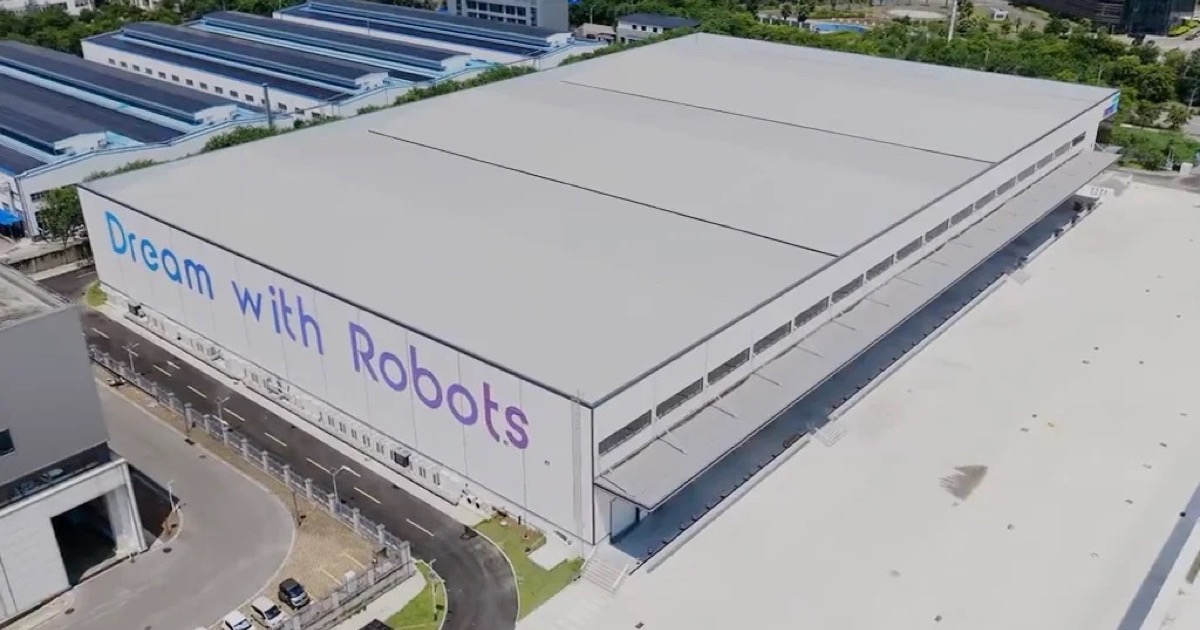
UBTECH Robotics has officially commissioned its Industrial Humanoid Robot Super Smart Factory in Liuzhou, Guangxi — a 14,000-square-metre plant engineered for one headline number: an annual capacity of more than 10,000 industrial humanoid and wheeled robots. Commissioning took place over the weekend of September 12–13, with Xinhua confirming the state-backed rollout on Saturday and UBTECH founder Zhou Jian on site alongside Siemens executives and Liuzhou municipal officials.
The plant’s design benchmark is a completed industrial humanoid every 10 minutes. There is no automotive-style overhead conveyor: instead, the mixed-model line builds the bipedal Walker S series and wheeled Cruzr platforms side by side, each chassis riding on self-docking rotating dollies with RFID tags tying every screw torque and inspection result to its serial number.
Robots building robots
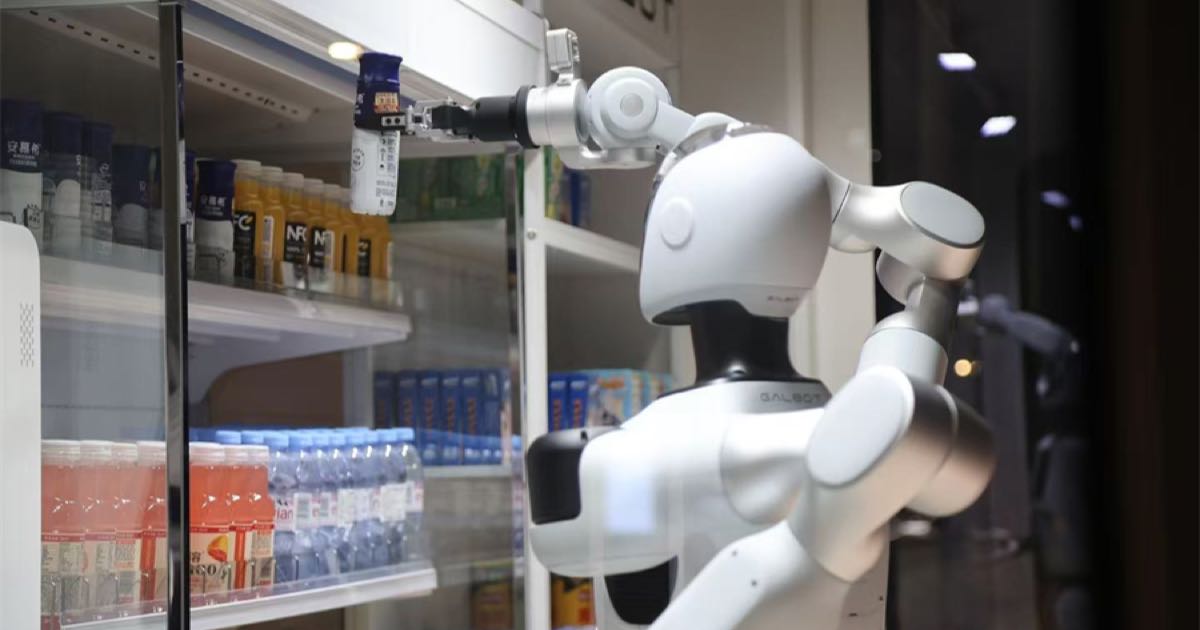
The line’s labour is partly its own product line. Wheeled Cruzr Y1 and Cruzr S2 mobile manipulators with 3D vision do the depalletising, bin picking and component transfer that human parts-runners would normally do, working alongside Wali autonomous forklifts and Chitu unmanned haulers. UBTECH’s Yanshee manufacturing operations platform, integrated with Siemens’ Intelligence Center X, orchestrates the fleet — a design validated in a 1:1 digital twin before ground was broken.
Every robot goes through more than four hours of end-of-line burn-in — gait balance, actuator calibration, payload stress — then walks itself through an automotive-grade lighting tunnel for visual inspection. A 65-square-metre high-bay automated warehouse buffers up to 112 finished units.
Why scale matters: the $20,000 humanoid
The economics are the point. UBTECH’s full-size humanoid revenue jumped 1,445 percent in the first half of 2026 on 921 bipedal deliveries, and the company is banking on volume to cut manufacturing costs 20 to 30 percent a year, targeting a production cost below $20,000 per unit by 2030. That threshold is widely treated in the industry as the price where humanoids stop being capital-intensive pilot projects and start being standard factory infrastructure. UBTECH says its supply chain is more than 90 percent localised in China, and the Liuzhou plant sits next to automotive partners including SAIC-GM-Wuling, where Walker S units have already trialled.
The competitive backdrop is unforgiving. Western rival Figure recently marked its 1,000th Figure 03 humanoid at a takt time of one robot per hour — UBTECH’s new line is designed to run six times that. At home, Counterpoint Research’s first-half data has AGIBOT and Unitree leading global shipment volumes, and China’s Ministry of Industry and Information Technology projects tier-one manufacturers will pass 100,000 cumulative units produced in 2026. Capacity, in other words, is table stakes.
The catch: absorption and software
Two caveats temper the milestone. First, capacity is only worth what the order book absorbs — UBTECH’s humanoid revenue is more than 96 percent enterprise, and absorbing 10,000 units a year requires customers who can actually deploy them. Second, hardware throughput does not solve the embodied-AI software problem: generalisation outside structured factory tasks remains the sector’s unsolved bottleneck.
That tension is the real story of Liuzhou. The industry has spent years defending demo videos; China’s humanoid makers are now answering with automotive-grade production discipline. Whether the orders follow — and whether the robots’ software is ready for what rolls off the line — is the open question UBTECH’s own aggressive scaling bet now has to answer. It is also the sharpest data point yet in the global humanoid shipment race, where Chinese manufacturers have turned supply-chain depth into a volume weapon Western rivals — still chasing their first thousand units — have not matched. And with regulators on both sides of the Pacific watching the market heat up, from China’s own humanoid IPO crackdown to the US blocking Chinese humanoid robots on national-security grounds, a 10,000-unit factory is as much a geopolitical statement as a manufacturing one.