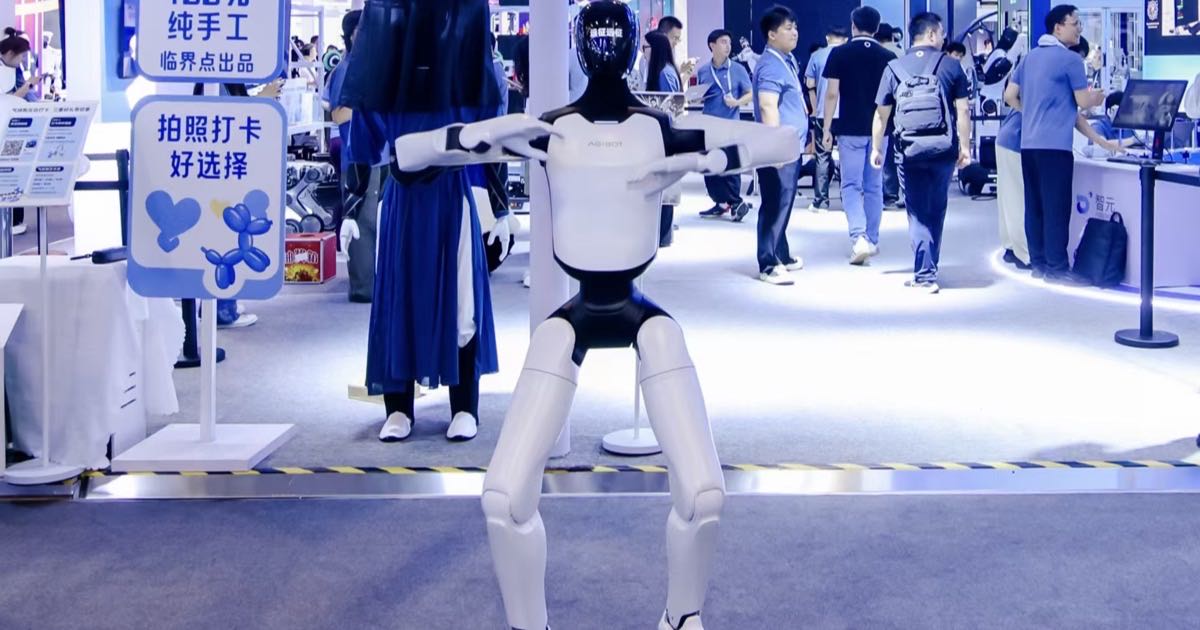
Separating two pieces of fabric sounds simple. For a humanoid robot, it is anything but. Too much force distorts the material. Too little and it slips from the gripper. Yet in Chinese garment factories, robots developed by Aitu, a Zhejiang-based intelligent sewing company, are already doing it — with a 97 per cent success rate on a single fabric type.
The number sounds impressive. The context matters more.
🔍 THE BOTTOM LINE
China’s humanoid robots are entering factories one station at a time, not as general-purpose workers. The government wants 10,000 units deployed by year-end. The factories testing them say the economics work — but only for narrowly defined, repetitive tasks. The broader claim that humanoid robots are ready to replace human labour remains unproven.
What is actually deployed
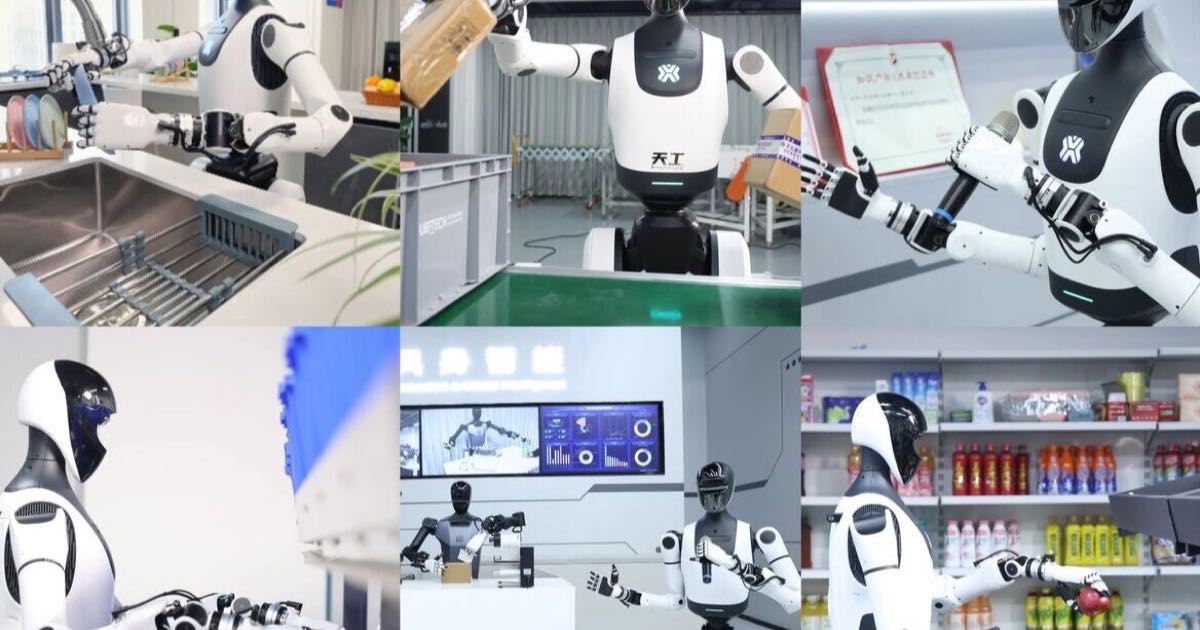
Aitu’s robots are being tested at three Chinese garment manufacturers: Sunrise Group, Eifini, and Chenfeng Group. Their assignments are specific: loading and unloading fabric at template sewing machines, positioning material for pocket setters, and picking up cut pieces at fusing press machines.
The company says more than 98 per cent of the resulting sewing work meets quality standards. At current efficiency, Aitu estimates the robot pays for itself in about 18 months.
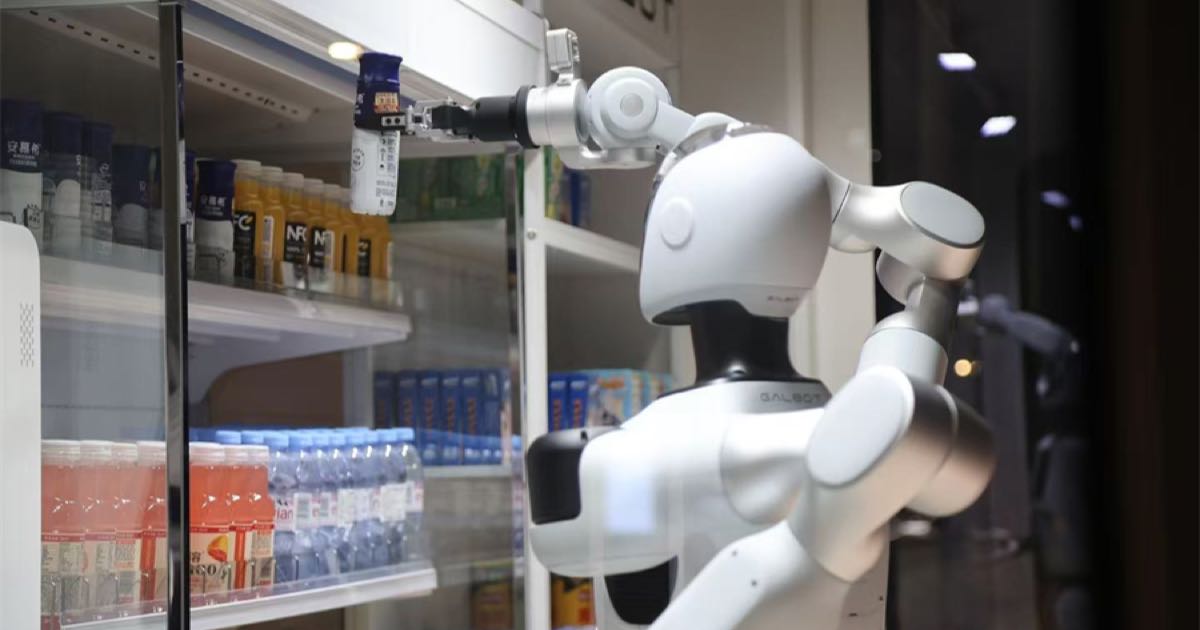
A second company, PIABOT Robotics, has deployed its G2 robot in electronics assembly and logistics sorting. In one trial at a major Chinese electronics manufacturer, the G2 completed 2,283 tasks over eight hours without an error. On an automotive safety-equipment line, it cut a seat-belt component tapping task from 18 seconds per cycle to 12.9 seconds — roughly a one-third efficiency improvement.
These are real numbers from real production lines. They are also narrowly bounded. Each robot does one thing, at one station, with one type of material or component.
The 10,000-unit target
China’s Ministry of Industry and Information Technology and its state assets regulator have launched a program to train humanoid robots and embodied AI systems in real-world settings. The goal: 10,000 deployed units by the end of 2026.
A training facility in Cixi, a manufacturing hub in Zhejiang, launched in mid-May with 40 embodied AI robots. It is designed around simulated scenarios from nine local industries — home appliances, automobiles, textiles — and is expected to provide more than 90 hours of effective robot training per day once fully operational. A similar national pilot base is taking shape in Hangzhou.
The ambition is clear. The gap between the ambition and the current state of the art is also clear.
What robots still cannot do
Lou Lingtong, general manager of Aitu, is blunt about the limitations. “Humanoid robots are still at the learning stage,” he said. “They can perform individual processes well, but are still unable to run an entire production flow without human involvement.”
The harder problem is generalisation. A robot trained to handle one fabric may struggle with another it has never encountered. Lou compared handling fabric to picking up tofu — too much force and it deforms, too little and you cannot hold it. Enabling robots to adapt their movements to unfamiliar materials is, in his words, a key technical problem the industry is working to solve.
Industrial production also leaves little room for error. Reflections and dust disrupt perception. Continuous operation stresses durability, heat management, and component life. A lack of common interfaces and safety standards raises integration costs.
The worker shortage driving adoption
The economic case for humanoid robots in Chinese factories is not purely about productivity. It is about labour supply.
Lou said the number of garment workers retiring or leaving the industry each year far exceeds the number of jobs being taken over by robots. “Factories cannot recruit enough people or persuade them to stay,” he said. The robots are filling gaps, not displacing workers.
Xiong Rong, chief scientist at the Zhejiang Humanoid Robot Innovation Center, added that wider robot use would also create jobs in maintenance, debugging, and secondary development. The net employment effect is an open question.
How this compares to the US and Europe
Chinese humanoid deployment is running on a different model than the West. US companies like Figure AI and Agility Robotics are deploying humanoids in automotive and logistics environments — BMW’s factory, Amazon warehouses. The Chinese approach is concentrated in lighter manufacturing: garments, electronics, consumer goods.
The FCC’s ban on Chinese humanoid robots means the two markets are diverging. Chinese robots stay in China and Asia. American-made robots serve the US and Europe. The technology is converging — hardware is commoditising, with companies settling on similar hand designs, actuators, and sensors — but the markets are splitting.
The timeline nobody wants to hear
Lou expects 2026 to 2028 to be a period of validating robots in individual processes. Coordinated deployment across multiple tasks — the thing that would actually transform factory operations — does not begin to scale until 2028 to 2030.
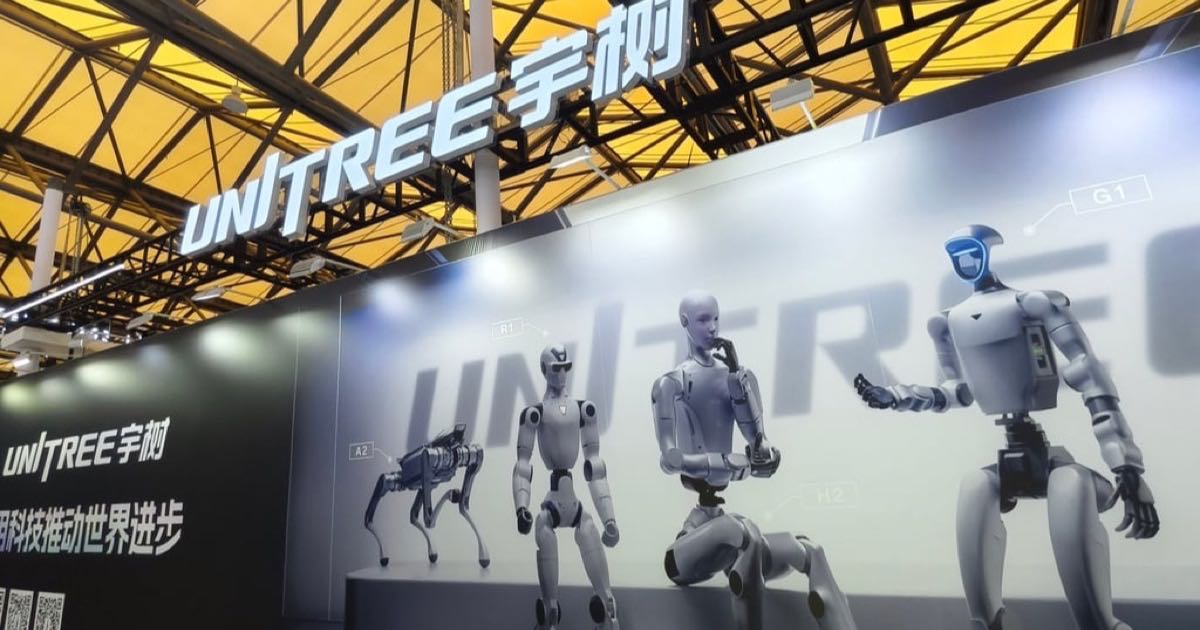
That is the honest assessment from someone running robots in a real factory today. It is not the timeline investors in Unitree’s $620 million IPO are pricing in. But it is the one that matches what is actually on the floor.
NZ angle
New Zealand’s manufacturing sector is dominated by small-batch, high-mix operations — food processing, agricultural equipment, specialised components. That is exactly the profile that has historically been left behind by automation. If the Chinese model of deploy-one-station-at-a-time proves viable, it could lower the barrier for NZ manufacturers who cannot justify a full automation cell but could handle one robotic workstation.
❓ FAQ
What is Aitu?
Aitu is an intelligent sewing technology company based in Zhejiang Province, China. It develops humanoid robots for garment factory tasks like fabric separation, loading, and positioning.
What is China’s 10,000-unit target?
China’s Ministry of Industry and Information Technology aims to have 10,000 humanoid robots and embodied AI systems deployed in real-world factory settings by the end of 2026, as part of a program to move robots from testing into actual production.
Can humanoid robots run a full production line?
Not yet. According to Aitu’s general manager, robots can perform individual processes well but cannot run an entire production flow without human involvement. The industry expects coordinated multi-task deployment to scale between 2028 and 2030.
How does this compare to US humanoid deployments?
US companies like Figure AI and Agility Robotics are deploying humanoids in automotive and logistics environments. Chinese deployment is concentrated in lighter manufacturing — garments, electronics, consumer goods. The FCC ban on Chinese robots means the two markets are diverging.
🔍 THE BOTTOM LINE
China is doing what it does best: deploying technology at scale, fast, with government backing. The factory-floor results are real but narrow. The 10,000-unit target is ambitious but achievable. The claim that humanoid robots are ready to replace human labour is not supported by what is actually happening on the floor. They are filling gaps, one station at a time.