The numbers look spectacular. Global humanoid robot shipments reached 22,000 units in the first half of 2026 — a near 300 per cent jump from the same period last year, according to Counterpoint Research. But the deployment data tells a more complicated story.
Over 60 per cent of those robots went to entertainment, performance, and data-collection research. Only 12.8 per cent ended up in smart manufacturing. Warehousing and logistics took 4.9 per cent. The headline growth is real. The practical deployment is not.
The shipment hierarchy
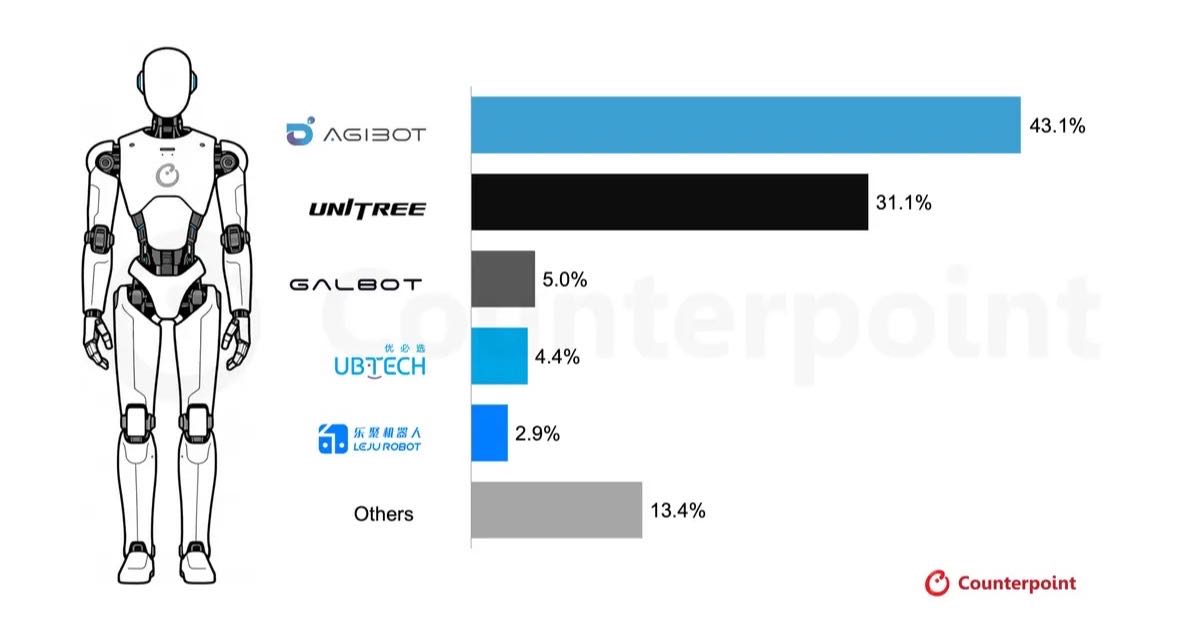
AGIBOT led the global market with 9,700 shipments (43.1 per cent share), followed by Unitree at 7,000 units (31.1 per cent). The top five vendors controlled 86 per cent of all deliveries. Galbot shipped over 1,100 units, mostly wheeled dual-arm logistics platforms. UBTECH delivered roughly 1,000, concentrated in automotive assembly. Leju Robotics rounded out the top five with 650 bipedal units for research and data collection.
| Vendor | H1 2026 Shipments | Share | Primary Focus |
|---|---|---|---|
| AGIBOT | ~9,700 | 43.1% | Multi-tier: biped, compact, wheeled industrial |
| Unitree | >7,000 | 31.1% | Bipedal: G1 compact, H1 general-purpose |
| Galbot | >1,100 | 5.0% | Wheeled dual-arm logistics, emerging biped |
| UBTECH | ~1,000 | 4.4% | Industrial bipeds, home platforms |
| Leju | ~650 | 2.9% | Bipedal research platforms |
Where the robots actually go
The deployment breakdown reveals the gap between the humanoid robot narrative and reality:
- Entertainment and performance (33.6 per cent): The largest single use case. Small-form humanoids deployed in exhibitions, media productions, and promotional events.
- Data production and research (27.0 per cent): Robots used to capture real-world sensorimotor data for training embodied AI models. This is the backbone of institutional hardware sales.
- Service and guidance (19.0 per cent): Unmanned retail, hospitality, public facility guidance.
- Intelligent manufacturing (12.8 per cent): Inspection, material transfer, sorting in automotive and electronics assembly.
- Warehousing and logistics (4.9 per cent): Palletizing, sorting, tote handling.
More than 60 per cent of all “humanoid robots” shipped in H1 2026 are essentially performing, demonstrating, or generating training data — not doing productive industrial work.
The form-factor debate
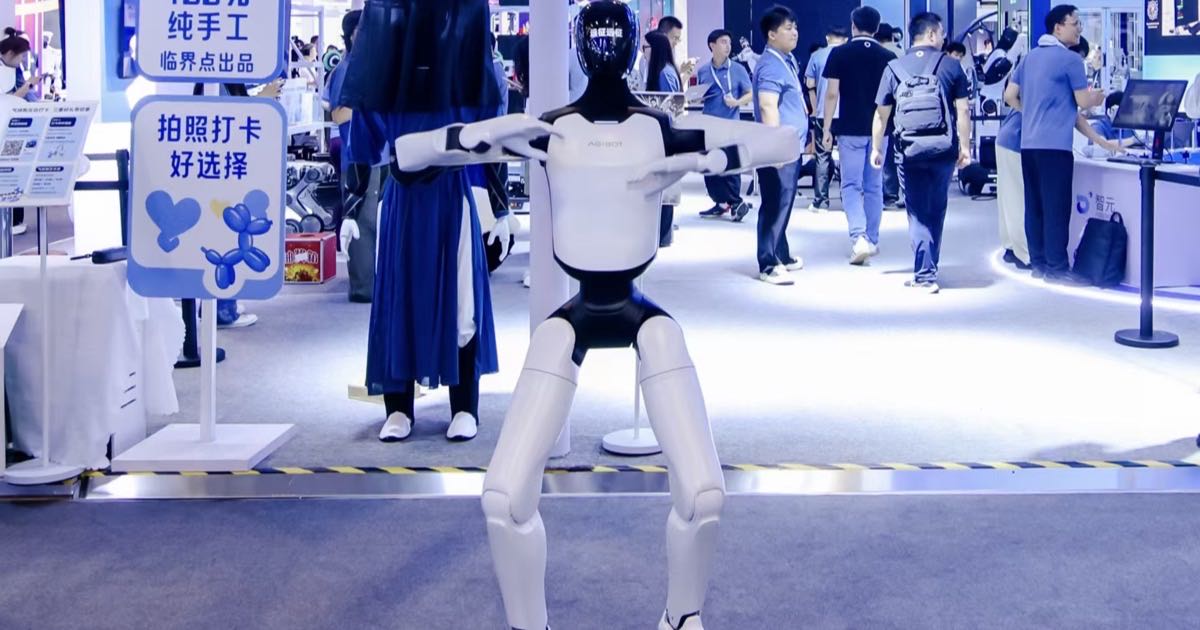
AGIBOT’s lead comes with an asterisk. The Shanghai-based company deploys a multi-tier product strategy spanning bipedal A-series robots, compact X-series units, and wheeled G-series industrial platforms. Not all of these are what most people picture when they hear “humanoid robot.”
Unitree has pushed back on counting wheeled platforms alongside legged machines. The Hangzhou company recently announced it had produced 18,000 cumulative bipedal humanoids, explicitly excluding wheeled systems from its count. The definitional dispute matters because it affects how the market is sized and who gets to claim the crown.
Why generalization is the real bottleneck
Counterpoint forecasts full-year 2026 shipments will exceed 50,000 units. But volume is not the constraint. The constraint is whether those robots can do useful work without being reprogrammed for every new task.
As Machine Dawn’s analysis noted, only about 20 per cent of shipped humanoids are deployed in smart manufacturing and warehousing. The gap between headline growth and practical factory adoption highlights that the industry’s real challenge lies in achieving generalization and task-copying abilities — not production volume.
This aligns with what Unitree founder Wang Xingxing told the World Robot Conference: the “ChatGPT moment” for humanoid robots requires a machine that can be dropped into an unfamiliar environment and complete roughly 80 per cent of tasks with only voice or text instructions. Today’s robots succeed at specific, pre-trained tasks in controlled settings. Generalising to novel environments is a different problem entirely.
The viral robots running into walls at this week’s World Humanoid Robot Games in Beijing are not just comedy. They are a visible demonstration of the same limitation. A robot that can run fast but cannot stop safely, cannot navigate a corner, or cannot recover from a stumble is not ready for a factory floor — let alone a home.
What comes next
Robotics makers are betting on hybrid AI architectures that combine world models with vision-language-action systems. AGIBOT is preparing to launch its GO-3 embodied foundation model and a Robot-as-a-Service programme this autumn. Unitree is partnering with DeepSeek on foundation-model software. The technical frontier is moving from hardware feasibility — can we build a bipedal robot that walks? — to cognitive generality — can that robot figure out a new task on its own?
Counterpoint expects industrial and commercial service applications to overtake research and entertainment as the primary volume driver over the next five years. That forecast depends on whether the software catches up to the hardware. The chassis are rolling off assembly lines. The question is whether the brains inside them can keep up.
❓ FAQ
How many humanoid robots shipped globally in H1 2026? Over 22,000 units, up nearly 300 per cent year-over-year, according to Counterpoint Research.
Which company shipped the most humanoid robots? AGIBOT led with 9,700 units (43.1 per cent market share), followed by Unitree with over 7,000 units (31.1 per cent).
Why are most humanoid robots not in factories yet? Over 60 per cent of shipments went to entertainment, performance, and data-collection research. Only 12.8 per cent went to manufacturing. The bottleneck is task generalization — robots can perform pre-trained tasks but struggle to adapt to new environments or tasks without reprogramming.