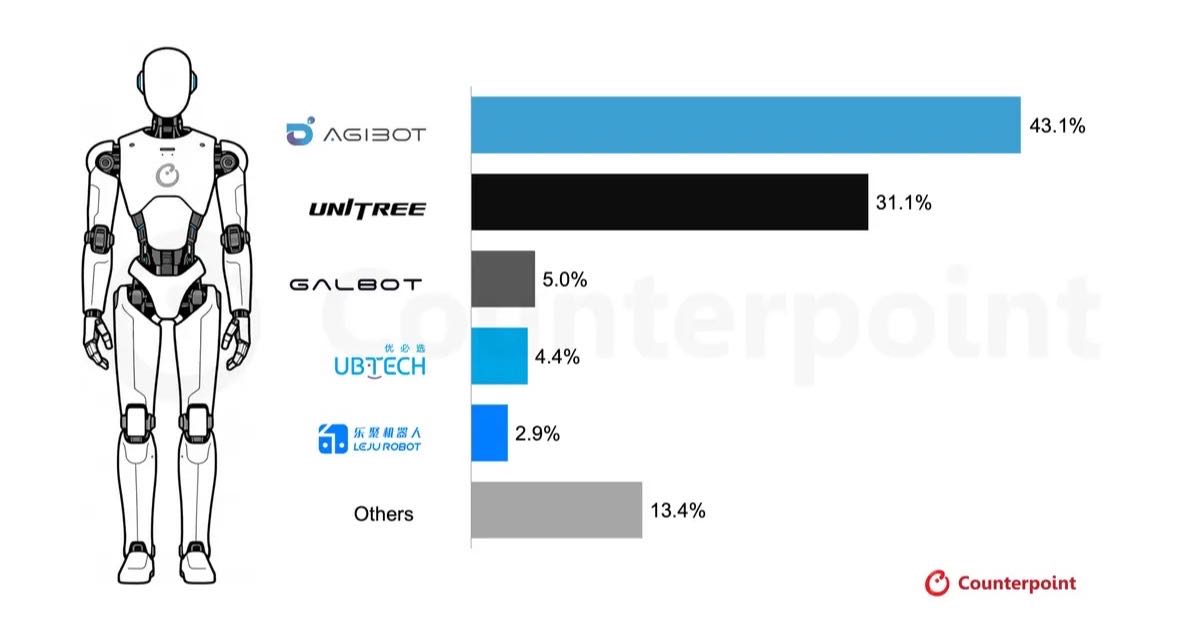
When we covered Agibot overtaking Unitree in August, the numbers came from one research firm’s estimate: roughly 8,400 humanoid robots shipped in the first half of 2026. A second firm has now weighed in, and its count is even higher. According to Counterpoint Research, Shanghai-based Agibot shipped approximately 9,700 humanoid robots in the first half of 2026 — more than 43 percent of the global market, and comfortably ahead of Unitree’s 31.1 percent.
Robotics & Automation News ran the figures on 18 September, a month after Counterpoint’s tracker first appeared and Agibot itself trumpeted the ranking in a press release on 20 August. The headline numbers: global humanoid shipments exceeded 22,000 units in H1 2026, up nearly 300 percent year on year, and Counterpoint expects the full-year total to pass 50,000 units as pilot projects move into broader commercial deployment.
Two firms, same story
It is worth being careful with research-firm numbers in a market this young. Smart Analytics Global’s August estimate had Agibot at 8,400 units; Counterpoint’s tracker puts the same half at about 9,700. That is a 15 percent spread between two firms measuring the same thing — a reminder that “shipments” can mean different things (units sold, units delivered, units produced) and that nobody outside the companies audits the figures. But the direction is unambiguous, and now two independent trackers agree on it: Agibot is the world’s largest humanoid robot vendor by units, and it is not close.
Counterpoint’s vendor breakdown puts Unitree second at 31.1 percent, followed by Galbot at 5.0 percent, UBTECH at 4.4 percent and Leju Robot at 2.9 percent, with everyone else at 13.4 percent combined. The top two alone control nearly three-quarters of the market, and both are Chinese — consistent with the 97 percent Chinese share of global humanoid shipments reported in August.
Unitree, for its part, has had a busy quarter: its Shanghai IPO in August closed 460 percent above the offer price, and its founder used the World Robot Conference to predict the industry’s “ChatGPT moment” within two to three years.
What Agibot is actually doing with 9,700 robots
The scale claim is easier to take seriously when you look at what Agibot says about its production line. The company announced in June 2026 that its 15,000th robot had rolled off the line — a cumulative figure spanning its whole portfolio, including the quadrupeds and commercial cleaning units, but still a genuine mass-production milestone in a market where most “humanoid makers” ship in the hundreds.
More interesting than the total is where the robots are going. Agibot’s G2 industrial humanoid has been deployed on consumer-electronics maker Longcheer Technology’s production line, where the company says the robots are performing real production tasks rather than demonstrations. The X2 series is being used in commercial service and research roles. That split matters: the market story of 2026 is not consumer humanoids but industrial ones, working fixed tasks on production lines where the environment can be engineered around them.
The 50,000 question
Counterpoint’s full-year forecast of more than 50,000 units implies the second half of 2026 will roughly double the first. If that lands, the humanoid market will have gone from a rounding error to a real industry in two years — though it is worth keeping the number in perspective. Fifty thousand units a year is about two days of global car production. The interesting question is not whether the humanoid market is growing fast; it plainly is. It is whether the pilots now running on factory floors convert into repeat orders, or whether the industry discovers — as robotics has before — that a robot that demos well and a robot that earns its keep are different machines.
Two research firms now agree on who is winning the first question. Nobody has data on the second yet.