Unitree Robotics founder Wang Xingxing told the 2026 World Robot Conference in Beijing that humanoid robots could reach their “ChatGPT moment” in two to three years — if everything goes right. Under less ideal conditions, he said, it could take up to a decade.
The comments came one day after Unitree’s blockbuster Shanghai IPO, which saw shares close 460 per cent above the offer price, valuing the Hangzhou-based company at roughly $50 billion. Wang’s first public address since the listing was titled “From Exhibits to Products: The Next Decade of the Humanoid Robot Industry” — a title that itself captured the tension between the market euphoria and the engineering reality.
What the “ChatGPT moment” means for robots
Wang defined the tipping point specifically: a robot that can be dropped into an unfamiliar environment — including a home — and complete roughly 80 per cent of tasks guided only by voice or text instructions. That is a high bar. Today’s humanoid robots succeed at specific, pre-trained tasks in controlled settings. Generalising to novel environments with nothing but a natural language command is a different problem entirely.
The bottleneck, Wang said, is not the AI model’s reasoning capacity. It is the physical interface between the model and the world. “When a robot reaches for an object, it looks like it has almost got hold of it — but that last bit of tactile feedback, that final small margin of error, it cannot correct,” he told the conference, according to Global Times. The residual error goes unresolved and the success rate collapses. Wang called this the biggest challenge facing embodied AI worldwide.
This is a telling admission from the founder of a company whose robots went viral for backflips and robot dog stunts. The gap between impressive demonstrations and reliable real-world deployment is tactile, not cognitive.
The numbers behind the hype
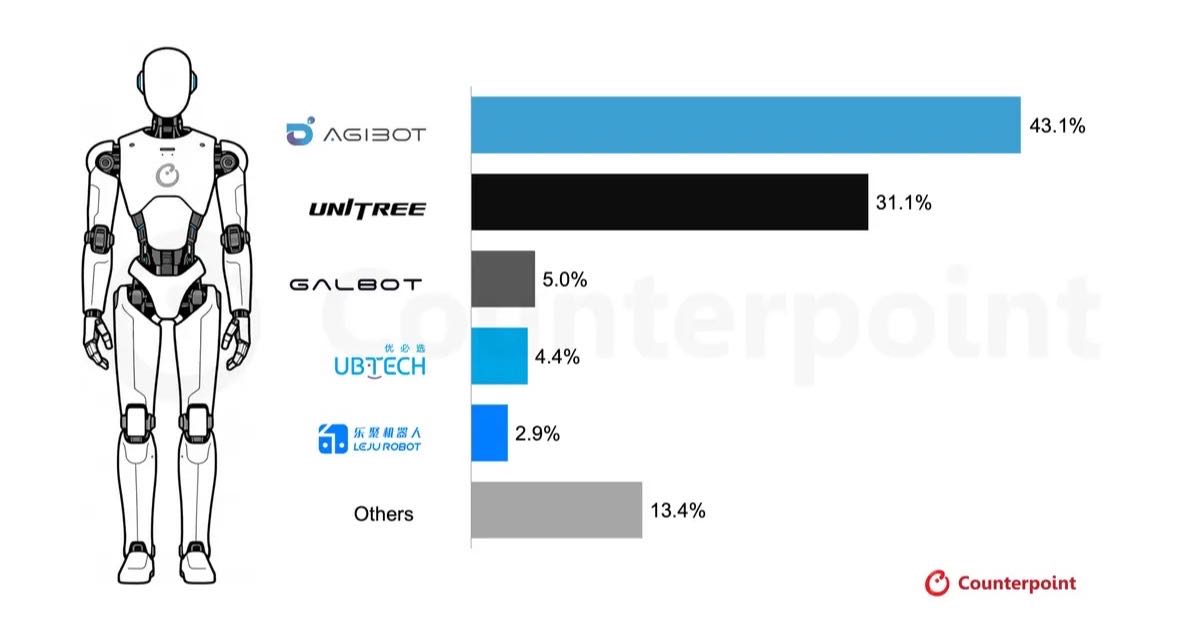
China shipped more than 40,000 humanoid robots in the first half of 2026, accounting for 97 per cent of global shipments, according to an industry report released at the conference and cited by Reuters. Unitree itself shipped around 5,500 humanoid robots in all of 2025.
JPMorgan forecasts global humanoid shipments will reach 60,000 units for 2026 as a whole, up from 18,000 in 2025, and 1.75 million by 2030. That is a 30-fold increase in four years. Whether the supply chain, the software, or the market demand can sustain that trajectory is an open question.
The World Robot Conference itself is a signal of scale. More than 300 exhibitors set up across four pavilions in Beijing’s E-Town, a 69 per cent increase from 2025, showcasing over 3,000 exhibits and 300 new products. BYD, China’s largest electric vehicle maker, debuted its first humanoid robot at the event. firefighting humanoids and tank-inspection climbers shared the floor with consumer-focused models.
Why the timeline matters
Two to three years is optimistic. Ten years is conservative. The range tells you more than either endpoint: nobody actually knows.
What is clear is that the hardware is further along than the software. Unitree’s robots can walk, run, backflip, and carry loads. What they cannot do is reliably grasp a novel object in a cluttered kitchen, interpret ambiguous instructions, or recover from the small errors that cascade into task failure. The AI models that power robot brains — including Google DeepMind’s Gemini Robotics ER 2, announced in July — are improving fast. The physical interface is not keeping pace.
Wang also showcased software under development that lets developers program and simulate humanoid robot movements on a computer before testing on physical machines. Simulation-first development is standard in robotics, but Unitree’s version is notable for its timing: the company is betting that better simulation tools will close the gap between lab demos and deployed products faster than hardware improvements alone.
The geopolitical backdrop
The conference opened days after the US Federal Communications Commission banned Chinese humanoid robots on national security grounds. China’s dominance of humanoid robot production — 97 per cent of global shipments — is not just an industrial statistic. It is a supply chain concentration that governments are starting to treat as a strategic risk.
For New Zealand, which imports virtually all of its robotics hardware, the concentration matters. A market where one country produces nearly all units means pricing, availability, and even software updates are subject to geopolitical winds. NZ firms deploying or testing humanoid robots are effectively betting on Chinese supply chains, whether they chose to or not.
The market clearly disagrees with Wang’s caution. Unitree’s $50 billion valuation prices in a future where humanoid robots are everywhere, soon. The CEO’s own timeline — two years if everything goes perfectly, ten if it does not — is the kind of hedging you hear from someone who knows how much can go wrong between a demo and a product.
❓ FAQ
What is the “ChatGPT moment” for humanoid robots? Unitree’s CEO defines it as a robot that can be placed in an unfamiliar environment and complete about 80 per cent of tasks using only voice or text instructions — no pre-programming required.
How many humanoid robots did China ship in 2026? Over 40,000 units in the first half of 2026, representing 97 per cent of global shipments, according to an industry report presented at the World Robot Conference.
What is the main bottleneck for humanoid robots? Tactile feedback and fine motor control. AI models can reason about tasks, but the physical interface — the last centimetre of grasp, the final correction of error — remains unreliable.
Will humanoid robots replace workers soon? Not imminently. Even Wang’s optimistic timeline puts general-purpose deployment two to three years away. Current deployments are in controlled factory environments performing specific, repetitive tasks.
📰 Sources
- Global Times — Humanoid robots may reach ChatGPT moment in 2-3 years
- CNBC — Unitree CEO: Humanoid robots’ ChatGPT moment years away
- Reuters — Robots poised for ChatGPT moment, Unitree CEO says
- Channel News Asia — Robots poised for ChatGPT moment
- Hindustan Times — Robot week in China: A record IPO, a US ban