Forestry robotics startup Kodama Systems has quietly put its autonomy stack to work in production logging: machines fitted with the company’s system moved more than 100,000 tons of timber across the southeastern United States over the past six months. On Monday, US time — overnight for us — The Robot Report first reported that the Sonora, California startup has raised a US$7 million seed round to push the approach further, and AgFunderNews carried the funding details in parallel.
The round was co-led by Konvoy Ventures and Breakwater Ventures. Per the syndicated announcement, a long tail of backers came in behind them — Breakthrough Energy Ventures, Congruent Ventures, Blue Forest Asset Management, NYA Ventures, Dangerous Ventures and M1C among them. Total funding now stands at US$14 million, and the new money is earmarked for deeper OEM partnerships and autonomy work in harder off-road environments.
The stack, and why it is teleop-first
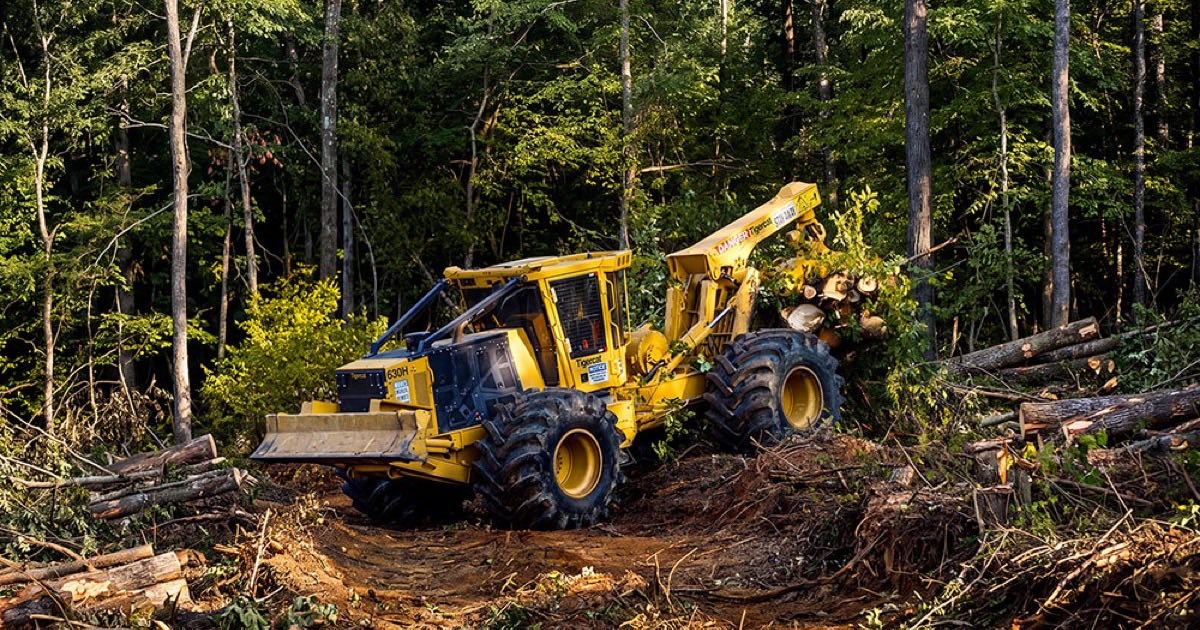
Kodama does not sell autonomous forestry machines. It retrofits ordinary logging equipment — skidders, the machines that drag felled timber out of the bush — with NVIDIA compute, eight cameras, two LiDAR units, GPS and a Starlink connection. A retrofit takes one to one and a half days. After that, the machine can be run by a remote operator from home: the system handles the repeatable stretches of the job under supervised autonomy, and a human takes the controls for the tricky parts.
The reason is labour, and CEO Merritt Jenkins does not dress it up. “The number one issue is labor reliability,” he told The Robot Report — citing one customer who went through eight skidder operators in a single year. Logging sites are remote, the shifts are long, and when an operator doesn’t show up, a machine worth hundreds of thousands of dollars sits idle in the trees.
The numbers claimed so far: Kodama says its system matches the per-hour productivity of a manually operated machine, and the next step is running 20 hours a day instead of 10, because LiDAR does not care about the dark. The data side is the load-bearing part of the pitch. “Every day that we remotely operate the machine, we’re generating about a terabyte of training data,” Jenkins says.
Two things worth chewing on
Teleop-first is a data strategy, not a hedge. The tempting read is that Kodama is doing teleoperation because full autonomy is too hard. The more accurate read is that teleoperation is how you collect the training corpus full autonomy requires. Unstructured forest terrain throws edge cases at you that no scripted dataset covers — a washout after rain, a log pivoting on a stump, afternoon light through eucalyptus canopy. Each remote-operated hour captures exactly those cases, in exactly the conditions production autonomy needs. Jenkins was explicit about the arc: “The future of heavy equipment will not arrive in a single autonomous leap. We are starting with human-in-the-loop autonomy systems and building toward an intelligent platform that orchestrates entire operations.” Konvoy’s managing partner Jackson Vaughan made the investor case plainly — the dataset required to make intelligent forestry work at scale grows with every machine and customer Kodama brings online, and that combination strengthens with each unit deployed, as AgFunderNews reported.
Forestry may be where physical AI crosses into cost-viability. We covered the Anthropic robot-exposure finding earlier this month: robots can technically perform 74% of physical work but are cheaper than people for about 0.3% of it. Skidder logging sits at the opposite end of that cost curve. The machines are capital-intensive, the operators are scarce, and the operating windows are long — so doubling utilisation by covering the night shift is not an efficiency garnish, it is the business case. That is the same economic shape as Fincantieri committing nearly US$100 million to physical AI across its shipyards and Shimizu backing construction humanoids for a shrunken Japanese workforce: heavy industries that cannot hire are buying utilisation, not novelty.
For New Zealand the relevance is direct. Forestry is one of this country’s largest export industries, its most labour-starved sites are on steep hill country, and operator churn in remote skid crews is a chronic, documented problem. A stack that lets a trained operator run a machine from a regional centre would widen the labour pool considerably. No NZ adoption news yet — the near-term tell to watch is the OEM partnerships, since retrofit-distribution through the big equipment makers is how a Sonora seed-stage startup reaches Southern Hemisphere fleets.
Sources: The Robot Report; AgFunderNews; Startup Researcher (syndicated release summary).