Shimizu Corporation, the 220-year-old Japanese general contractor, has completed an investment in Noble Machines Inc., a Silicon Valley startup building the MOBY series of humanoid AI robots for construction, and launched a full-scale development collaboration, according to Shimizu’s news release issued Friday (16 October 2026). Virtual trials start by the end of this year. Real construction-site testing follows next spring.
🔍 THE BOTTOM LINE
This is the first time one of Japan’s top-tier general contractors has taken an equity stake in a Western humanoid startup for site work, and it comes with a checkable timeline rather than a concept video: simulations using Shimizu’s own BIM/CIM construction data by end-2026, physical robots on actual Shimizu sites from spring 2027. The financial terms were not disclosed, and the companies stress the partnership is still at the development stage — but the clock is now running in public.
What Shimizu Announced
The official release names Noble Machines’ CEO as Wei Ding, lists the company at 236 E. Caribbean Drive in Sunnyvale, California, and dates its founding to May 2024. Noble develops the MOBY series of humanoid AI robots for the construction industry along with the control systems — effectively an operating system — and application software that general-purpose robots need before they can be handed real tasks.
Shimizu’s side of the bargain is domain knowledge. The contractor will fold its construction expertise into Noble’s hardware, control systems and application software, with the stated goal of robots that can support or replace “physically demanding and hazardous tasks” on Japanese sites. Neither company has said how much money changed hands; robot24’s coverage confirms the investment amount was deliberately left undisclosed.
The motivation is demographic, and Shimizu is unusually blunt about it: an aging workforce and a shrinking pipeline of young entrants mean Japan must meet future construction demand with a smaller workforce, which the company says will require “closer integration of people and robots” on site. New Zealand’s construction sector faces a milder version of the same squeeze — an aging trades base and persistent productivity gap — which is why Japanese site-automation experiments tend to preview what Australian and NZ contractors pilot a few years later.
The Timeline Nobody Else Has Put on Paper
What separates this from the usual robotics MoU is the schedule. By the end of 2026 — weeks away — Shimizu plans to begin virtual simulations of construction-site applications using its BIM/CIM building data: transporting materials and equipment, navigating sites, and conducting patrols. From spring 2027, the company says it will test those same tasks with physical MOBY robots at actual construction sites.
That gives outsiders two hard checkpoints. If the simulations start by 31 December, the partnership is real. If physical site tests begin around Japan’s spring of 2027, the program survived its first contact with mud, scaffolding and weather. The AI Insider’s write-up framed the deal the same way — an investment plus a development collaboration, not a deployment contract.
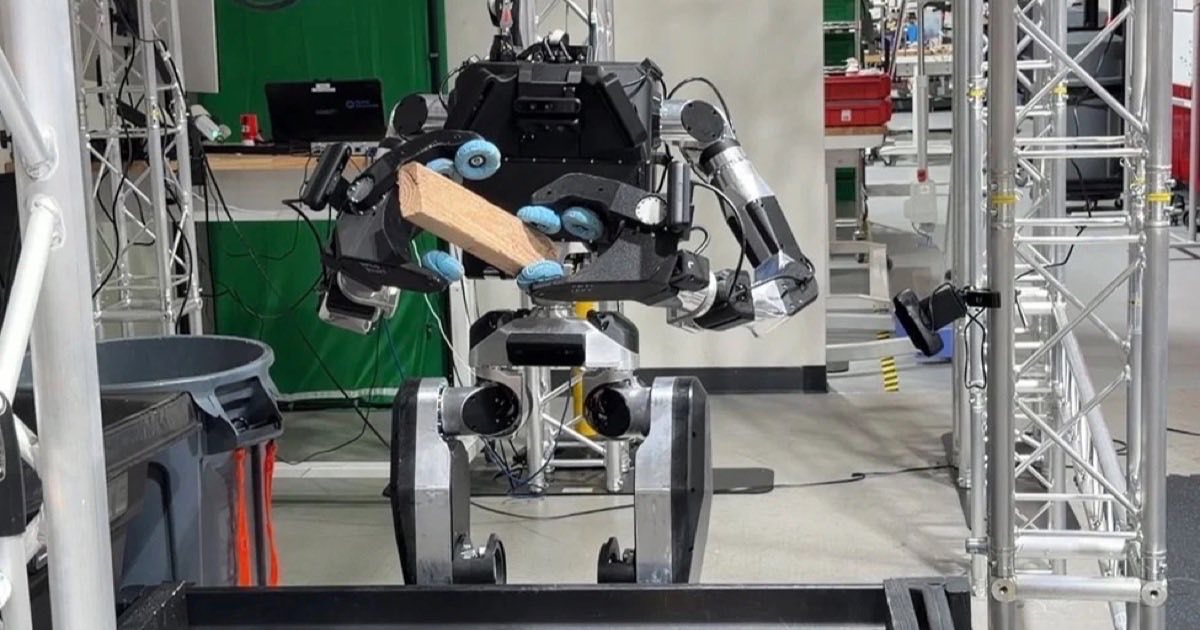
MOBY itself has a public track record beyond renders. When Noble exited stealth in March 2026, The Robot Report documented a robot able to lift roughly 27 kilograms (60 lb) and navigate steep inclines and outdoor terrain — the two capabilities a construction site actually demands. Noble’s own mission statement, in CEO Wei Ding’s framing, is “to tackle all the hazardous, physically demanding industrial tasks that keep the world moving.”
The Honesty Clause That Should Travel With Every Humanoid Story
The most useful paragraph in the coverage comes from robot24, which dryly notes that the partnership remains at the development stage: Shimizu has announced no commercial robot deployments, no customer orders and no performance results from site trials. That sentence should be stapled to every humanoid headline this year. An investment plus a research timeline is a bet on 2027, not a robot on your site today.
The same week offers the counterpoint. Origin, a California startup that emerged from stealth on 15 October with US$20 million co-led by Accel and Zacua Ventures, is already running wheeled robots that hang drywall compound and sand walls — completing interior walls three times faster than human crews, according to the company, though still with a human on site for prep and maintenance. Special-purpose machines are shipping; general-purpose humanoids are being funded to eventually get there. Shimizu, notably, is hedging by paying attention to both ends of that spectrum.
❓ FAQ
What is the MOBY humanoid robot? MOBY is the humanoid AI robot series built by Noble Machines, a Sunnyvale startup founded in May 2024. Per The Robot Report’s March 2026 coverage, MOBY can lift up to 27 kg and handles steep inclines and outdoor environments, and the platform ships with Noble’s control systems and application software.
When will Shimizu’s construction humanoids actually appear on sites? Virtual simulations using Shimizu’s BIM/CIM data are planned by the end of 2026, and physical robot tests at real construction sites are scheduled from spring 2027, according to Shimizu’s release.
How much did Shimizu invest in Noble Machines? The financial terms were not disclosed by either company.
Why is a general contractor buying into humanoids? Japan’s construction workforce is aging faster than it can be replaced, and Shimizu argues productivity alone won’t close the gap — hence robots that support or replace hazardous, physically demanding tasks.
Does this affect New Zealand construction? Not directly — no NZ involvement has been announced. But NZ contractors watch Japanese site-automation closely because both markets share the aging-trades problem, and Japanese pilots tend to reach Australasia a few years later.
🔍 THE BOTTOM LINE
A top-tier Japanese contractor putting money and its own site data behind a two-year-old Silicon Valley humanoid startup is a stronger signal than any demo video: the customer with the labour crisis is now also the investor with the test sites. Watch the two dates — simulations by end-2026, physical site tests in spring 2027. If either slips, the general-purpose construction humanoid thesis slips with it; if both land, the special-purpose-vs-humanoid debate gets a live trial on real Japanese mud.
📰 Sources
- Shimizu Corporation — news release 2026044 (16 October 2026)
- robot24.com — “Shimizu Backs Humanoids as Origin Raises $20M” (16 October 2026)
- The AI Insider — “Japan’s Shimizu Invests in Noble Machines to Develop Humanoid Robots for Construction” (16 October 2026)
- The Robot Report — “Noble Machines exits stealth with Moby humanoid” (March 2026, background)