Faraday Future, the California company better known for years of EV production struggles, has launched FF Nova — an entry-level embodied AI humanoid robot priced at $2,490 — alongside FF Nova Mini, a $299 sibling pitched squarely at K-12 classrooms. The joint launch event with FF EAI Robotics Ecosystem Inc. was held on 15 October 2026, and per Business Wire, both machines officially join the company’s “One Brain, Multi-forms, Multi-capabilities” Robot World 2.0 lineup.
The headline claim is that Nova is “America’s first embodied AI humanoid robot priced below $2,500.” If it holds, it undercuts the current floor by a wide margin. Unitree’s R1 sells for $5,900, Flourish’s home robot opened preorders at $3,555, and the price-tracking picture we assembled earlier this year puts anything bipedal under $5,900 firmly in the “cheap but limited” tier. Nova at $2,490 resets that anchor — again.
What $2,490 Actually Buys
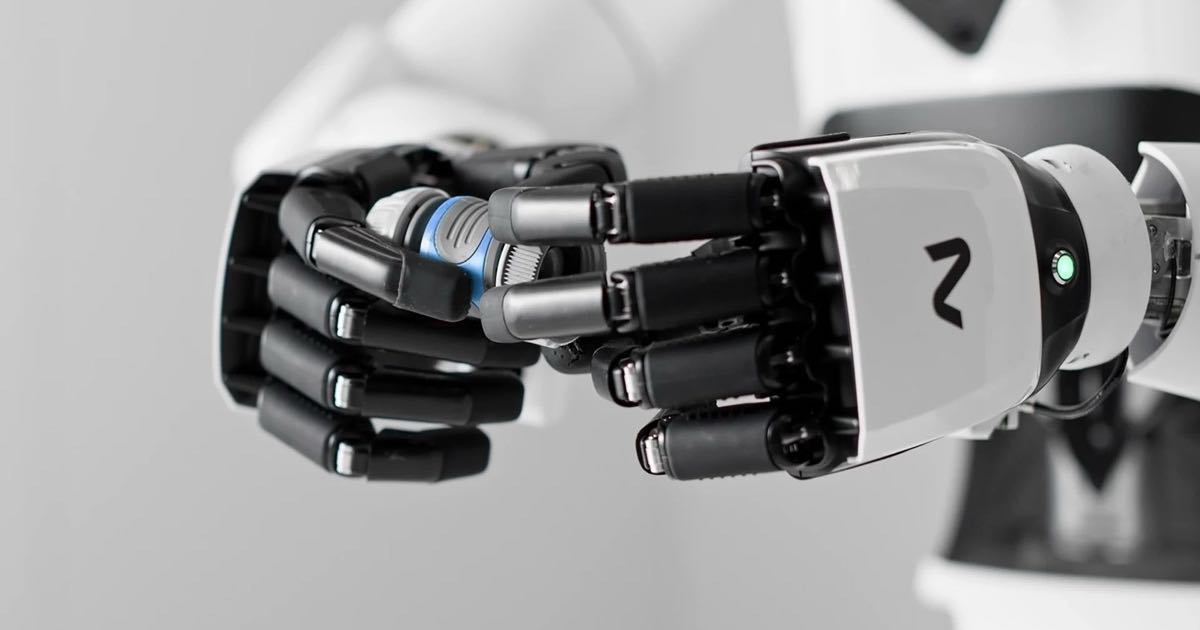
The specs, as detailed by Unite.AI from FF’s product page, are more credible than the price suggests. Nova stands 49.7 centimetres tall, weighs 2.8 kilograms, and carries 20 degrees of freedom split across head, arms and legs. It walks bipedally at 0.1 m/s or rides a detachable wheeled base at 0.8 m/s, and can get back on its feet after being knocked over — a genuine trick at this price point.
The sensor stack is the surprise: a 2D LiDAR, a roughly four-megapixel wide-angle camera, a 3D time-of-flight depth sensor, and a three-microphone ring array for voiceprint recognition and sound localisation. On-device compute runs at 10 TOPS with 8 GB of RAM. It connects to a large voice model for conversation, and FF says a cloud-based AI agent can operate through the robot’s body — the “embodied AI” pitch in one sentence.
The developer story is the part worth taking seriously. Per Engineering.com, Nova ships with a fully open SDK, a ROS 2 workflow, over-the-air updates, and a planned Sim2Real reinforcement-learning pipeline built on NVIDIA Isaac — train in simulation, tune reward functions, then deploy the policy on physical hardware. A Skills Store will let developers share and potentially monetise what they build.
Rollout: 100 Units First
Nobody is buying one tomorrow. Phase One is invitation-only: 100 units for selected developers and educational institutions, with the first 20 ready for immediate delivery and a seven-day application window through developer.ff.com. Phase Two opens to all developers and education buyers, with a full consumer launch deferred to Phase Three.
The $299 Nova Mini targets children eight and up, with a $499 curriculum bundled — 16 live small-group classes over two months, lesson plans, classroom kits and teacher training. FF says it will work with Montessori organisations and elementary schools to develop teaching kits. It is a consumer-electronics playbook applied to humanoids: cheap hardware, then sell the content.
The Part That Isn’t Really About Robots
The launch is entangled with a corporate restructuring. On 12 October, FFAI and FFR signed definitive agreements for FFR to acquire FFAI’s robotics business in an all-stock transaction, valuing that business at roughly $200 million and FFR itself at about $60 million. Upon closing, FFR becomes a separately listed pure-play humanoid robotics company, and the joint announcement, carried on Business Wire, positions the combined entity as the first US-listed full-stack humanoid ecosystem company. The reverse-merger structure, the tiny PIPE, and the 13-million-share float are equity-market engineering — the robots are the product, but the listing is the point.
There is also a credibility discount any FF hardware claim must carry. Faraday Future has spent a decade promising vehicles that mostly did not materialise, and sceptics have called the robot pivot exactly what it looks like — a listed shell chasing a new narrative. Jalopnik’s February verdict (“Faraday Future Pretends It Makes Humanoid Robots Now, Too”) was about the earlier, larger FF machines; nothing about the October launch changes that history. The $299-plus-curriculum education bundle, in particular, echoes the toy-to-classroom pipeline that prompted New York to move against humanoid robots in schools.
The pattern to watch is the one Nori set with its $1,688 developer humanoid — and, in a different way, DexForce’s virtual-world training pitch: the bottleneck in robotics is no longer actuators or sensors, it is useful software, so cheap open hardware aimed at developers who might write that software is a defensible bet. FF Nova is a credible version of that bet attached to a company with little credibility to spare. The 100-unit phase will be the tell: 20 units shipping “immediately” is a claim that can be checked against delivery within weeks.