The home robot market finally has a price war. Flourish Robots, a startup straddling San Francisco and Paris, came out of stealth on 29 September and opened preorders for “Flourish 1,” a $3,555 wheeled home robot that the company says can be taught new chores in about 30 minutes using nothing more than a smartphone — guide it through a task once from your phone, wait an hour, and it runs on schedule forever after, per the company’s own site. The Robot Report broke the story with CEO Antoine Marcel, and CNET followed with preorder confirmation: the first 50 hand-built units are in assembly now, with deliveries promised in December — the batteries alone carry two-month lead times. That price point is remarkable in context: 1x’s Neo sells as $20,000 Early Access on 1x’s own order page (or $499/month on subscription), and Weave’s Isaac 1, covered here in July, runs $7,999.
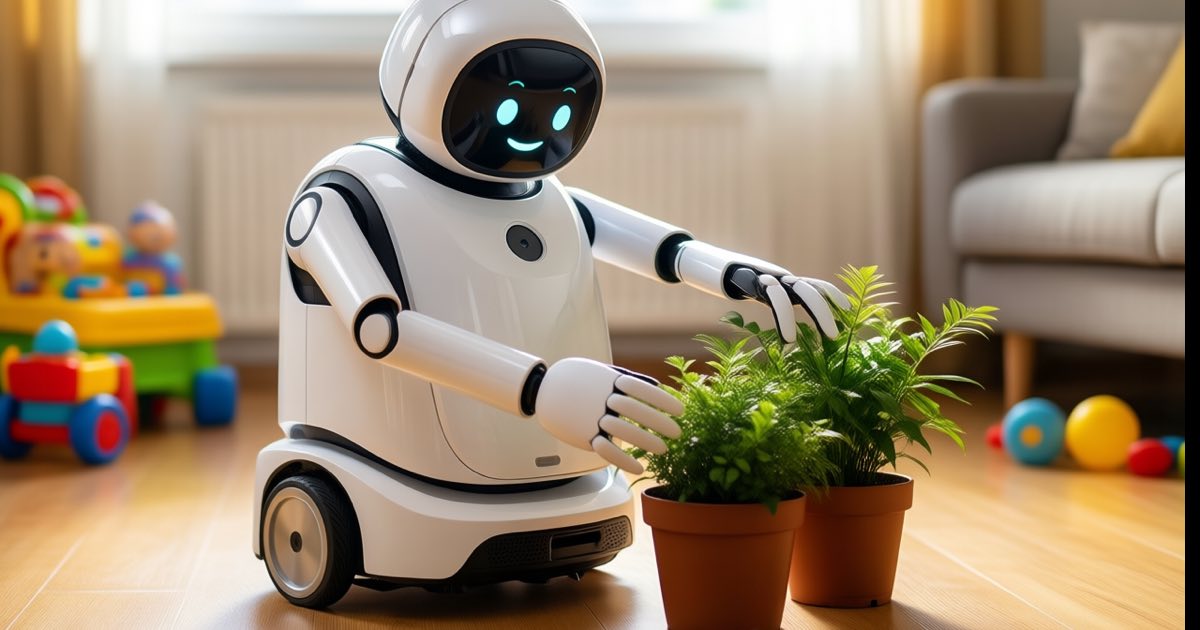
The hardware choices tell you exactly who this robot is for. Flourish 1 skips legs entirely — a six-wheeled base, two lightweight arms with 1.5 kg payload each, a wrist camera on each two-fingered gripper, floor-level lidar for obstacles, 12-hour battery. It stands 3’7” and weighs 44 pounds. Marcel is explicit that these are cost and safety decisions, not compromises he resents: legs can add “tens of thousands of dollars” to a platform’s hardware, and a wheeled, low-payload robot moving slowly around children and pets has far less energy on tap if something goes wrong — the robot stops when a person or animal enters its work area. The Raspberry Pi brain keeps the bill of materials low by pushing “thinking” (skill-training and higher-level inference) to the cloud, with an option to run workloads on the owner’s own computers instead. It cannot climb stairs, handle anything heavier than 3.3 pounds, go near water, or — as CNET quotes the site — look after your kids: “It works around your kids. It doesn’t look after them.”
The training model is the interesting part. Owner demonstrates the task with a phone — sliding it across the table to show wiping, holding it to mirror a loading motion — and the phone acts as a teleoperator proxy for roughly 30 minutes. After an hour of model internalisation, the robot reports it can schedule the task solo. Crucially, Marcel says the robot learns the task rather than a trajectory: show it “shoes go in the cabinet” once and its perception system finds the shoes wherever they land tomorrow. Skills are fine-tuned per task, per home, on cloud GPUs — because, in his telling, “the way I tidy my apartment is not the same as you do in your house.” Unlike 1x or Weave, he says no human operators will remotely control robots in normal use, and customers can opt out of sharing training data.
The first 50 buyers are effectively beta customers, though Marcel insists “it’s a product launch, not a paid beta.” CNET’s robotics editor is openly sceptical the price can hold beyond a 50-unit founder run, and the company itself says scaling will require industrialising production it currently does by hand. Founded in January 2026, Flourish is shipping a marketable product inside twelve months — a timeline that would have been science fiction in 2024.
The pattern worth watching is broader than one startup. The domestic generalist robot is arriving as a family of compromises: wheeled rather than bipedal (Flourish, Weave), teleop-assisted rather than autonomous (1x’s Neo), cloud-brained rather than self-contained. Each vendor is guessing differently about which constraint breaks first. Flourish’s bet — that per-household fine-tuning beats a shared generalist model, and that homes will tolerate slow, safe, wheeled competence over fast humanoid showmanship — is the most explicitly anti-warehouse thesis of the three. Stanford’s HomeBody work, covered yesterday, points the same direction from the research side: the home is its own robotics problem, not a showroom floor for factory demos. If December’s 50 units hold up, the first real question is not whether the robot can scoop litter — it is whether 30-minute phone training produces skills robust enough to survive contact with a house containing three kids, a dog, and a week of nobody tidying anything. New Zealand’s smaller living spaces and high labour costs make it, on paper, a natural market for exactly this class of machine — whenever the $3,555 price survives contact with shipping, GST and cloud-compute subscriptions.