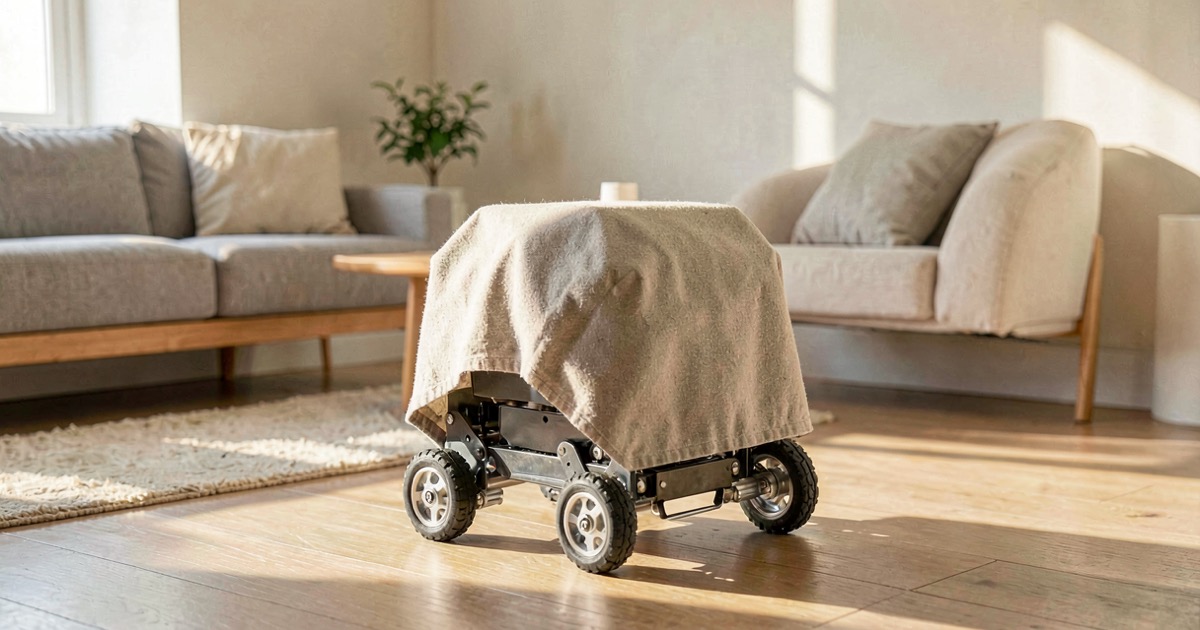
San Francisco startup Weave Robotics has opened pre-orders for Isaac 1, a $7,999 home robot designed to fold laundry, tidy rooms, and make beds. The robot is wheeled, not humanoid, stands between 3 feet and 5’9” tall with a collapsible torso, and ships in fall 2026. It hit 67 points on Hacker News within hours of launch — the highest-engagement robotics story on the front page this week.
🔍 THE BOTTOM LINE
Isaac 1 is not a humanoid, and that’s the point. While Tesla, Figure, and Unitree chase the bipedal dream, Weave is shipping a wheeled, fabric-covered robot that does a narrow set of household tasks for under $8,000. The bet is that “good enough at laundry” beats “theoretically amazing at everything” — and that teleoperation, not full autonomy, is the bridge to consumer trust.
What Isaac 1 Actually Does
According to Weave Robotics’ product page, Isaac 1 has three core capabilities:
- Laundry Flow — finds and picks up dirty clothes, handles loaded hampers, folds laundry. The robot goes “beyond folding” to actively seeking out laundry around the house.
- Daily Reset — resets rooms so “every day you come back to spaces that are ready to be lived in.” Beds made, pillows and blankets arranged, toys and shoes returned to their places.
- On-demand tasks — works only when scheduled or activated via a companion app, whether you’re home or away.
The robot navigates autonomously by default, with teleoperation assistance “when needed to guarantee we complete tasks.” That last clause is doing a lot of heavy lifting — it means Weave can’t yet guarantee full autonomy for every task, so a human operator can remote in to finish the job. It’s the same approach Tesla’s humanoid program has quietly adopted: ship with human backup, learn from the teleop data, improve autonomy over time.
The Design Choices That Matter
Isaac 1’s hardware decisions are a deliberate departure from the humanoid arms race:
| Feature | Isaac 1 | Typical humanoid |
|---|---|---|
| Mobility | Wheeled base (passively stable) | Bipedal (balance required) |
| Shell | Soft fabric, swappable | Hard plastic/metal |
| Height | Collapsible 3’–5’9” | Fixed height |
| Price | $7,999 | $30,000–$200,000+ |
| Battery | 8 hours, 2hr charge | 2–5 hours typical |
| DoF | 17 (neck 2, arms 2×6, hands 2×1, torso 2, base 3) | 28–40+ |
The fabric shell is the most interesting choice. Weave says it provides “passive safety” and can be “swapped or removed to fit the character of your home.” The collapsible torso means the robot can extend to human height when working, then shrink down to be “out of sight and out of mind” when not. The wheeled base is passively stable — it can’t fall over, which is the single biggest failure mode for humanoid robots in home environments.
The company designed and built its own actuators, remote actuation system, and safety systems from the ground up in San Francisco. It won a San Francisco Design Week award for the product.
The Teleoperation Bridge
The most honest line on Weave’s product page: “Isaac 1 completes tasks and navigates your home autonomously by default, with teleoperation assistance when needed to guarantee we complete tasks.”
This is the model that Figure AI and others have adopted quietly — human operators ready to take over when autonomy fails. The difference is that Weave is upfront about it, and the wheeled platform makes teleoperation dramatically easier. A teleoperator controlling a wheeled robot that can’t fall over is a much simpler problem than one controlling a bipedal robot that absolutely can.
The data play is obvious: every teleop intervention is a training data point. Weave is shipping a product now that generates the data needed to make the next product more autonomous. That’s the same playbook Waymo used with robotaxi deployments — start with heavy human oversight, learn from every edge case, gradually reduce intervention rates.
What $7,999 Buys — and What It Doesn’t
The price puts Isaac 1 in the premium consumer electronics bracket — more than a high-end refrigerator, less than a premium hot tub, roughly the same as a top-of-the-line riding mower. It’s not impulse-buy territory, but it’s within reach of the same household that buys a $3,000 Dyson vacuum or a $5,000 Peloton.
What it doesn’t buy: cooking, dishwashing, bathroom cleaning, outdoor work, or any task requiring the robot to navigate stairs. The footprint is 20.5” × 22” — roughly the size of a small armchair — and it requires Wi-Fi. The 8-hour battery life means it can work through a full day’s worth of tidying, but it needs 2 hours to recharge.
The Competition
Isaac 1 enters a market that has seen more promises than products. Unitree’s R1 is available on AliExpress for $5,999 but is bipedal and aimed at research/enthusiast use. NVIDIA’s GR00T foundation model is powering humanoid development but no consumer product. Tesla’s Optimus is years from home deployment. Samsung’s Ballie is a rolling companion ball, not a task robot.
Weave’s differentiation is narrow but clear: a wheeled robot that does laundry and tidying, ships this year, costs under $8,000, and comes with teleop backup. Whether that’s enough to build a consumer robotics category that decades of attempts haven’t managed to create is the real question.
❓ FAQ
When does Isaac 1 ship? Fall 2026. Pre-orders are open now at weaverobotics.com. Weave hasn’t specified exact delivery dates beyond “fall 2026.”
Can it handle stairs? No. Isaac 1 is wheeled and designed for single-level homes. Multi-story households would need one per floor.
What happens when it gets stuck? Isaac 1 falls back to teleoperation — a human operator takes over remotely to complete the task. The robot learns from these interventions to improve future autonomy.
Is the $7,999 a deposit or full price? Weave’s pre-order page doesn’t clarify the deposit structure. Full pricing and deposit terms are on the order page.
Does it work with smart home systems? Weave mentions a companion app for scheduling and on-demand activation. There’s no mention of HomeKit, Google Home, or Matter integration yet.
🔍 THE BOTTOM LINE
Weave Robotics isn’t trying to build the general-purpose home humanoid. It’s trying to build the first home robot that’s good enough at a few tasks — laundry, tidying, bed-making — that people pay $7,999 for it and don’t return it. The wheeled design, the fabric shell, the teleop backup: every choice trades ambition for reliability. If it works, it creates the category. If it doesn’t, it’s the most expensive laundry folder ever made.