Galaxy Robot Park in eastern Seoul has become the world’s most-visited live demonstration of humanoid robotics — and, according to a New York Times report published Monday 5 October (our time), the world’s most instructive one, though not for the reasons the park intends. The Times’ verdict is in the headline: “The Humanoid Robot Future Has Arrived at a South Korean Park. Sort of.”
What the park shows, and what it doesn’t
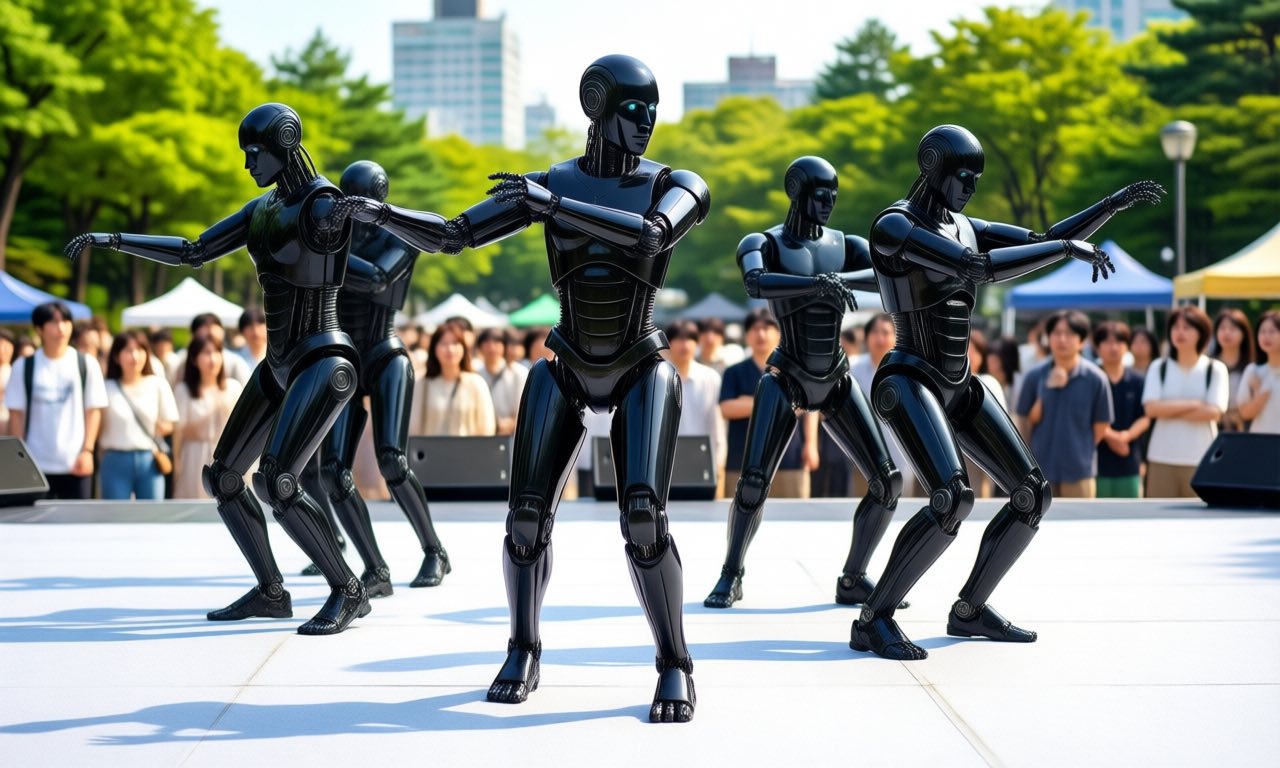
The park, opened 15 May by entertainment firm Galaxy Corporation in Seoul’s Gangdong district, runs ten child-sized Unitree G1 humanoids through a 50-minute dance and martial arts show, multiple times a day. During fast K-pop numbers the machines spin, coordinate, and correct drift without wobbling much — a genuine improvement on the stiff demo reels of two years ago, and a point the Times concedes. During slower sequences the polish falls away: movements turn jerky, and the gap becomes stark when human taekwondo fighters share the stage.
The Times’ reporting, republished in full by Moneycontrol, documents the part the gift-shop brochures leave out. A humanoid that appears to chat with visitors is operated by a handler holding a controller behind his back. The boxing and football robots are remote-controlled too. Oregon State robotics professor Alan Fern told the paper there is a real difference between polished one-off demos and machines performing commercially several times a day — but choreography, per artist and professor John McCormick, means those dance routines largely run on pre-programmed sequences that never require the robot to understand its surroundings or make a decision.
Galaxy’s own numbers fill out the business case that makes this worthwhile regardless. CEO Choi Yong-ho told The Guardian in May — before the park’s 15 May opening — that the company plans three to six K-pop concerts daily, over 1,000 shows annually, and a world tour by the end of the year, with choreography programmable once and replayable by any robot worldwide. The Unitree G1 units performing it cost about $13,500 each — pocket change next to the six-figure humanoids, and cheap enough that a mechanical failure mid-show, as happened during the opening performance when a robot had to be pulled offstage, is an affordable event rather than a crisis.
The honest version of the humanoid story
What makes this worth covering — beyond the fact that it’s a genuinely new kind of attraction — is that the park is an accidental honesty device. The same unit price that makes 10-robot dance troupes viable also makes the G1 the most-deployed humanoid on earth, which means the gap between its stage presence and its autonomy is now on public display daily, to families, without a press-release filter. Compare that with the Beijing Robot Games coverage from earlier this year (reality check) and China’s factory-floor deployments, where most shipped humanoids still aren’t working — the pattern is identical: locomotion and choreography have outrun perception and decision-making, and the public is the last audience to be told.
The training-data argument in the Times piece is the one worth keeping. Language models had the internet; robots have no equivalent corpus of “how bodies interact with the world,” which is why the path to general-purpose humanoids runs through teleoperation-as-data-collection — handlers with controllers are, unglamorously, exactly how the next generation learns. Korea is betting its entertainment-export industry can be that data engine, on top of the trillion-dollar AI bet the country placed earlier this year.
For New Zealand, there’s a small but real signal here: the gap between “robot that performs” and “robot that works” is now big enough to sustain an entire theme park. Unitree’s G1 — the same model researchers showed could be hijacked over Bluetooth earlier this year (our coverage) — is popular partly because it’s cheap, not because it’s autonomous. Anyone budgeting for humanoid pilots in 2027 should price the handler, not just the robot. The dancing is real. The independence isn’t, yet.