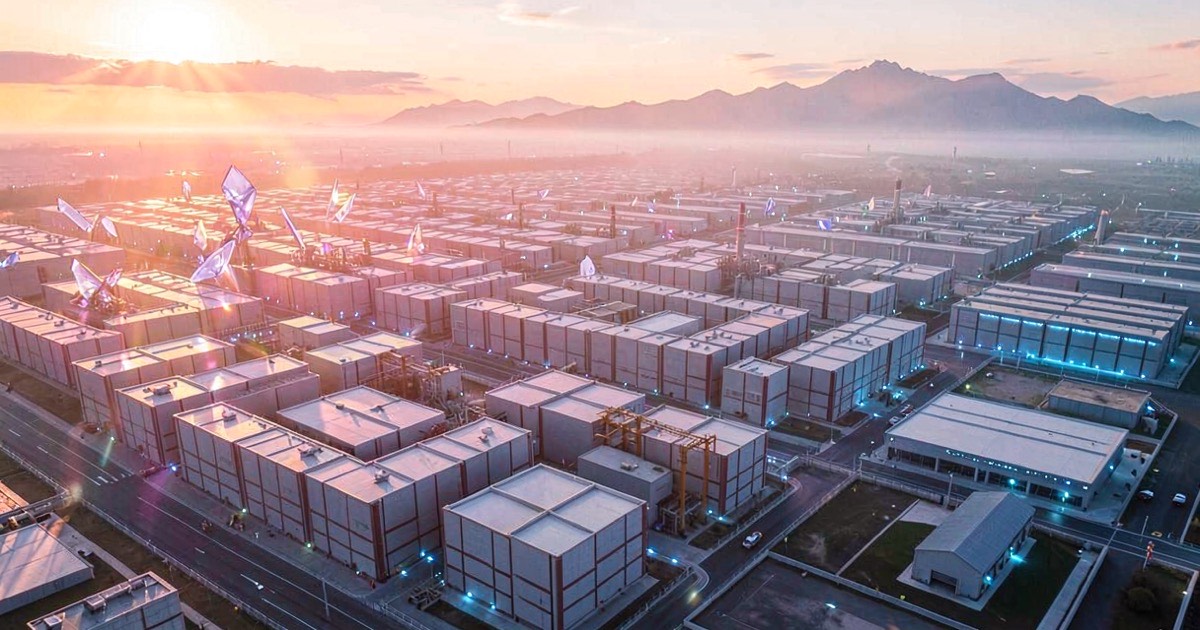
South Korea’s government and its largest tech companies are committing $1 trillion to three AI infrastructure megaprojects — $585 billion for chip fabs, $357 billion for data centers, and a national push to deploy 30,000 humanoid robots by 2028. President Lee Jae Myung called semiconductors, physical AI, and data centers “the triple axis for a great leap forward.”
🔍 THE BOTTOM LINE
This is the largest single-nation AI infrastructure commitment in history. It tests whether a democratic society can mobilize capital, energy, and labor at the speed AI competition demands — or whether the friction of politics and worker pushback makes authoritarian-style mobilization the only path that actually ships on time.
What $585 Billion Actually Buys
Samsung and SK Hynix are pouring $585 billion into new chip fabrication plants in South Korea’s southwest provinces, with the stated goal of doubling the country’s DRAM production within five years. The bet comes as both companies ride record profits from AI-driven memory demand — and as global consumers face sky-high prices for everything from Macs to Steam Machines.
But the timeline is sobering. SK Hynix Chairman Chey Tae-won noted it took nine years to build a single chip cluster in Yongjin, near Seoul. Doubling DRAM output in five years requires execution at a pace South Korea’s own industry leaders describe as historically unprecedented. The chip interconnect bottleneck is already straining global supply chains — this buildout would be the largest attempt yet to break it.
$357 Billion for Data Centers in the Provinces
SK Group, GS Group, and Naver are backing a $357 billion data center push into outlying provinces — South Chungcheong, Gangwon, and the North and South Jeolla regions. The decentralization is strategic: Seoul’s grid can’t absorb the load, and spreading data centers across the country reduces single-point failure risk.
The government is also designating “physical AI” — the AI systems that let robots and autonomous vehicles interact with the real world — as a national strategic industry. The plan includes developing a Korean general-purpose foundation model based on world models within three years, The Chosun Daily reported. This isn’t just infrastructure spending. It’s a bet that the next AI frontier is physical, not purely digital.
30,000 Atlas Robots by 2028
Hyundai Motor Company has committed $5.8 billion to a robot manufacturing facility and AI data center in Saemangeum. The company is already scaling Boston Dynamics — which it acquired in 2021 — to produce 30,000 Atlas humanoid robots per year by 2028. The government wants humanoid robots commercialized across 10 major industries by the same deadline, with 10,000 “AI robotics specialists” trained over five years.
The number is staggering. For context, Boston Dynamics produced roughly a handful of Atlas units per year for research until 2024. Jumping to 30,000 annually is a 1000x scale-up in four years — a manufacturing leap comparable to Henry Ford’s Model T assembly line, but for machines that walk, lift, and reason.
The Power and Water Problem
The fabs alone need 6.3 gigawatts of electricity and 650,000 tons of water, The Korea Times reported. The data centers need another 8 GW. To put that in perspective: 14.3 GW is roughly the entire generating capacity of New Zealand’s national grid, deployed for chips and servers in a single country that already imports nearly 25% of its electricity as natural gas.
South Korea’s energy mix — 30% nuclear, 30% coal, 25% gas — means the AI buildout depends heavily on fossil fuels and LNG imports transiting the Strait of Hormuz. The energy security math is brutal: the more AI capacity South Korea builds, the more exposed it becomes to the same geopolitical chokepoints that drive its import dependence.
When Workers Push Back
On June 25, four days before the announcement, Hyundai Motor’s labor union overwhelmingly approved a potential strike over profit-sharing and job protections against the Atlas robot deployment. A state labor mediation committee granted the union legal strike rights before Hyundai appealed for a return to negotiations.
The tension isn’t just at Hyundai. South Korean officials have floated a “national dividend” — distributing excess tax revenue from AI-driven corporate profits to citizens — before walking it back as a personal view rather than official policy. The debate mirrors the global pattern: Ford’s AI automation retreat showed what happens when companies deploy robots without worker buy-in. South Korea is betting it can avoid Ford’s mistake through scale and state coordination — but the union vote suggests the social contract is far from settled.
The NZ Angle
For New Zealand, South Korea’s $1 trillion bet is a stress test of what “AI sovereignty” actually costs. A country of 5.2 million can’t match Samsung’s fab spending — but the Korean strategy reveals the minimum entry fee for serious AI participation: domestic power generation, water infrastructure, skilled labor pipelines, and regulatory frameworks that don’t strangle deployment.
The narrowing AI race between the US and China has already marginalized mid-tier players. South Korea is spending $1 trillion to avoid being squeezed out entirely. New Zealand’s choice is simpler and starker: partner deeply with one of the surviving powers, or accept permanent technology dependency.
❓ FAQ
Is the $1 trillion government money or private investment? Both. The government is providing strategic designation, land, infrastructure commitments, and policy support. Samsung, SK Hynix, Hyundai, and other chaebols are providing the capital. The split reflects South Korea’s traditional state-corporate coordination model.
Can they really build 30,000 humanoid robots per year by 2028? The manufacturing scale is unprecedented for humanoid robotics — a 1000x increase from current Boston Dynamics output. Hyundai’s supply chain expertise helps, but the timeline assumes no major technical setbacks in actuator production, battery density, or AI control systems.
What happens to memory chip prices? The stated goal is to double DRAM production in five years, which could ease global shortages. But SK Hynix’s own chairman says fab construction takes nine years historically. If AI demand keeps accelerating, the new supply may arrive after the shortage has already reshaped consumer electronics pricing.
Does South Korea have the power grid for this? Not yet. The 14.3 GW required for fabs and data centers is enormous — comparable to New Zealand’s entire grid. South Korea is planning new nuclear and renewable capacity, but its 25% gas dependence creates a geopolitical vulnerability through Strait of Hormuz shipping routes.
Why should New Zealand care? South Korea is demonstrating the minimum investment threshold for meaningful AI participation. The energy, water, and labor requirements show that AI infrastructure isn’t just software — it’s industrial policy at a scale most countries can’t afford. NZ’s strategic choices are narrowing.
🔍 THE BOTTOM LINE
South Korea has staked its industrial future on $1 trillion of silicon, servers, and humanoid robots. The capital is committed; the question is whether democratic societies can execute at the speed the AI race demands. The answer arrives in 2028 — and every nation watching this bet is learning what the entry fee for AI sovereignty actually costs.
📰 Sources
- Ars Technica — South Korea to spend $1T on more memory chip production and humanoid robots
- BBC News — President Lee Jae Myung televised speech, June 29, 2026
- Reuters — Samsung/SK Hynix $585B fab investment, humanoid robot commercialization targets
- The Korea Times — Power/water requirements, Hyundai union strike vote
- The Chosun Daily — Physical AI national strategic industry designation, Hyundai $5.8B robot facility