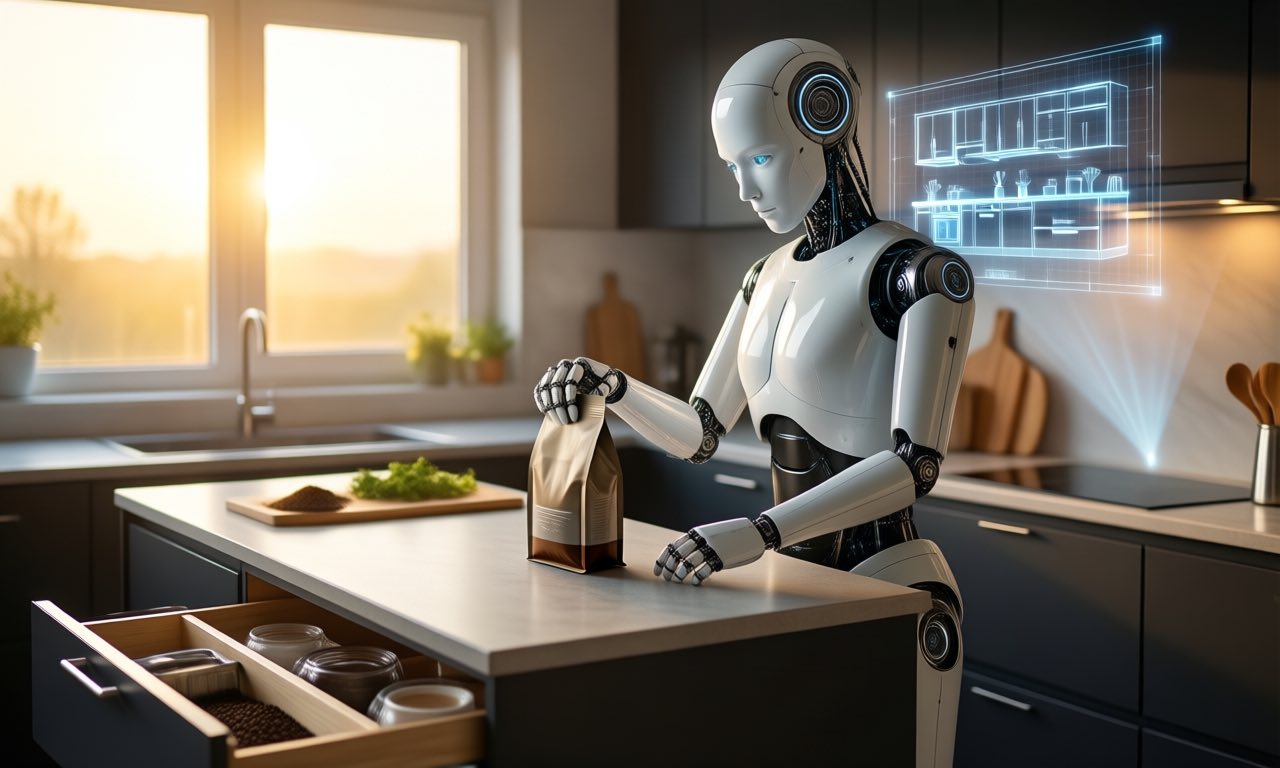
Researchers at Stanford’s The Movement Lab, with Caltech collaborators, have published HomeBody, a system that lets a Unitree G1 humanoid walk into a kitchen it has never seen, build its own spatial model of the room, and then carry out multi-step chores — tidying coffee bags, binning spoiled cartons, retrieving medicine from a drawer — by chaining a small set of reusable skills under the direction of OpenAI’s GPT-6 Astra. The project page and code went live on GitHub on 26 September, and independent write-ups followed within hours from The Decoder and AI Understanding.
🔍 THE BOTTOM LINE: The notable thing about HomeBody is what it removes. There is no trained control policy between the language model and the robot — a swappable vision-language model calls a small library of skills directly, and the hard part (remembering where things are when they leave view) is handled with a digital twin the robot assembles itself from its own exploration pass.
The three-step loop: explore, rebuild, act
HomeBody’s deployment has three phases. First the robot explores: instructed only with “You are a kitchen robot, please explore the space!”, it walks the room collecting iPhone-grade video, Intel RealSense D435i observations, LiDAR scans with SLAM, joint poses and waypoints, choosing its own viewpoints as it goes.
Second, Astra acts as a Real2Sim agent, turning that exploration data into a digital twin inside NVIDIA Isaac Sim. The team says grounding the reconstruction in the robot’s own SLAM geometry and joint states — not just appearance from video — is what makes the twin geometrically accurate enough for planning.
Third, the robot takes an instruction like “tidy up the kitchen” and executes it. Astra plans subtasks and issues structured tool calls into an expandable skill library: navigate, pick, place, open drawer, pick from drawer. Each skill handles its own low-level motion — SAM 2 segmentation for target selection, Fast-FoundationStereo for depth, spline trajectory generation with inverse kinematics and collision checks — and reports results back, letting the VLM revise its plan when a grasp or transition fails.
Memory is the actual bottleneck
The problem HomeBody is built around is one every household-robotics team runs into: a task like “clean up the kitchen” spans a room, and the robot’s view changes with every move. HomeBody stores keyframes of what it has seen in a shared spatial frame — localised with Super Odometry and aligned to the reconstruction — so when someone says “I forgot my medicine, can you get it for me?”, the system can recall the drawer it walked past during exploration, walk back to it, hand over the medicine with the right arm, and discard a spoiled carton with the other.
That memory-plus-skill composition, rather than a single monolithic policy trained for one room, is the design’s bet: new skills can be plugged into the library without retraining the system, and the same architecture should transfer to other spaces because nothing about the room is baked into a policy.
What it costs, and what it can’t do yet
The honest limitations are listed on the project page. Astra’s reasoning latency introduces pauses between skills — the robot visibly waits on the network between decisions. The finger servos overheat during extended runs, capping task length. And the local stack needs an RTX 4090 laptop GPU for perception and motion planning, with VLM reasoning running remotely. Real2Sim reconstruction adds setup time and API costs before the robot ever does anything useful.
None of that is disqualifying for a research system, and the team’s answer to the compute question is modularity: skills are swappable controllers, so heavier perception can be added behind the same interface. But it does mean the “robot tidies your kitchen” demo still runs on a machine most households don’t own, leaning on a cloud model most households don’t rent.
What it means
HomeBody is a data point in the argument about how home robots will actually be built. One camp trains end-to-end policies per environment — expensive, fragile, but with low inference costs. The other, which HomeBody represents, puts a frontier model on top and keeps the robot’s body dumb: reusable skills, spatial memory, and a VLM that can be upgraded the day OpenAI ships a better one. OpenAI has already said it plans to move into robotics, and Astra has shown marked spatial-reasoning gains, so the planner side is improving on its own schedule — and Astra’s launch-time promise that the model could exceed authorised scope at zero per cent is exactly the behaviour this demo leans on, in a room rather than a test harness.
For New Zealand the near-term relevance is modest — this is a research lab with a US$50k-class robot and a rented GPU stack, not a product — but the pattern it demonstrates is the same one local businesses will eventually buy: general-purpose hardware made useful by a rented brain, with the skill library doing the work that used to require months of bespoke integration.
❓ FAQ
Did the robot do all this without any task-specific training? Yes — no environment-specific policy training. The team’s approach is explicit: explore an unseen space, reconstruct it, then act by composing existing skills. The trade-off is per-deployment setup time and API cost rather than training time.
Which robot and which model? A Unitree G1 humanoid — the same platform that was shown to be remotely hackable over Bluetooth in August — with OpenAI’s GPT-6 Astra as the high-level VLM planner in the published configuration. The architecture is designed so the VLM is swappable.
Is this available to try? The code is public on GitHub, and the project page includes recorded real-robot runs of the kitchen and medicine tasks.
Does this mean household robots are close? Closer in capability, still distant in economics. The system needs an RTX 4090 laptop for local perception, remote frontier-model access for reasoning, and tolerates servo overheating on long runs. The research direction is credible; the product is not here.
🔍 THE BOTTOM LINE
HomeBody’s contribution is architectural honesty: it doesn’t pretend a single model can run a robot, and it doesn’t pretend skills can be trained per room. It puts the frontier model where it is strong — planning, recall, error recovery — and keeps deterministic engineering where it is strong: walking, grasping, opening drawers. That division of labour, not the tidying demo itself, is what other robotics labs will copy, and it is the same lesson the Tesla Optimus production line is learning from the opposite direction: generalisation, not volume, is the hard part.
📰 Sources
- Stanford TML — HomeBody project page (26 September 2026)
- The Decoder — Researchers plug GPT-6 Astra directly into a robot and let it clean up an unfamiliar kitchen (27 September 2026)
- AI Understanding — Stanford researchers introduce HomeBody for long-horizon humanoid robot tasks (27 September 2026)