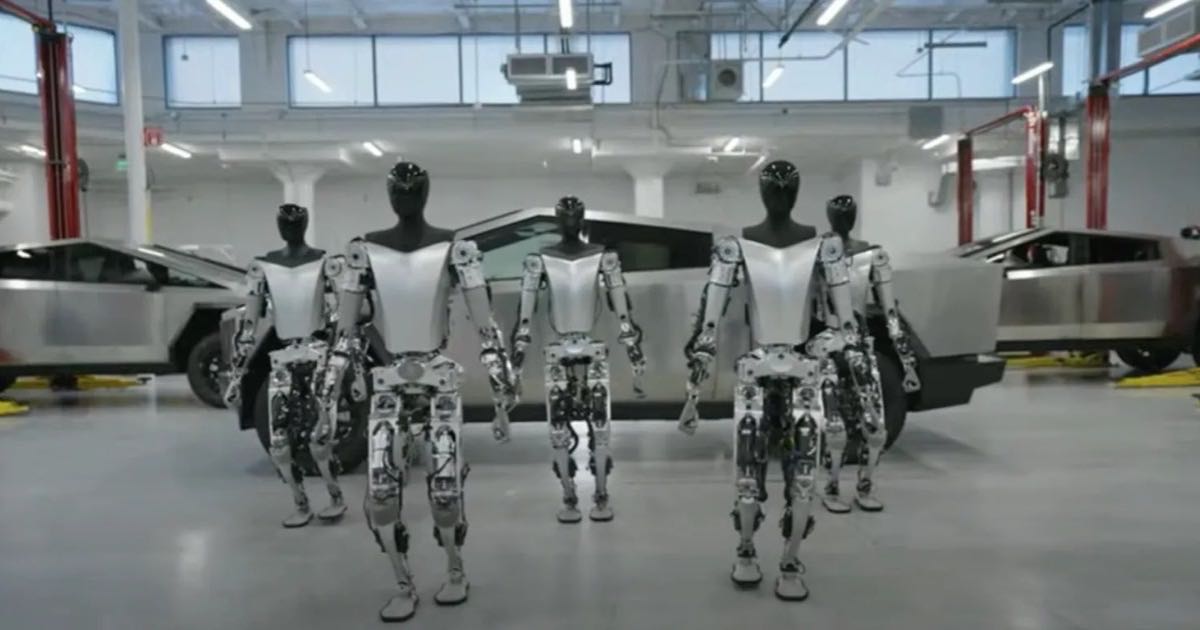
Tesla’s humanoid robot programme has crossed from promise into production volume — and immediately hit the wall everyone who builds robots predicted it would. According to a report in The Information, covered by Interesting Engineering and Electrek, Tesla is now building several hundred Optimus humanoids per week at its Fremont factory, roughly a tenfold increase on its Q2 output, with managers aiming for a continuous line capable of more than 1,000 robots per week by the end of the year. The longer-run ambition on record — the million-robots-a-year target Musk set last year — works out to about 20,000 a week.
The striking part is what Tesla is conceding about the machines coming off that line. Per the reporting, the company has acknowledged that Optimus is still far from handling generalised tasks — the issue, in the formulation that’s now travelling through coverage of the report, is “not the body, but rather its brain.” Production volume is no longer the bottleneck; usefulness is.
Where the robots are actually going
Most of them are going nowhere, or more precisely, staying home. Electrek’s read of the report notes that most units are used internally for testing, training and data collection, and the ones working inside Tesla’s own factories are confined to supervised, tightly controlled areas, programmed for specific tasks rather than operating as general-purpose machines. The V3 robots being built now aren’t even the version Tesla plans to commercialise — that one still has to clear stricter durability and reliability thresholds. The line itself is the former Model S and Model X assembly area, converted after Tesla ended production of both flagships in May, with workers and engineers pulled off the car programmes onto the robot one. For context, when Tesla claimed its first 1,000 deployed Gen 3 units in March, those robots were likewise working inside Tesla’s own facilities on narrow, rehearsed tasks — the deployment number has always moved faster than the capability.
The hands are the hard part
The mechanical failures in the report are almost mundane, which is what makes them significant. The Optimus hand and forearm contain over 100 screws and small components that workers still assemble by hand. Fixtures at several stations — hands, joints, electronics testing — can’t consistently align parts that are smaller and tighter-tolerance than anything on a car, so robots come off the line needing rework. Touch sensors have durability problems; Tesla’s planned fix is a replaceable “sensing glove” due next year so a failed sensor doesn’t mean scrapping the whole hand. And the supply chain is straining: outside suppliers, many of them in China, can make good motors and precision gears in prototype quantities but struggle to hold quality at volume. We’ve covered the Chinese supply-chain dependency before — it remains both Optimus’s cost advantage and its single point of fragility.
DriveTeslaCanada’s coverage of the same report lands on the same two words: reliability and dexterity. For a robot to be worth its price it has to do a job not once but thousands or millions of times without breaking — and human-level dexterity, the spec Musk has promised, remains one of the hardest problems in robotics precisely because human hands combine fine motor control, tactile sensing and strength in a package evolution spent millions of years tuning.
The generalisation wall
The deeper problem is software. Three people familiar with the system told The Information that Optimus’s AI can’t yet reliably handle a wide range of tasks, and behaves unpredictably in situations it hasn’t been trained on. Even a fairly basic new task can take several days of training. The illustrative case in the coverage is instructive: a competent robot should handle “put those boxes on shelf B” while coping with different box sizes, a fallen box, an obstruction on the floor. Optimus currently can’t be relied on to do that unaided.
Tesla’s response is a familiar playbook. It is building a library of fundamental behaviours — grabbing, lifting, walking, placing — that the AI can recombine into novel actions, backed by more than 500,000 hours of training data it wants to double by year-end, motion-capture suits, camera-helmeted data collectors, and training hubs in Colorado, Arizona and Florida. The commercial plan follows the same logic as FSD: lease rather than sell, to a short list of companies whose factories and warehouses resemble Tesla’s own, then use their deployment data to improve the AI. Ship the hardware, collect the fleet data, promise the software catches up.
The industrial reality check
That playbook is unproven for robots in a way it wasn’t for cars. A factory robot that learns a task in several days of training is not yet a product, it is a science demonstration with a production line attached — and the economics only work if the task library generalises faster than customers’ patience runs out. What Tesla’s own admission concedes is that the industry’s hardest problem isn’t manufacturing humanoids at volume anymore. It’s making them worth the electricity they consume.
For the wider industry the datapoint cuts both ways. On one hand, a tenfold production ramp in months shows the hardware side of the humanoid business is maturing fast — Chinese makers like Unitree have driven component costs down to the point where a thousand-unit monthly run is a manufacturing problem rather than a research problem. On the other, the fact that the richest, best-instrumented robotics programme on the planet still can’t crack generalisation suggests everyone else is further from that goal than their demo videos imply. When China’s robotics leadership talked about humanoid soldiers and factory workers on a five-to-ten-year horizon, the honest reading was that nobody — including Tesla — knows how to cross from trained tasks to general ones yet.
What it means for New Zealand
There’s a local angle worth naming, because the hype travels faster than the caveats. If and when Optimus-class machines reach real commercial deployment, they will arrive in New Zealand first as warehouse and factory equipment leased through global operators, not as domestic purchases — and the leasing model Tesla plans (robots priced like a service, tuned on fleet data) fits a market where few firms could fund a six-figure humanoid outright. The realistic near-term question for NZ industry isn’t “when do we buy a robot worker” but “which of our repetitive, structured, high-volume tasks — meat processing lines, distribution centres, kiwifruit packing — look like Tesla’s own factory floor closely enough to be first in the queue.”
The caveat to hold onto: everything here routes back to one paywalled report and Tesla’s own framing of its struggles, with no independent audit of the production numbers and no demonstration of the commercial version. Companies announcing hard targets rarely do so expecting to be judged softly against them. The number to watch is not robots per week — it’s whether any customer outside Tesla’s own factories is running one unsupervised by this time next year.