A Tokyo startup has raised $1.2 million — a rounding error by humanoid-industry standards — to build something the big spenders are not: a humanoid robot designed to be repaired with the same speed it breaks.
O-ID, founded in Tokyo in 2025 by Norwegian CEO Stian Jakobsen and Dutch CTO Simon Gormuzov (the two met at Waseda University), announced the pre-seed round on September 24. Chicago-based TAWANI Ventures led; Hustle Fund, Techstars and angels including early 1X investors participated. The money goes toward moving the company’s first robot from prototype to production, with deployments planned on Japanese factory floors.
The modular bet
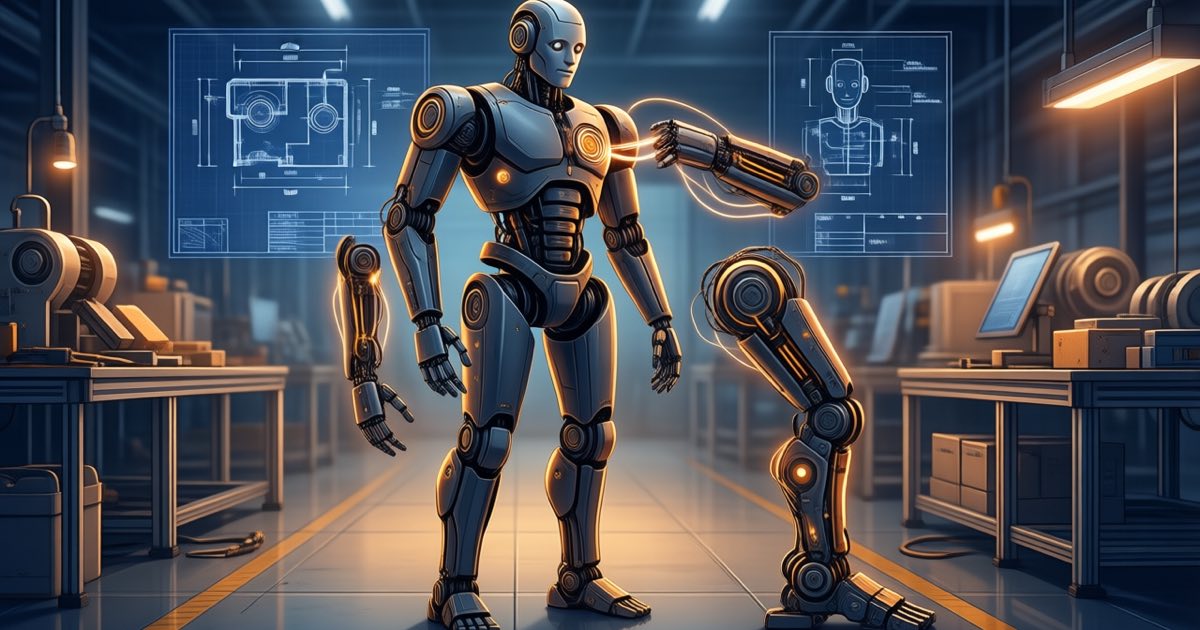
O-ID’s premise is that the industry’s biggest hidden cost is downtime. Its robots are built from hot-swappable modules — joints, limbs, compute units — that come off and go back on in about five minutes without tools, according to the company. Onboard sensors track component wear and flag parts approaching failure so replacements ship before a robot goes down.
The contrast O-ID draws is with general-purpose humanoids whose single failed component can idle the machine for months while it goes back to the manufacturer. That matters more than it sounds: Newsweek reported in July that an hour of downtime at a large automotive plant now costs $2.3 million. The company has filed a provisional US patent on its modular connector technology.
O-ID says its robots fit existing factory layouts with no rebuild and meet current industrial safety standards for immediate deployment — and, unusually for a startup at this stage, it has already signed a letter of intent with Sumitomo Electric Industries to explore Sumitomo’s technologies in wire harnesses for humanoid robots.
Why Japan, why now
The market logic is demographic. O-ID cites Recruit Works Institute research estimating Japan faces a shortage of about 3 million workers today, potentially 11 million by 2040 as the population ages. In June 2026, Japan announced a target of ¥10.5 trillion ($65.1 billion) in public and private investment in physical AI, aiming to deploy 10 million AI-equipped robots by 2040. O-ID’s robots are built and manufactured entirely in Japan, with an eye on US defence-compliance requirements (NDAA) for a later American push.
The company’s initial targets are automotive manufacturing and logistics — the same factory-floor proving ground where China’s humanoids are being tested at scale.
The funding gap tells its own story
The wider context makes O-ID’s raise look almost defiant. In August, XPENG’s robotics arm raised more than $900 million ahead of its humanoid production run. Figure is buying $3.5 billion of compute from Nscale. LG’s humanoid, due 2027, runs Nvidia’s Isaac GR00T. The prevailing theory is that humanoid competitiveness is bought with compute and capital.
O-ID’s bet is the opposite: that the bottleneck is not intelligence but uptime — that a fleet of repairable, good-enough robots integrated into existing lines beats a smarter fleet sitting in a service queue. Japan’s own robot industry, from factory robots already working through the demographic crunch to Toyota’s 400,000-robot fleet, has long prioritised reliability over spectacle, and O-ID is explicitly positioning itself as the inheritor of that tradition — “made entirely in Japan,” as Techstars put it.
Whether a $1.2 million pre-seed can fund a production humanoid is the obvious question — the number is closer to a rounding error than a war chest. But O-ID is not trying to win the capability race. It is trying to win the maintenance one, and as 22,000 humanoids shipped in six months with most still not working in factories, uptime might be the metric that actually matters.