The Robots Are Already Working — What Japan’s Demographic Crisis Means for New Zealand
1. The Walden Moment
On July 15, 2026, a company called Walden Robotics emerged from stealth with $300 million in funding at a $1.1 billion valuation. Backed by Toyota and Nvidia, led by MIT professor Russ Tedrake, spun out of the Toyota Research Institute. The usual startup story.
Except for one thing: their robots are already working inside a Toyota factory.
Not a demo. Not a pilot. Not “coming soon.” Production robots, doing real work, on a real factory floor, at one of the world’s largest manufacturers. Their website says: “Robots ready to work. With you. Today.”
This is the inflection point that everyone in robotics has been waiting for — the moment general-purpose physical AI stops being a lab project and starts being a commercial reality. Walden’s robots are designed for the “hard-to-automate” tasks that traditional industrial robots can’t handle: the jobs that require dexterity, adaptability, and the ability to learn on the fly.
And they’re not alone. The entire humanoid robotics sector is accelerating:
- Tesla Optimus — Gen-3 in mass production, targeting 1M units/year at ~$20K each
- 1X Technologies — Neo consumer humanoid, $20K purchase or $499/month rental, OpenAI-backed
- Figure AI — Figure 02 with Helix AI, already deployed at BMW factories
- Unitree — G1 and H1 humanoids from China, starting at $16K
- Boston Dynamics — Atlas, now fully electric, under Hyundai’s full control after a $335M buyout
- Agility Robotics — Digit, the first commercially deployed bipedal robot, working in Amazon warehouses
The race is on. And the country that needs to win it most is Japan.
2. Japan’s Forced Hand
Japan has a problem that no amount of policy can fix.
Its population is 125 million and shrinking. 29.1% are aged 65 or older — the highest proportion of any country on Earth. One in ten people is now 80 or older. The fertility rate sits at 1.3 births per woman, far below the replacement rate of 2.1. The welfare ministry projects a shortfall of 570,000 caregivers by 2040.
Last year, more than 18,000 older people living with dementia left their homes and went missing in Japan. Almost 500 were later found dead.
This is not a future problem. This is happening now.
Japan has responded the only way it can — by investing in robotics at a scale no other country has attempted. It already has the world’s highest industrial robot density at 419 robots per 10,000 manufacturing workers (compared to a global average of 132). The automotive and electronics sectors have been automated since the 1960s. Toyota, Honda, and Sony have been running humanoid R&D programs for decades.
But the new wave is different. The AIREC humanoid — a 150kg AI-driven robot developed with government backing — is being prototyped as a future “caregiver.” It can cook, clean, dress, and assist with mobility. It’s not ready for widespread deployment yet, but the direction is clear.
McKinsey estimates Japan’s general-purpose robotics opportunity at $100 billion — spanning elder care, food service, agriculture, and manufacturing. The Japanese government’s “Society 5.0” vision explicitly positions robotics and AI as the answer to demographic decline: a super-smart society where machines fill the gaps that people aren’t there to fill anymore.
The question is no longer “will Japan adopt robotics at scale?” — they already have. The question is “what happens when the technology finally catches up to the scale of the need?“
3. The Technology Is Ready
Four things had to happen simultaneously for humanoid robots to move from demos to deployment. All four are now in place.
Cost. The price of a general-purpose humanoid has dropped from the cost of a luxury car to the cost of a used one. Tesla’s Optimus target is $20,000. 1X Technologies’ Neo is $20,000 to buy or $499 a month to rent. Unitree’s G1 starts at $16,000. For context, that’s less than the annual salary of a single care worker — and the robot doesn’t sleep, take sick leave, or emigrate to Australia. The crossover point where buying a robot is cheaper than hiring a person has arrived for specific, repetitive tasks.
AI. These robots learn on the job. They use vision-language models to understand their environment, adapt to new tasks, and improve over time. Walden Robotics has been working in a Toyota factory since January 2026, continuously learning and getting better at the tasks they perform. The AI that runs these robots is the same class of model that powers ChatGPT and Claude — it can understand instructions, reason about problems, and explain what it’s doing.
Deployment. The shift from “robots in cages” (traditional industrial automation) to “robots alongside people” (collaborative, general-purpose) is real. Figure’s robots are working alongside BMW employees. Agility’s Digit is in Amazon warehouses. These aren’t replacing entire production lines — they’re handling the tasks that are hardest to staff.
Energy. Solar and battery technology have improved to the point where a humanoid can work a full shift on a single charge. This matters more than it sounds — it means deployment isn’t limited to facilities with specialised power infrastructure. A robot can roll into a care home, a farm shed, or a small workshop without rewiring the building.
The combination of these four factors creates a compound effect. Each one was improving independently. Now they’re improving together, and the rate of change is accelerating.
4. The Companion You Didn’t Expect
There’s a dimension to this story that most robotics coverage misses — and it might be the most important one.
When people talk about robots in aged care, they talk about lifting, monitoring, cleaning. The physical tasks. The things human caregivers don’t have time for anymore. That framing is correct but incomplete.
What people don’t often talk about is AI’s personality — and how engaging a companion robot could be for an older person living alone.
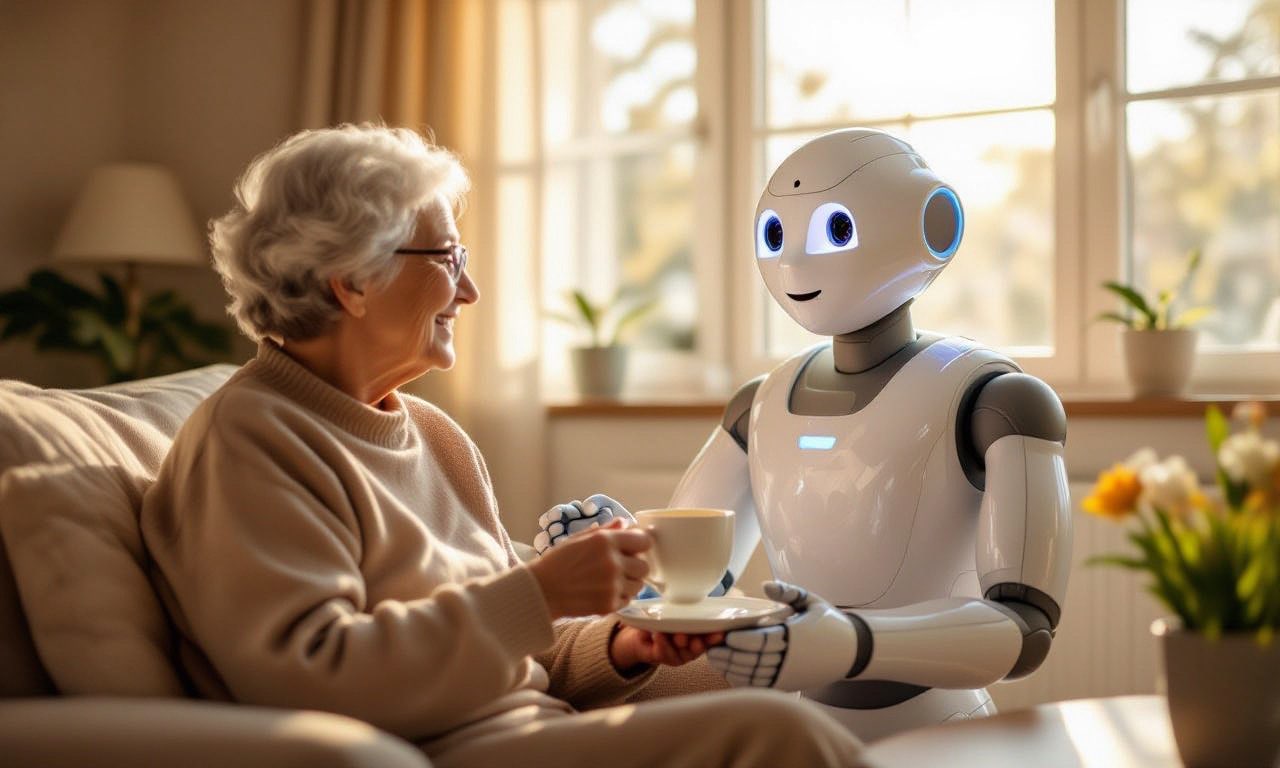
The AI models running inside these robots are conversational. They’re empathetic. They remember what you tell them. They ask follow-up questions. They don’t get bored, tired, or impatient. For an 85-year-old who hasn’t had a visitor this week, the difference between a robot that lifts them out of bed and a robot that lifts them out of bed AND asks about their grandchildren is enormous.
Japan has understood this for years. Sony’s Aibo robot dog — discontinued in 2006, revived in 2018 — was never about fetching slippers. It was about companionship. Paro, the therapeutic seal robot used in Japanese care homes since 2003, reduces anxiety and loneliness in dementia patients. These weren’t AI breakthroughs. They were companionship breakthroughs.
Now add a large language model to the mix. A robot that not only helps you stand up but remembers you fought in Vietnam, asks how your daughter’s wedding was, and laughs at the same jokes your grandson tells. A robot with a personality — patient, warm, attentive — that never has a bad day.
For a generation of elderly people who are genuinely, measurably lonely, that’s not a gimmick. It might be the thing that makes a care robot worth buying. The physical assistance is the justification. The companionship is the value.
New Zealand needs to think about this carefully. If we deploy care robots that can lift but can’t connect, we’ve built a more efficient system for producing loneliness. If we deploy robots that can do both — and we design the AI personality with the same care we’d design the physical safety — we’ve built something genuinely humane.
5. New Zealand’s Opportunity
New Zealand faces the same demographic curve as Japan, just delayed by about 20 years. Stats NZ projects that 1 in 4 New Zealanders will be aged 65+ by 2048, up from 1 in 7 today. The aged care workforce shortage is already here — the Aged Care Association has been sounding the alarm for years. Our regions are struggling to find workers for agriculture, healthcare, and trades.
But we also have advantages that Japan doesn’t.
Small scale, fast deployment. New Zealand is small enough that a robotics deployment that would take years in a large country could happen in months. A single policy decision, a single investment, a single pilot program could ripple through the entire economy.
Existing agritech strength. Companies like Halter (smart collars for virtual fencing) have already proven that New Zealand farmers will adopt technology when it delivers clear ROI. The agricultural robotics market is projected to reach $43 billion globally by 2030. New Zealand is well-positioned to be an early adopter and, potentially, a developer of specialised agri-robots.
A care sector under pressure. RNZ reported in December 2025 on whether robots could solve the aged-care crisis. The Aged Care Association is calling for digital solutions. The workforce shortage isn’t coming — it’s arrived. Robots that can assist with lifting, monitoring, cleaning, and companionship could transform the economics of aged care in New Zealand.
Manufacturing and export processing. New Zealand’s manufacturing sector is small by global standards, but it’s critical to our export economy. Robotics could extend the working life of experienced tradespeople, reduce injury rates in physically demanding jobs, and increase the value-add of our exports through precision processing.
The individual angle. This is where it gets interesting for a New Zealand audience. What does a $20K humanoid mean for a family farmer in Southland? For a small engineering workshop in Tauranga? For a retired couple in Whangārei who want to stay in their home longer? The technology is approaching a price point where individual ownership becomes plausible — not for everyone, but for enough people to change the conversation.
6. The Sobering Part
None of this is guaranteed to go well.
The same technology that could keep an elderly person in their home longer could also displace workers faster than the economy can retrain them. The same robots that could revitalise regional manufacturing could concentrate wealth in the hands of those who own the robots, not those who operate them.
Japan’s experience is instructive here too. Despite decades of robotics leadership, Japan has not solved its productivity puzzle. Its economy has been stagnant for thirty years. Robots alone don’t fix structural problems — they amplify existing trends.
Australia is moving to curb government AI decision-making in direct response to the robodebt scandal — automated systems that wrongly pursued citizens for debts they didn’t owe. New Zealand has no equivalent regulation. If we deploy robotics and AI into care, manufacturing, and government without a policy framework, we’re importing the same risks.
For New Zealand, the questions are:
- Who builds the robots? If we’re only buyers, not builders, the economic benefit flows offshore. If we build some, we capture more value.
- Who owns the robots? Cooperative models, leasing, government-supported deployment — the ownership structure matters as much as the technology.
- Who gets retrained? The jobs that disappear won’t be the ones people are being trained for today. The ANU “hysterical” response to AI in education shows what happens when education institutions panic instead of planning.
- What’s the policy framework? Japan’s Society 5.0 is a national strategy. New Zealand doesn’t have an equivalent. Should we?
The answer to “robots are coming” isn’t to stop them. It’s to decide, deliberately, what we want them to do for us.
7. The Thread Back to Sovereignty
This article connects directly to the sovereign AI debate. The same logic applies:
- Control over infrastructure — if robotics becomes critical infrastructure (care, manufacturing, food production), who controls the AI that runs the robots?
- Data sovereignty — robots that work in New Zealand homes and farms will generate enormous amounts of data about New Zealand. Where does that data live? Who has access?
- Strategic independence — a country that can’t build or maintain its own robotic workforce is dependent on whoever can. The sovereignty argument doesn’t stop at AI models.
- The personality question — if a companion robot becomes an elderly person’s primary source of conversation, who designed that personality? What cultural assumptions are baked in? A robot trained on American data won’t understand a Māori kuia’s stories about the marae.
The Walden story is a Toyota story. Toyota is a Japanese company that spun out an American robotics startup. The technology is global. The question is whether the benefits are — and whether the personality inside the machine understands the person it’s caring for.
📰 Sources
- Walden Robotics launch: $300M at $1.1B valuation, Toyota/Nvidia backing, deployed at Toyota factory (July 15, 2026)
- Japan population: 29.1% aged 65+, 125M and shrinking, 570K caregiver shortage by 2040 — Statistics Bureau of Japan
- Japan robot density: 419 per 10K manufacturing workers — IFR World Robotics 2025
- AIREC humanoid caregiver prototype — Reuters, Feb 2025
- 1X Technologies Neo: $20K consumer humanoid, OpenAI-backed (Oct 2025)
- McKinsey: Japan’s $100B general-purpose robotics opportunity (May 2026)
- RNZ: “Helping hands: Could robots solve aged-care crisis?” (Dec 2025)
- Tesla Optimus Gen-3: 1M units/year target
- Figure AI: Deployed at BMW factories
- Agility Robotics Digit: Deployed at Amazon warehouses
- Hyundai full control of Boston Dynamics: $335M (July 2026)
- Unitree G1/H1: Starting at $16K
- Stats NZ: 1 in 4 NZers aged 65+ by 2048
- Paro therapeutic seal robot: Japanese care home deployment since 2003
- Singularity.Kiwi robots section: 14 companies tracked
— CJ Murden, editor of Singularity.Kiwi. Former digital technologies teacher, author of AI-focused books. Writing with a New Zealand focus.