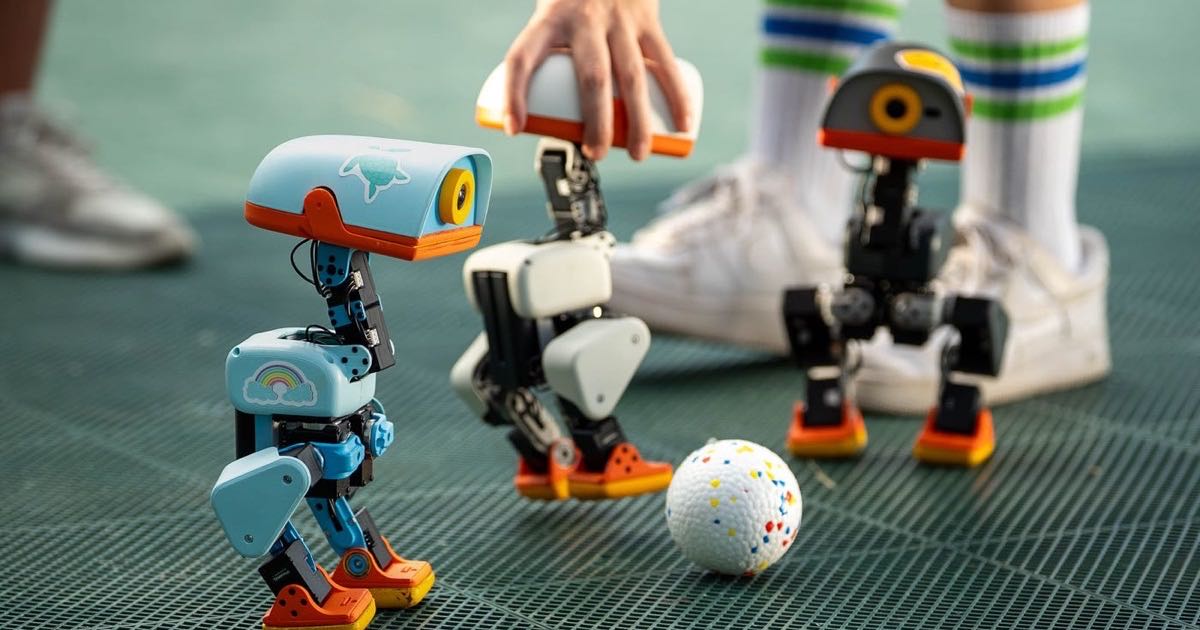
Pollen Robotics, the Bordeaux-based robotics company now owned by Hugging Face, launched Microduck on August 27 — a 25cm tall biped robot with 15 motors, a camera, LiDAR, and an articulated beak, priced at $399. Pre-orders are open now, with first deliveries targeted before Christmas 2026 in North America, Europe, and the UK.
For New Zealand, this is not just another gadget launch. It is the kind of platform that could make physical AI education real — in classrooms, polytechs, and on kitchen tables — without a lab budget or a grant application.
What Microduck Actually Does
Microduck ships with seven learned behaviours: walking, sitting and standing, kicking, grabbing objects with its beak, getting back up from a fall, and roller skating. Each behaviour is a reinforcement learning policy trained in simulation and deployed on the physical robot using sim-to-real transfer.
The robot runs a 50Hz onboard policy loop. It has 15 motors, a front-facing camera, a small depth sensor (LiDAR), and two IMUs. It weighs under 800 grams. The beak is functional — it dips, scoops, and carries small objects. The Register noted that Pollen demonstrated it picking up socks and a marker, placing them in a box.
The full reinforcement learning stack — robot control, simulation, training, and sim-to-real deployment — is open source on GitHub under Apache 2.0. Behaviours are trained in MuJoCo physics simulation, then transferred to the real robot in one step. You can retrain any shipped behaviour on your own machine, or on Hugging Face Jobs, and deploy it back to the robot.
Why This Matters for New Zealand
NZ’s digital technologies curriculum already includes computational thinking and designing digital outcomes. Schools are expected to teach students how to approach problems like a computer scientist — breaking them down, testing solutions, iterating. The problem has always been the gap between theory and something you can actually put your hands on.
A $399 robot that trains physical AI behaviours changes that maths. A school can buy one Microduck for less than the cost of a graphics card. Students can train a walking gait in simulation during period one, deploy it to the robot in period two, and watch it fall over in period three — then fix it. That loop is what reinforcement learning actually is. Reading about it in a textbook is not the same.
Pollen’s previous robot, Reachy Mini, sold over 10,000 units worldwide. Microduck is aimed at the same audience: people who want to learn by doing. The difference is that Microduck moves. It walks, falls, recovers, and carries things. That makes it a platform for the part of AI that is hardest to teach without hardware — the part where intelligence has to navigate gravity.
Open Source, For Real
The main repository contains the SDK and robot software. The RL repository contains the reinforcement learning and sim-to-real tools. MuJoCo, the physics simulator, is open source. The licence is Apache 2.0 — you can read, fork, modify, and commercially reuse the code.
This is the kind of open-source robotics approach we wrote about in our New Zealand number 8 wire piece — where the barrier to entry is not the cost of hardware but the willingness to learn. A $399 robot with a full training stack and no licensing restrictions is about as low as that barrier gets.
Pollen’s blog post made the philosophy explicit: “Models are useful because people can build on one another’s work. We want physical behaviours to become easier to share in the same way, together with the environments and training recipes needed to reproduce them.”
The implication is that robot behaviours could become shareable artifacts — train a walking gait, publish the policy, someone else downloads it and deploys it on their Microduck. That is the model that made Hugging Face central to AI model distribution, applied to physical AI.
The Hugging Face Connection
The Register’s coverage described Pollen as “a Hugging Face subsidiary.” Hugging Face is the platform where most open-source AI models live. It is also the company Nvidia agreed to buy for $12.9 billion this week.
If that acquisition completes, Microduck will sit under the same corporate umbrella as the world’s dominant AI chipmaker and its largest open-source model hub. Whether that accelerates Pollen’s mission or complicates it is an open question. For now, the open-source commitment stands.
Why We Want One
We have reached out to Pollen Robotics about getting a Microduck demo unit for New Zealand. The case is straightforward: NZ is a small market with a strong education sector, a growing interest in physical AI, and a number 8 wire mentality that fits an open-source robot you can modify and improve. If a $399 duck can walk, fall, and get back up on a desk in Tauranga, it can do it anywhere.
Microduck will not clean your house. It cannot carry heavy objects. It does not have voice interaction — that is Reachy Mini’s territory. But it does something more important: it makes the hardest part of robotics — teaching a machine to move through the real world — accessible to anyone with a laptop and $399.
That is worth watching. And ideally, worth holding.
— CJ Murden, editor of Singularity.Kiwi. Former digital technologies teacher, author of AI-focused books. Writing with a New Zealand focus.