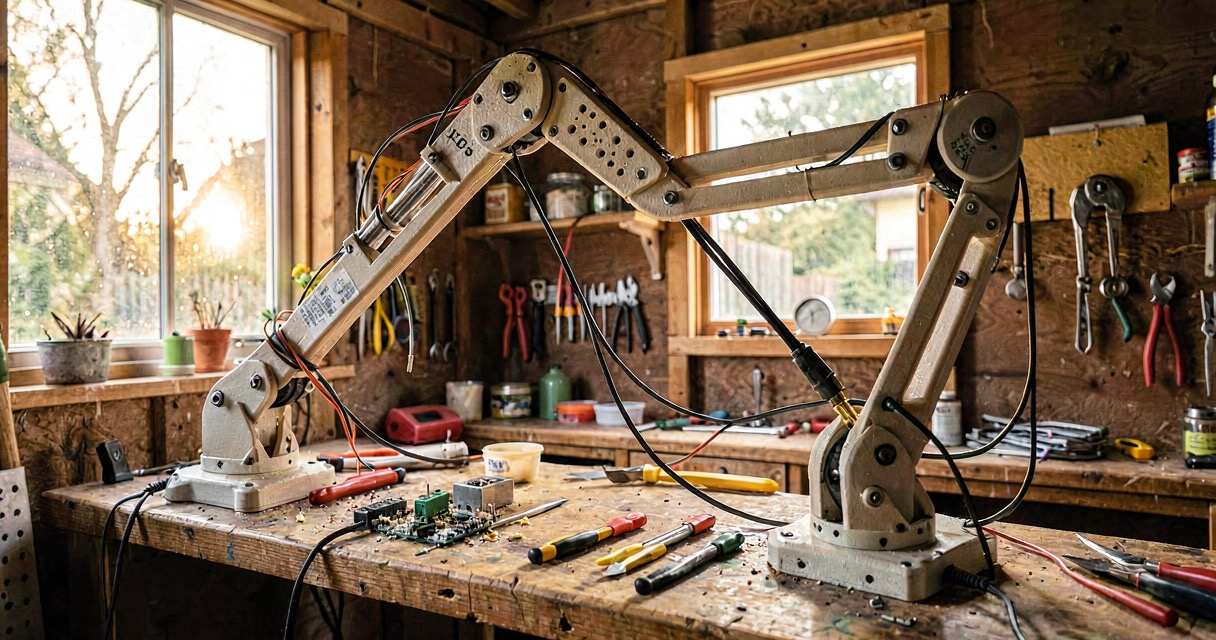
Milo is a robotic guide dog that costs about US$2,000 to build. The hardware designs, simulation software, and pre-trained AI models are all free to download. A team at Mila, the Quebec AI institute, built it to prove that autonomous robotic guidance doesn’t require cloud computing, pre-mapped routes, or a venture capital budget.
In New Zealand, that number lands differently. A trained guide dog here costs approximately $175,000 to raise, train, and maintain over its working life. Blind Low Vision NZ — the country’s sole provider — receives zero government funding. The average wait time for a guide dog is 226 days. Someone develops blindness in New Zealand every three hours. There are 183,000 Kiwis who are blind or have low vision, and only 35 qualified guide dogs came out of training in the most recent period reported.
Milo in New Zealand dollars, with shipping and GST, is maybe NZ$4,000. That’s not a finished product — it’s a research platform, and the developers are honest about that. But it’s 35 times cheaper than a guide dog, there’s no waiting list, and anyone with the right skills can build one.
The question isn’t whether Milo replaces a guide dog. It doesn’t. The question is what happens when the cost of building useful robots drops this low and the plans are free. Because that’s the moment where New Zealand’s number 8 wire mentality stops being a quaint cultural cliché and starts being an economic strategy.
The Number 8 Wire Tradition
Number 8 wire is a British gauge of fencing wire that became shorthand for Kiwi ingenuity — the ability to solve problems with whatever you’ve got, because you’re a long way from anywhere and nobody’s coming to help. It’s been criticised as an excuse for doing things half-arsed, and sometimes it is. But the core of it — isolation driving resourcefulness — is real, and it has a track record.
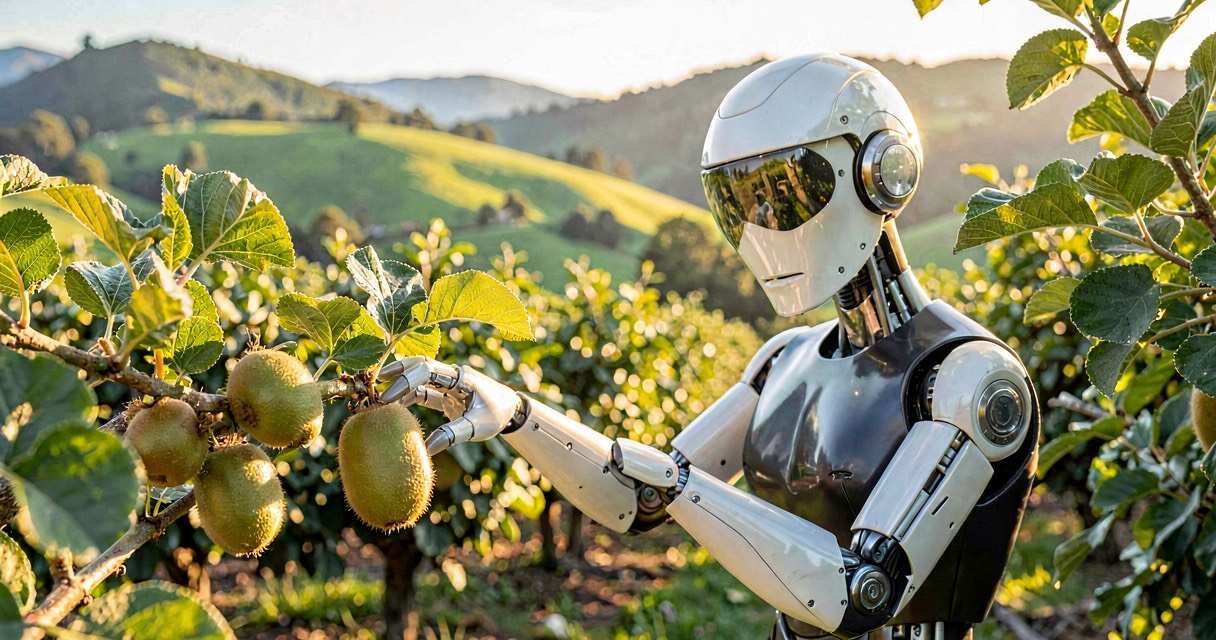
Robotics Plus started in a small shed surrounded by orchards in Tauranga. Steve Saunders and his team built autonomous orchard vehicles because nobody else was building machines for New Zealand’s steep terrain and tight row spacings. Yamaha Motor acquired the company in 2025 to form the foundation of a global precision agriculture division. A shed in Tauranga became Yamaha’s robotics arm. That’s number 8 wire with a cheque at the end.
Halter built smart cow collars that let farmers manage herds from a phone. Founded in New Zealand because the problem was local — dairy farming at scale, in terrain that overseas robotics companies weren’t designing for. In March 2026, Halter raised NZ$377 million in Series E funding at a US$2 billion valuation. Peter Thiel’s Founders Fund led the round. A Kiwi cow collar is now a two-billion-dollar company.
Agovor, another New Zealand robotics startup, raised AU$3 million in early 2026 to build autonomous electric tractor platforms for horticulture. The machines are designed for the row spacing, soil types, and crop varieties that define NZ orchards — specifications that overseas manufacturers don’t care about because the market is too small.
These companies succeeded by solving local problems that global robotics firms ignored. That’s the number 8 wire pattern. But each of them required significant capital to get started. They followed the traditional startup path: build, raise, scale, exit. Open-source robotics changes the entry point.
What Open Source Does to the Math
When Milo’s developers released the full platform — hardware schematics, simulation environments, pre-trained models — they did something that matters more for New Zealand than for most countries. They removed the capital barrier.
You don’t need a Series A to build on Milo. You need a 3D printer, some off-the-shelf components, a makerspace membership, and someone who can read GitHub. New Zealand has the makerspaces — Tinkd in Tauranga, Unleash Space at the University of Auckland, Hackland studios, Christchurch City Libraries’ fabrication workshop. We have the engineering students — University of Waikato is already developing AI for kiwifruit ripeness detection. We have the DIY culture. What we’ve lacked is the starting point: something worth building that doesn’t require a million dollars to begin.
That’s what Milo represents. Not the robot itself, but the proof that useful robotics can be open, cheap, and modular. If a robotic guide dog can be built for NZ$4,000 from free plans, what else can be built the same way?
The NZ Opportunity
New Zealand is too small a market for Boston Dynamics to design a robot for our footpaths, too far away for Figure to optimise for our orchard rows, too marginal for most global robotics companies to care about. That’s been our disadvantage. Open source flips it.
When the plans are free, the advantage goes to whoever adapts them best to local conditions. New Zealand’s local conditions are specific: steep terrain, tight orchard spacing, high-value organic crops that need gentle handling, a dairy industry that’s our biggest export, an ageing population that needs assistive technology, and a disability sector chronically underserved by global product designers.
Adapting Milo for New Zealand footpaths, weather, and accessibility standards is exactly the kind of problem Kiwi engineers are good at. The plans are free. The adaptation is where the value is. And if it works here — on our terrain, in our weather, for our users — it works in plenty of other places too. That’s the number 8 wire export model: solve a local problem, sell the solution globally.
Robotics Plus did it with orchard vehicles. Halter did it with cow collars. The open-source version of that pattern hasn’t been built yet, and it doesn’t require NZ$377 million to start.
What It Would Take
The ingredients exist. The maker spaces have the equipment. The universities have the students. The agricultural sector has the problems. The disability community has the need. What’s missing is the connective tissue — someone to take an open-source platform like Milo, adapt it for New Zealand conditions, and turn the adaptation into something deployable.
It doesn’t need to be a startup. It could be a university research group, a makerspace project, a community trust, or a Blind Low Vision NZ initiative. The open-source model means there’s no licensing fee, no vendor lock-in, no waiting for a foreign company to decide our market is worth their time. The only cost is time and talent, and New Zealand has both.
The number 8 wire mentality has always been about making do with what you’ve got. For the first time, what we’ve got includes free robot designs, cheap components, and a global community of open-source robotics developers. The question is whether we pick up the wire.
— CJ Murden, editor of Singularity.Kiwi. Former digital technologies teacher, author of AI-focused books. Writing with a New Zealand focus.