New Zealand has a robot problem. Not that we have too many — that we don’t have enough, and the accounting is starting to make that obvious.
Take a worker on $55,000 a year. That’s not what they cost you. KiwiSaver at 3.5% adds $1,925. ACC work levies add another $380 at the average rate — more if you’re in manufacturing or food processing, where injury rates push levies toward $5 per $100 of earnings. Holiday pay is 8%: $4,400. Sick leave, ten days: $1,060. Public holidays, eleven days: $2,330. Payroll admin, uniforms, recruitment costs: call it $2,000.
That $55,000 worker actually costs $67,095 a year. Roughly 22% on top of the salary. Every year. And it only goes up — the minimum wage rose to $23.95 an hour on 1 April 2026, one of the highest in the world relative to cost of living.
Now look at the robot.
A Unitree G1 — a full-size, walking, task-capable humanoid — lists at US$13,500. At today’s exchange rate of about NZ$1.70 to the US dollar, that’s NZ$22,950 before it touches New Zealand soil. Add shipping and insurance from China (call it NZ$2,000), then 15% GST on the landed value, and you’re at roughly NZ$29,000 all-up. That’s the developer model.
Tesla’s Optimus is projected at US$20,000 to US$30,000 when it ships commercially — but that’s a US price. Landed in New Zealand with shipping and GST, you’re looking at NZ$43,000 to NZ$62,000. The commercial-grade Unitree H2 sits in similar territory at around NZ$62,000 landed.
These aren’t cheap. But here’s what changes the equation: no ACC. No KiwiSaver. No holiday pay. No sick leave. No recruitment fees. A robot works 24 hours a day, seven days a week, and doesn’t need accommodation or a ride from the hostel to the orchard.
Here’s the part that should make New Zealand business owners sit up: the government’s Investment Boost scheme lets you deduct 20% of the cost of new business assets immediately, then depreciate the remaining 80%. Buy a NZ$29,000 robot, claim $5,800 as an expense in year one, and depreciate the rest. A human worker generates costs that never get written off — they only go up.
The math is still brutal, even at NZ prices. One worker costs $67,000 a year for a single shift. A NZ$29,000 robot works three shifts. On a single-shift comparison, the robot pays for itself in about five months. If it replaces night shift, where penalty rates apply, the payback period shrinks further. Even the NZ$62,000 commercial-grade Optimus pays for itself in under a year against a single worker — and it’s working three shifts.
The Organic Opportunity
This is where it gets interesting for New Zealand specifically.
Our organic sector generates $1.2 billion annually, with $606.7 million in exports. It’s growing at roughly twice the rate of conventional agriculture. Fonterra’s organic milk achieves a 27% price premium. Organic kiwifruit commands higher tray returns through Zespri.
But organic farming is inherently labour-intensive. No synthetic herbicides means hand-weeding. No chemical pest control means manual intervention. More human hours per hectare, more hands on the crop, more cost per unit produced. That’s the trade-off that has kept organic food expensive and niche.
Robots change that equation. If autonomous systems handle the weeding, the harvesting, the sorting — the tasks that make organic expensive to produce — then the premium price stays but the cost base drops. The margin gap between organic and conventional widens in New Zealand’s favour. We could produce organic food more cheaply than competitors produce conventional food.
The RSE Reckoning
New Zealand horticulture runs on the Recognised Seasonal Employer scheme — 20,000+ workers from the Pacific, contributing $2.2 billion to the horticulture economy. It’s a system that works economically but carries growing reputational risk. The 2026 RSE review brought fresh scrutiny of worker accommodation, transport, and conditions. Treasury has a “Horticulture Workforce Transition Plan” — they know dependence on offshore labour is a ticking clock.
A robot doesn’t need a visa, accommodation, or a bus from the hostel. It doesn’t get homesick. It doesn’t send remittances back to a Pacific nation, which is a genuine downside of transitioning away from RSE — but that’s a policy problem with policy solutions, not a reason to keep doing things the expensive way forever.
New Zealand Companies Already Building This
This isn’t hypothetical. The ecosystem exists.
Agovor, a New Zealand robotics startup, raised AU$3 million in early 2026 to build autonomous electric tractor platforms for horticulture. Their machines are designed for the row spacing, terrain, and crop types that define NZ orchards.
University of Waikato researchers are developing AI that helps harvesters identify kiwifruit ripeness in real time — the exact bottleneck that has prevented automated harvesting of a crop that’s notoriously hard to judge by colour alone.
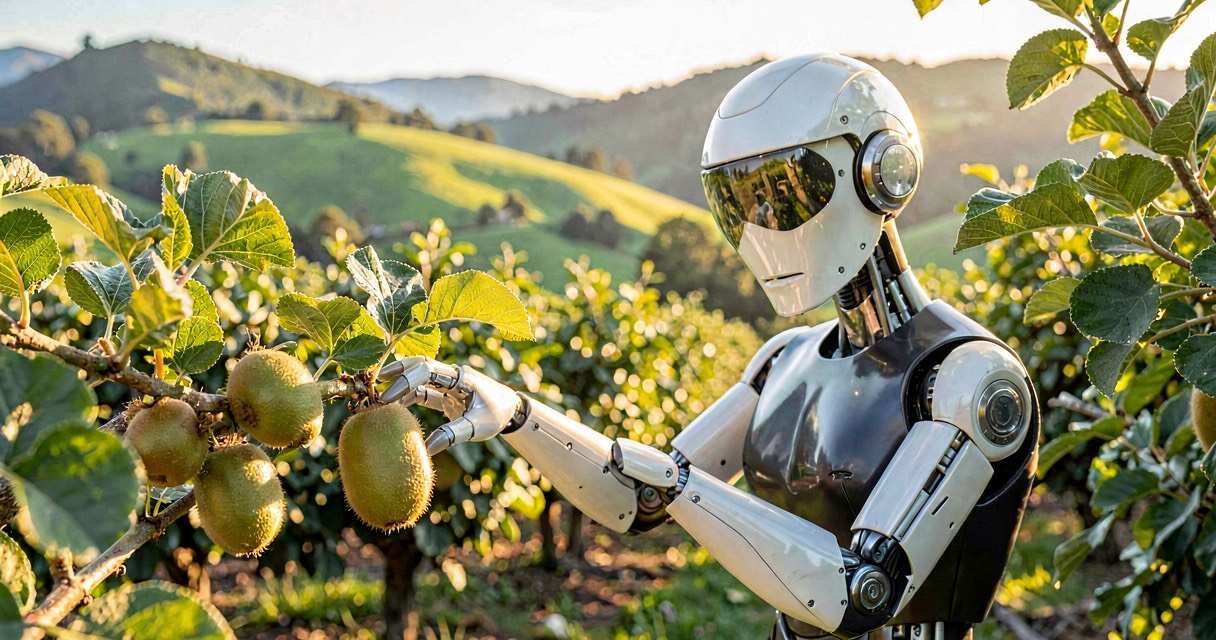
Bonsai Robotics, working with farm-ng’s Amiga platform, has already demonstrated kiwifruit harvesting using vision-based autonomy. Cameras read the field. Soft robotic grippers pick the fruit.
Maf Roda NZ has installed automation equipment in twelve kiwifruit packhouses across the country. The post-harvest side — sorting, grading, packing — is already partially automated. The harvest itself is the remaining frontier.
The Bigger Play
New Zealand has a pattern of turning agricultural challenges into export industries. We solved our isolation problem by pioneering refrigerated shipping. We solved our scale problem by building Fonterra. We solved our distance from markets by becoming the world’s dairy and kiwifruit exporter of choice.
The next iteration is obvious: become the country that grows premium organic food with robots, then sells the robots and the systems to everyone else facing the same labour math.
Agovor’s autonomous tractors, Waikato’s ripeness AI, Bonsai’s vision systems — these are export products. Europe’s organic farms face the same labour costs and stricter regulations. American agriculture has its own immigration-labour reckoning coming. The technology built for New Zealand’s steep hills and tight orchard rows works in places that conventional farm machinery can’t reach.
What It Adds Up To
The NZIER says 46% of New Zealand jobs have high automation potential. That statistic gets quoted as a warning. It’s also an opportunity.
The question isn’t whether robots will show up in New Zealand packhouses and orchards. Agovor is already selling them. The question is whether we’re training people for the roles the article from Velora described — monitoring, judgement, collaboration with machines — or just hoping the transition sorts itself out.
The economics already work. The technology exists. The tax system encourages it. The export markets want what we’d produce. The only thing missing is a plan — and New Zealand has never been short of those when the math is this clear.
— CJ Murden, editor of Singularity.Kiwi. Former digital technologies teacher, author of AI-focused books. Writing with a New Zealand focus.