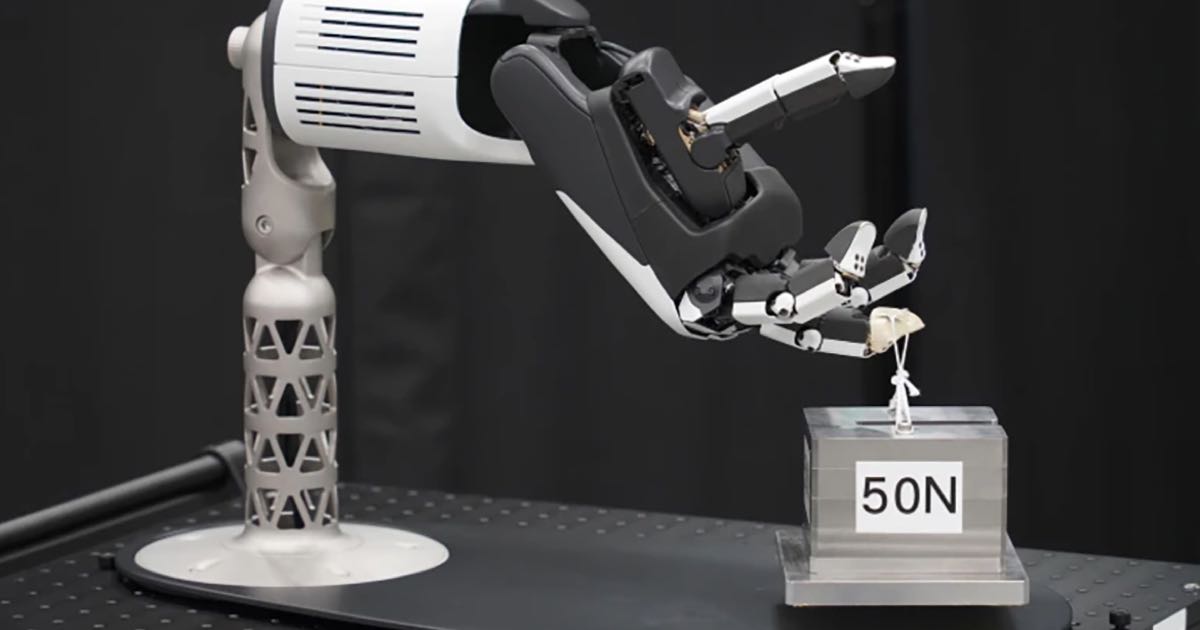
Honda has built a robotic hand that can pick up a screw 1.6 millimetres in diameter, rotate it, and insert it into a hole. The same hand can lift a 5 kilogram object using only its fingertips. That range — fine motor precision and meaningful payload on the same platform — is the core claim behind the dexterous manipulation system Honda unveiled at a Tokyo robotics exhibition in late May, with full-scale factory testing planned at its Yorii plant in Saitama.
The hand has four fingers, not five. Honda dropped the little finger after determining that four were sufficient for the manipulation range required in manufacturing assembly. Tactile sensors across the fingers detect object shape, enabling the hand to orient components correctly before insertion rather than relying on precise pre-positioning by external systems. A newly patented finger drive mechanism replaces the conventional motor-and-wire approach, which executive chief engineer Takahide Yoshiike described as bending “like a willow” — transmitting force efficiently while accommodating the flex that delicate manipulation requires.
Honda plans to begin full-scale field testing at Yorii, where the robot will sort large volumes of parts supplied by subcontractors. The factory application is specifically chosen because parts from external suppliers arrive in variable orientations and configurations — not the perfectly positioned components of a controlled lab. Commercialisation is targeted for the early 2030s.
Why ASIMO’s Retirement Led Here
The announcement marks Honda’s most significant public robotics development since it retired ASIMO, the bipedal humanoid it debuted in 2000, in 2022. The company shifted its robotics research toward dexterous fingers around 2019 and has continued the work largely out of public view until now.
ASIMO’s retirement was not about technology capability — the robot could walk, run, and pour drinks. It was about safety in uncontrolled environments. As Honda Research Institute’s announcement notes, the company concluded it could not adequately address concerns about unexpected human-robot contact. “Honda could not eliminate concerns that the robot might knock over people nearby in unexpected situations, such as a child suddenly hugging it,” Yoshiike said, making further business expansion difficult to envision.
The pivot from bipedal humanoid to dexterous industrial hand reflects both that lesson and the commercial reality that manufacturing labour shortages create more immediate demand than consumer humanoid companionship. Honda has also announced a joint research project with RIKEN during fiscal 2026 to accelerate development of physical AI — technology intended to allow robots to autonomously learn tasks rather than requiring explicit programming for each new operation.
The Dexterous Hand Market Is Getting Crowded
Honda enters a dexterous hand space that has accelerated rapidly in 2026. The competitive landscape includes tendon-driven systems including tendon-driven systems like the 25-DoF hand shown for the NEO home humanoid in July, fluidic tendon designs like Tacta Systems’ five-finger variant, and Chinese mass-production efforts from companies profiled in our dexterous hand market analysis.
What distinguishes Honda’s approach is the integration target. Rather than building a hand as a standalone product or a component for a humanoid platform, Honda is designing for a specific industrial workflow: one robot performing multiple tasks across a production line. The Yorii testing will validate whether the hand can handle the variability of real-world parts sorting — the kind of unstructured manipulation that has historically required either human labour or bespoke single-task automation.
What Stands Out
The 1.6mm-to-5kg range is the detail that matters. Most dexterous hands are optimised for either precision (small object manipulation, electronics assembly) or strength (heavy lifting, industrial pick-and-place). Honda’s claim is that a single system handles both extremes. If the Yorii testing confirms this under factory conditions — not just exhibition demos — the hand addresses one of the persistent bottlenecks in manufacturing automation: the need for separate specialised robots for different task types.
The commercialisation timeline is the constraint. “Early 2030s” means this is a research platform entering field testing, not a product approaching launch. Honda’s own framing acknowledges this — the company is starting with a factory deployment because it controls that environment, and the hand will need years of iterative improvement before it reaches the reliability levels that commercial sale demands. That puts Honda behind Chinese competitors targeting 2026 mass production, but ahead on the specific claim of multi-task dexterous manipulation in a single system.
Honda’s manufacturing heritage is the structural advantage here. The company makes cars at scale — it understands production-line reliability, component lifecycle testing, and the gap between a working prototype and a deployable system. The Yorii facility gives Honda something competitors relying on external factory partnerships cannot easily replicate: a controlled but real industrial environment where the hand can fail safely, collect operational data, and iterate without commercial customer pressure.
❓ FAQ
Can I buy Honda’s robotic hand? Not yet. Honda is targeting commercialisation in the early 2030s, with full-scale factory testing at Yorii beginning now. The hand is a research platform entering field validation, not a product approaching market.
Why does it only have four fingers? Honda determined through task analysis that the little finger was not needed for the manipulation range required in manufacturing assembly. Four fingers provide sufficient dexterity for the tasks the hand is designed to perform, and dropping the fifth simplifies the mechanical design.
How is this different from ASIMO? ASIMO was a full bipedal humanoid designed for mobility and human interaction in unstructured environments. The dexterous hand is a manipulation-focused system designed for industrial assembly. Honda pivoted after concluding that ASIMO’s safety risks in uncontrolled environments — a child hugging the robot, for instance — could not be adequately addressed.
What is the finger drive mechanism? Honda has applied for a patent on a new finger drive mechanism that replaces the conventional motor-and-wire approach. The system is described as bending “like a willow,” transmitting force efficiently while accommodating the flex that delicate manipulation requires. Full technical details are not yet public.