Most robot dogs are closed systems. You buy them, you use them, and if you want to change how they work, you’re out of luck. China’s MirrorMe Technology is doing something different with the Black Panther X — and it’s the latest sign that open robotics is becoming a movement worth watching.
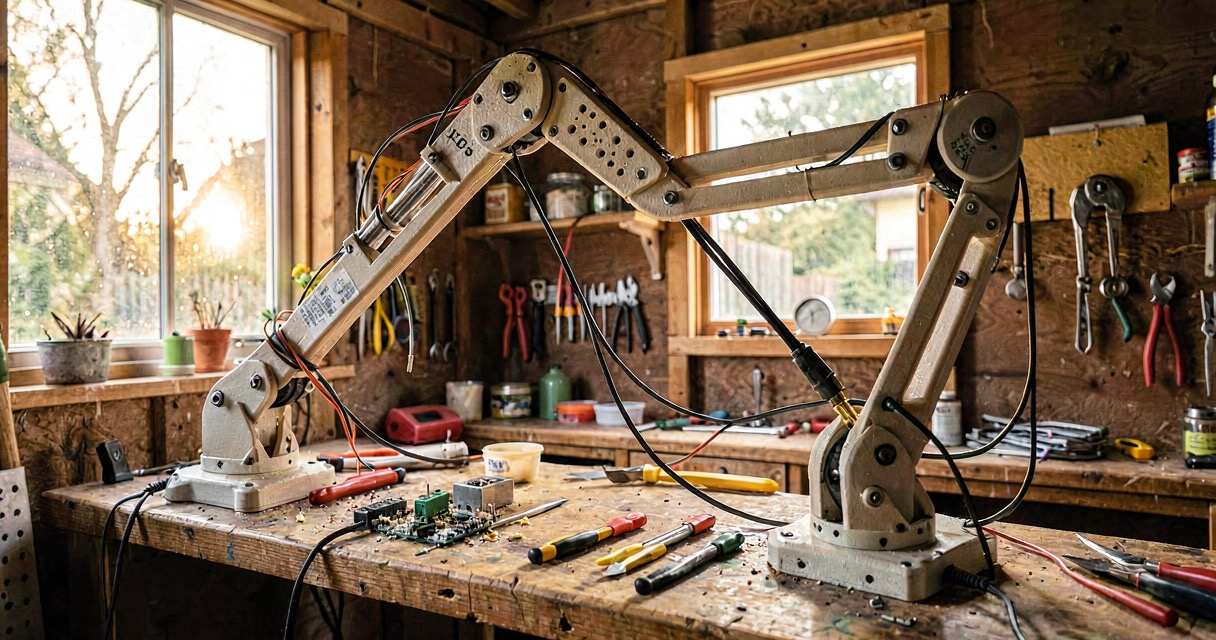
The Black Panther X is a modular, open quadruped platform. It ships with 200-plus components, 12 high-performance joints, open interfaces, and open code. You assemble it — the company describes the build process as LEGO-like — and then you modify it, program it, and build on top of it. It supports third-party sensors and payloads. The spec sheet reads like a challenge: 4 m/s top speed, 33 Nm joint torque, 8 kg payload while in motion, and a 720-degree aerial flip with stable landing.
MirrorMe opened pre-orders on Kickstarter. The company is driving the cost of advanced mechatronics into territory that makerspaces and university labs can reach.
Not a Toy Company
MirrorMe is not a startup playing at robotics. Founded in May 2024 and headquartered in Shanghai, with its core team drawn from Zhejiang University, the company built the Black Panther 2.0 — a research-grade quadruped that sprinted 100 metres in under 10 seconds, beating the previous record set by Korea’s HOUND robot. They also built Bolt, a humanoid robot that set a world record as the fastest in its class at 10 metres per second.
The Black Panther X takes that engineering pedigree and makes it modular and open. That’s the part that matters. The fastest robot dog in the world is interesting. A fast robot dog that you’re supposed to take apart, understand, and improve — that’s a development platform.
The Open Robotics Pattern
The Black Panther X isn’t alone. It joins a growing list of open robotics platforms that are lowering the barrier to entry for anyone who wants to build, not just buy.
Milo, the open-source robotic guide dog from Mila in Quebec, costs about US$2,000 to build from free plans. Hugging Face’s LeRobot project is building open-source robotics datasets and models. The SO-101 robotic arm is a low-cost, open 6-DoF arm that researchers are already using. NavBot sells open-source quadruped kits for STEM education. PiDog runs on a Raspberry Pi with phone-based controls.
The pattern is clear: the expensive part of robotics used to be the engineering. Now the engineering is shared, and the expensive part is just the components. When a company that built the world’s fastest robot dog releases a modular version with open code, the message is that the knowledge barrier has collapsed. What’s left is the build barrier — and that’s the one that makerspaces and university labs are built to cross.
Why This Matters for New Zealand
New Zealand has the pieces. The Auckland University Robotics Association just won the 2025 and 2026 New Zealand VEX U National Championships and is representing Aotearoa at the VEX World Championships in Kentucky. Glenfield College has qualified at the national level. AUT showcased humanoids, quadrupeds, and AI at TechWeek 2026 in Auckland. The University of Waikato is developing AI for kiwifruit ripeness detection. The Waikato Robotics, Automation and Sensing Group collaborates across the University of Auckland, University of Canterbury, Lincoln Agritech, and Plant and Food Research.
We have the students. We have the makerspaces — Tinkd in Tauranga, Unleash Space at the University of Auckland, Hackland, Christchurch City Libraries. We have the DIY culture. What open platforms like the Black Panther X provide is the starting point: something worth building on that doesn’t require a venture capital round to begin.
The Development Angle
Here’s the opportunity most people don’t see.
When a NZ university robotics club or makerspace builds on an open platform like the Black Panther X, they’re not just learning. They’re creating adaptations — for NZ terrain, for agricultural applications, for accessibility use cases, for conditions that the original Chinese designers never considered. Those adaptations have value.
Robotics Plus started in a shed in Tauranga building autonomous orchard vehicles for NZ terrain that nobody else was building for. Yamaha bought the company. Halter built smart cow collars for NZ dairy farms and reached a US$2 billion valuation. Both solved local problems that global companies ignored.
The open-source version of that pattern is the next iteration. A robotics club takes a Black Panther X, adapts it for kiwifruit orchard monitoring, and the adaptation becomes a project that could become a product. A makerspace takes the open plans for Milo, modifies it for NZ footpaths and weather, and the modification becomes a deployable accessibility tool. The platform is free. The adaptation is where the value lives.
The Window
The open robotics movement is where open-source software was in the early 2000s — growing fast, dismissed by incumbents, and about to become the foundation for everything. The difference is that hardware costs money. The components for a Black Panther X or a Milo build are affordable right now, in the same way that a $900 GPU can run frontier AI right now.
That window may not stay open. The same hardware inflation hitting GPU and RAM prices — DDR5 up 89% in 2026, NVIDIA cutting consumer production — affects the components that go into robots. Motors, sensors, controllers, and batteries are all part of the same supply chains being squeezed by AI infrastructure demand.
The platforms are open. The skills exist in New Zealand. The question is whether anyone picks them up before the cost of building climbs past what a university club or makerspace can afford.
📰 Sources
- Eren Chen (@ErenChenAI) — X post on Black Panther X
- MirrorMe Technology — Black Panther X
- BackerCrew — Black Panther X coverage
- CnEVPost — MirrorMe and Bolt humanoid
- University of Auckland — AURA VEX Championships
— CJ Murden, editor of Singularity.Kiwi. Former digital technologies teacher, author of AI-focused books. Writing with a New Zealand focus.