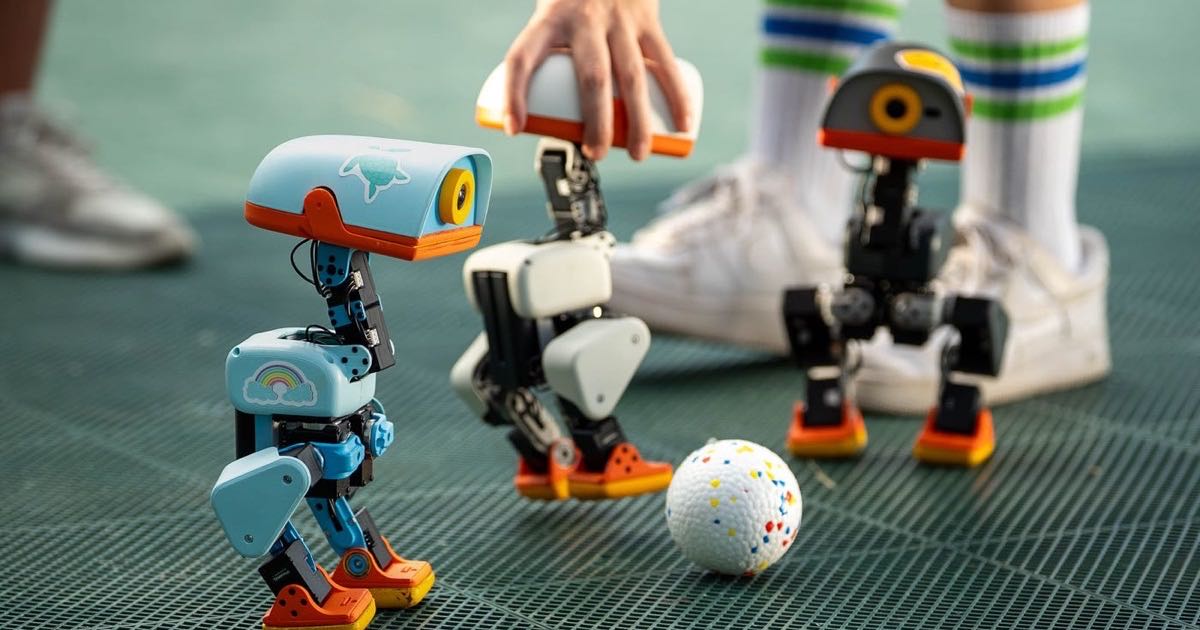
Hugging Face has a duck problem — the good kind.
Cofounder Thomas Wolf posted on X Friday that the company’s $399 Microduck robot took more than $2.6 million in orders during its first 24 hours on sale. That’s roughly 6,500 ducks, at roughly $399 each, for a 10-inch robot that kicks a tiny soccer ball and rights itself when it falls over. Hours after the launch on Thursday, Wolf had already reported $1 million in preorders, so the curve didn’t slow — it accelerated.
Now comes the awkward part. A red banner on the checkout page reads: “The community ordered a lot of ducks. We can’t promise Christmas delivery for new microduck orders anymore, but we’re ramping up production. First ordered, first shipped. Current estimate for new orders: 4—6 months.”
So if a duck was on your Christmas list, you’re too late. February, more likely.
What the Duck Actually Is
Microduck is the second consumer robot from Pollen Robotics, the French robotics company Hugging Face acquired last year, after the desktop Reachy Mini. It has two legs, one eye, a camera, lidar, two motion sensors, and 15 motors. Out of the box it walks, sits, stands, kicks a ball, picks up small objects with its plastic mandible, and — with a $39 roller accessory pack — skates around. Battery life is about an hour, from a removable rechargeable pack.
The interesting bit isn’t the duck tricks. It’s the training loop. Developers train new movements in a physics simulator using trial-and-error reinforcement learning, transfer the behaviour to the physical robot, export it as an ONNX file, and share it with the community. Hugging Face CEO Clément Delangue posted a video Friday of a user-trained Microduck doing gymnastics.
That makes Microduck closer to a programmable RL development kit with legs than a toy. And it’s priced like something you’d impulse-buy, not budget for.
Why the Numbers Matter
Consumer robotics has a graveyard: home robots that over-promised, under-delivered, and died. What’s different here is the price point and the open model. At $399, Microduck costs less than a mid-range phone, and every behaviour it performs was built by people outside the company and shared openly.
The counterpoint: demand this hot, this fast, on a company still finding its manufacturing feet means queues, delays, and possible disappointment for thousands of buyers. Hugging Face’s banner is honest about it, which is more than most hardware launches manage. Whether the ramp-up holds quality is the question that will decide if this becomes a footnote or a real consumer robotics business.
For context: we covered the Microduck pre-order pitch and its open-source RL stack when it launched Thursday, and the $2.6 million day suggests the education angle — Kiwi kids training physical AI on a $399 robot — hit a nerve well beyond robotics labs.
❓ FAQ
How much does Microduck cost? US$399, with a $39 roller-skate accessory pack sold separately.
When will Microduck orders ship? First-orders are targeted around Christmas; new orders now face an estimated 4-6 month wait, per Hugging Face’s checkout page.
How many orders did Microduck get? Hugging Face cofounder Thomas Wolf said orders topped $2.6 million in the first 24 hours — a company statement, not independently audited.
Is Microduck open source? The training stack is: movements are trained in simulation, exported as ONNX files, and shareable with the community. The robot’s camera, lidar, and motion sensors are developer-accessible.
— CJ Murden, editor of Singularity.Kiwi. Former digital technologies teacher, author of AI-focused books. Writing with a New Zealand focus.