The architecture firm behind some of the world’s most recognisable buildings wants robots to assemble a timber structure from the top down — roof first, foundations last.
Foster + Partners announced this week that its SWIFT-Build proposal — Swarm-based Inverted Fabrication for Timber Buildings — won a €4 million, three-year research grant from the European Innovation Council’s Pathfinder programme. The studio is the industry partner in a consortium of seven European universities, including Bristol, TU Delft, TU Munich, and the University of Pisa. Dezeen and E&T both covered the announcement on August 28, so this is fresh, not a rehash.
How Inverted Construction Works
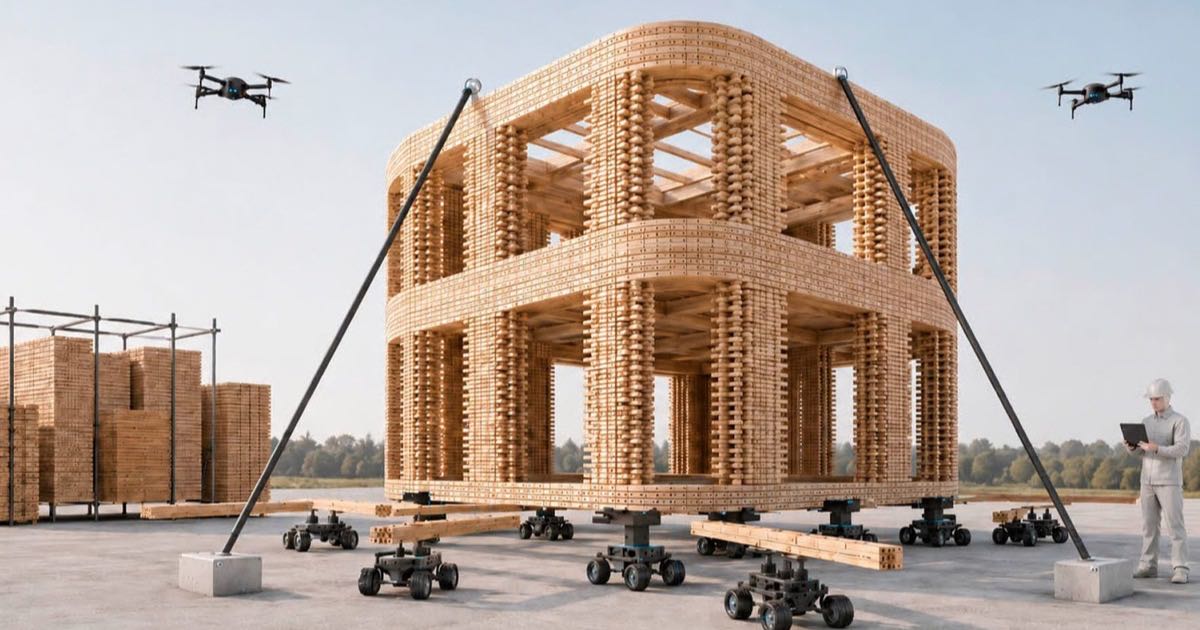
The idea inverts the normal sequencing of a build. Ground-based robotic assemblers and lifting units start by putting together the uppermost level of a structure while it sits on the ground. Machines then lift the finished level to make room for the one beneath, and the cycle repeats. Drones fly overhead, monitoring progress and flagging problems.
Layer by layer, the building rises — from the top, downward.
Foster + Partners says the robots share information continuously so they can adapt and operate safely without constant human supervision. The three-year project ends with a full-scale demonstration: autonomous robots building a timber pavilion designed for disassembly.
That last detail matters. The pavilion is a research object, not a commercial building, and it’s worth being clear about that. A €4 million Pathfinder grant is an exploratory bet — the same programme funds things like synthetic biology and quantum sensing. Nobody is dispatching robotic swarms to a New Zealand subdivision next year.
Why It Still Matters
What’s interesting is who’s funding robot swarms to assemble timber, and why. Timber modular construction is the sustainability hook — Foster + Partners senior partner Irene Gallou tied the project’s “circularity and flexibility” to its agenda. But there’s a labour story underneath: Europe faces a well-documented construction skills shortage, and the consortium is explicitly building a system that needs less constant human intervention, not more.
NZ readers will recognise the pattern. Our construction sector has its own productivity problem, and the standard answer — pre-fab and modular — is exactly the manufacturing approach SWIFT-Build automates. If a robot swarm can assemble a modular timber building like LEGO, the same logic eventually applies to prefab factories here. That’s a decade away, at best. Still, the direction of travel is clear: SoftBank recently put $200 million behind Gravis Robotics, which retrofits excavators with autonomous AI, and the ABB “mobile robotic factory” was deployed for modular housing after the LA wildfires. Construction robotics is no longer a fringe.
What sets SWIFT-Build apart is the top-down assembly method. It’s an elegant reversal — build the roof on the ground where gravity works in your favour, then grow the building beneath it. Whether that idea survives contact with wind, weather, and a real building code is the honest question.
❓ FAQ
What does SWIFT-Build stand for? Swarm-based Inverted Fabrication for Timber Buildings.
How much funding did it get and from whom? A €4 million, three-year grant from the European Innovation Council’s Pathfinder programme. Foster + Partners is the industry partner; the consortium includes the universities of Bristol, Birmingham, Southern Denmark, Pisa, TU Delft, TU Munich, and LMU Munich.
When will we see it in action? The project runs three years and ends with a full-scale demonstration: robots autonomously constructing a disassemblable timber pavilion.
Is this relevant to New Zealand? Indirectly. NZ’s construction productivity push leans on prefab and modular timber — the same building method SWIFT-Build aims to automate. But applications here are years out, and the demonstration is a pavilion, not a house.
— CJ Murden, editor of Singularity.Kiwi. Former digital technologies teacher, author of AI-focused books. Writing with a New Zealand focus.
📰 Sources
- Dezeen — Foster + Partners unveils plans for autonomous robot construction project
- E&T (Institution of Engineering and Technology) — Robot swarms to construct timber buildings from the top down
- European Innovation Council — Pathfinder funding programme
- Foster + Partners — official project descriptions (fosterandpartners.com)