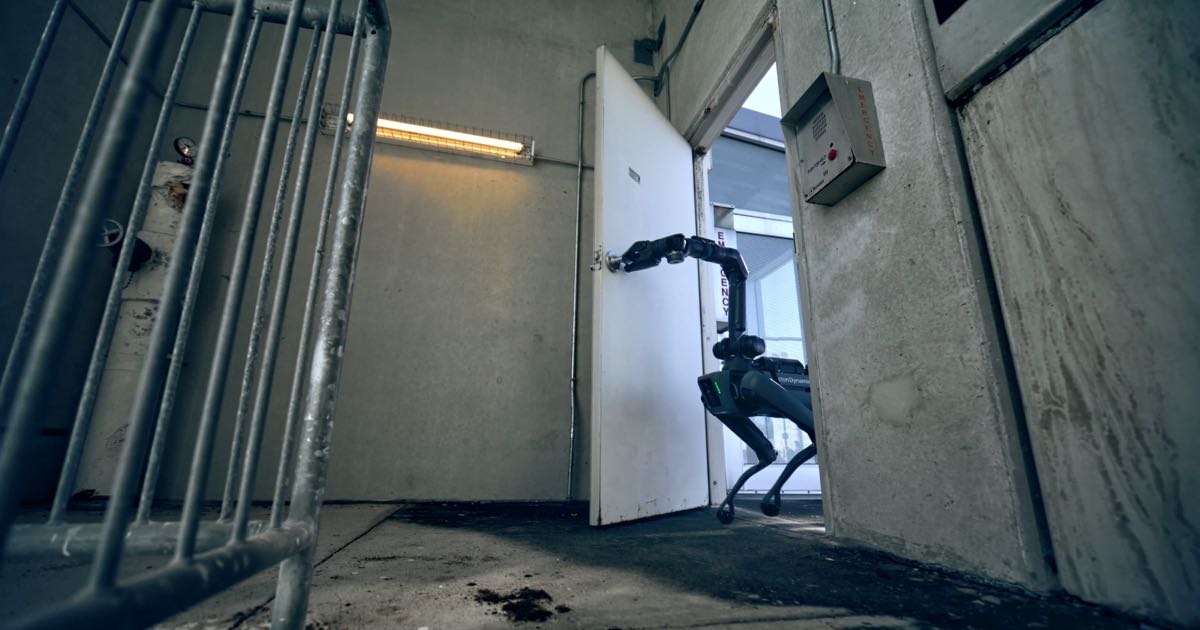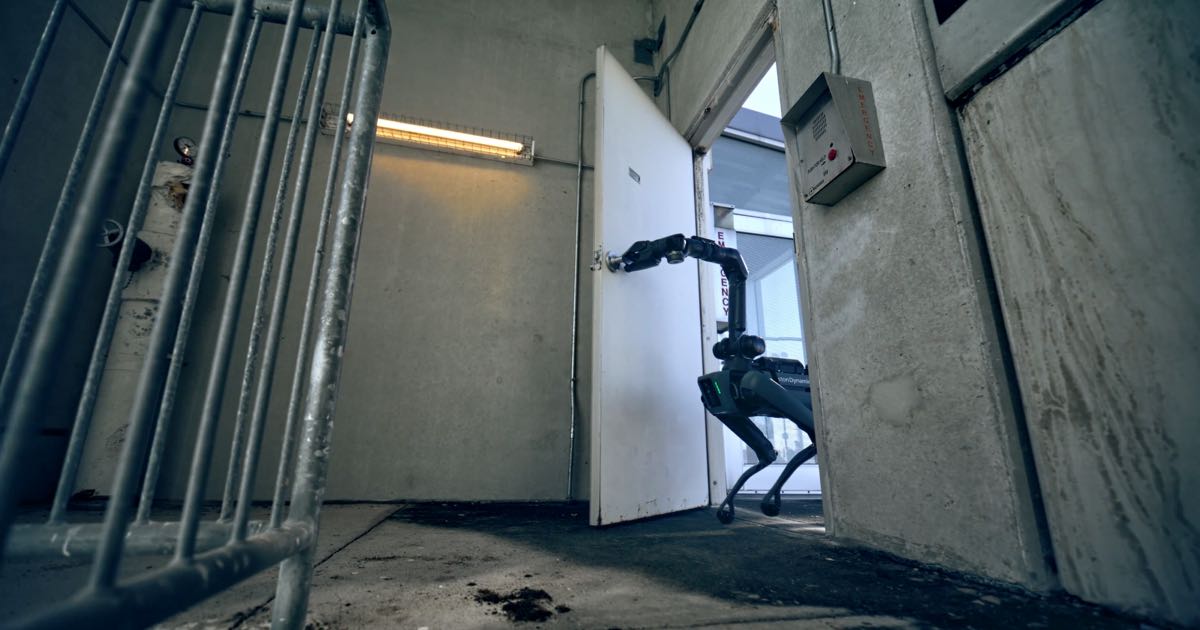
US Immigration and Customs Enforcement plans to spend between $1 million and $2 million on Boston Dynamics’ Spot quadruped robots, according to 404 Media reporting on a Department of Homeland Security announcement published August 28, 2026. The stated purpose is not enforcement at all — at least on paper. DHS describes Spot as a remotely operated tool for inspection, situational awareness and hazard assessment, intended to “improve officer safety” and support decisions in “dangerous, confined, unstable, or difficult-to-access areas.”
That framing is worth taking seriously, because it matches what Spot is genuinely good at. The robot has found steady work checking for hazardous gases, inspecting unexploded ordnance, examining suspicious packages and assessing structures after fires. It’s a camera and sensor platform with legs; it can open doors with an add-on arm and pick up objects. Sending a $75,000 robot down a potentially unstable stairwell instead of a person is a defensible use case, and it’s the one Boston Dynamics itself emphasises when it sells to public-safety agencies.
The tension — and there is one — is that deployment context changes public tolerance dramatically. The same robot that inspects gas leaks comfortably becomes something very different in the public eye when its operator is an immigration enforcement agency during a period of rising deportation arrests, as NBC News framed the purchase. Precedents cut both ways: the LAPD used Spot to retrieve two imitation firearms, while the NYPD cancelled its Spot contract in 2021 after public backlash over how the robot looked patrolling public housing.
What’s notable is how thin the line is between the safety framing and the operational reality. A robot that can gather 360-degree video, open doors and handle objects “before sending personnel inside,” as one summary of the buy put it, is a tool that extends how far an agency can project its presence. Whether that’s officer safety or presence expansion depends on the incident — and the same hardware serves both.
Boston Dynamics has its own stated boundary: the company has said Spot is not designed or intended for weaponisation or intimidation, and it has terms requiring customers not to use its robots to physically harm or intimidate people. A $1–2 million inspection buy by a civilian enforcement agency sits within those terms. But the purchase also lands in a US market where, earlier this month, officials were reportedly weighing restrictions on imported humanoid robots — meaning domestic industrial robots like Spot are the ones positioned to take government work.
One more detail worth flagging from the same reporting: this wasn’t ICE’s only tech buy this week. Procurement records showed the agency contracting for 6,000 pairs of electric shock gloves at $16.7 million, per the Associated Press. The Spot purchase is small by comparison — and yet robots attract outsized attention precisely because people read them as a signal of what enforcement will look like, not just what tools it uses.
There’s no allegation of misuse here, and this piece isn’t making one. It is a procurement notice for inspection robots with a safety rationale, from an agency whose operations are contested. Whether quadrupeds in US enforcement work normalises the technology or triggers the NYPD-style backlash again is the thing to watch through 2027.
— CJ Murden, editor of Singularity.Kiwi. Former digital technologies teacher, author of AI-focused books. Writing with a New Zealand focus.