When David Heinemeier Hansson — the creator of Ruby on Rails, the man who built 37signals into a bootstrapped empire and wrote the book on remote work (twice) — announces that his hobby Linux desktop is getting $10 million in backing, it’s worth paying attention. Not because the money is large by tech standards, but because of who’s writing the cheques and what they’re betting on.
This month, DHH incorporated the Omacom Foundation, a nonprofit that will hold the Omarchy trademarks, fund its infrastructure and support the open-source projects it depends on. Eight Founding Patrons are each contributing $1 million: Tobi Lütke (Shopify), Patrick Collison (Stripe), Michael Dell (Dell Technologies), Jack Dorsey (Block), Matthew Prince (Cloudflare), Brendan Iribe (Oculus/Sesame), Jason Fried (37signals) — and DHH himself.
“We’re going to make the prophecy of The Year of Linux on the Desktop come true,” DHH wrote in the announcement. “All the pieces are now in place. Time to go all in.”
What Omarchy actually is
Omarchy is an opinionated Arch Linux distribution: the Hyprland tiling window manager, a curated set of developer tools, and a distinctive aesthetic, all configured to work together out of the box. It is not a beginner’s Linux in the Ubuntu sense — Arch underneath means rolling releases and occasional friction — but it removes most of theArch setup pain by shipping a complete, opinionated desktop that just works the way its author thinks a computer should.
What makes it a 2026 story rather than a 2006 one is the AI layer. Omarchy treats AI coding agents like Claude Code as first-class desktop citizens — terminal-first, keyboard-driven, integrated into the daily workflow rather than bolted on as a chat bubble. It’s a desktop designed for people whose primary collaborator is now a machine. That’s not a philosophical stance; it’s a bet about how software gets written from here on, and Lütke — whose Shopify internal policy essentially assumes AI-first work — putting personal money behind it tells you which way the wind blows among people who run engineering organisations.
We tried it on a 2015 MacBook
The real test for us wasn’t a spec sheet. It was a 2015 MacBook Pro that had spent recent years as a drawer-dweller: official macOS support long gone, battery average, perfectly good screen and keyboard going to waste.
Omarchy installed cleanly on it. Not “ran adequately” — ran well. The tiling desktop is fluid, battery life is respectable, and the machine that macOS had written off handles a modern development workflow, browsers, and terminal AI agents without breaking a sweat. This is the quiet environmental story inside the louder funding story: a decade-old Mac, which Apple’s upgrade treadmill had declared dead, becomes a fully useful computer again. In a country that ships more than its share of e-waste offshore, reviving hardware you already own beats recycling it.
An honest caveat for anyone tempted: the keyboard shortcuts are a genuine hump for a newcomer. Tiling window managers live on key combinations — Super-key chords for moving windows, splitting panes, switching workspaces — and muscle memory built on a Mac takes days, not minutes, to remap. The first evening is humbling. By day three it clicks, and by day five you stop reaching for the mouse. But if you’re new to Linux, budget the weekend and keep the manual open.
Why this matters beyond the desktop
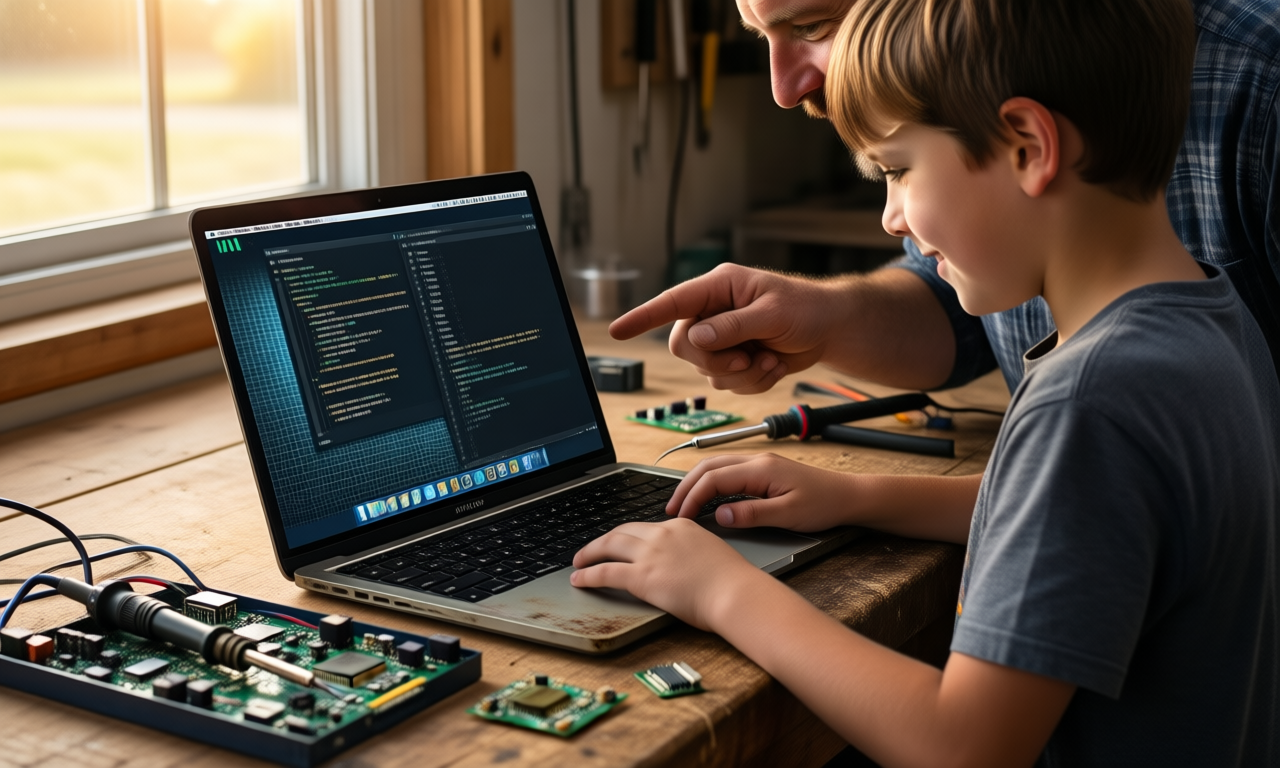
The reason we’re covering a Linux distribution on an AI-and-robotics site is that this kind of system changes the economics of tinkering. Learning to program microcontrollers, flash firmware, or drive serial buses requires a computer — but it doesn’t require a new computer. An $8 ESP32 development board paired with a revived 2015 laptop is a complete AI-era lab, and the barrier between “curious” and “building real things” is now a free download.
We’re exploring more of that territory here at Singularity.Kiwi in the months ahead — smaller-scale, hands-on projects alongside the industry coverage — and Omarchy-style systems are a big part of why that’s now practical on hardware most households already own.
The Year of Linux on the Desktop has been a running joke for twenty years. It may not arrive the way anyone predicted — not through corporate deployments or market share charts, but through a million drawer-dwelling laptops quietly coming back to life as the machines people build the future on.
— CJ Murden, editor of Singularity.Kiwi. Former digital technologies teacher, author of AI-focused books. Writing with a New Zealand focus.