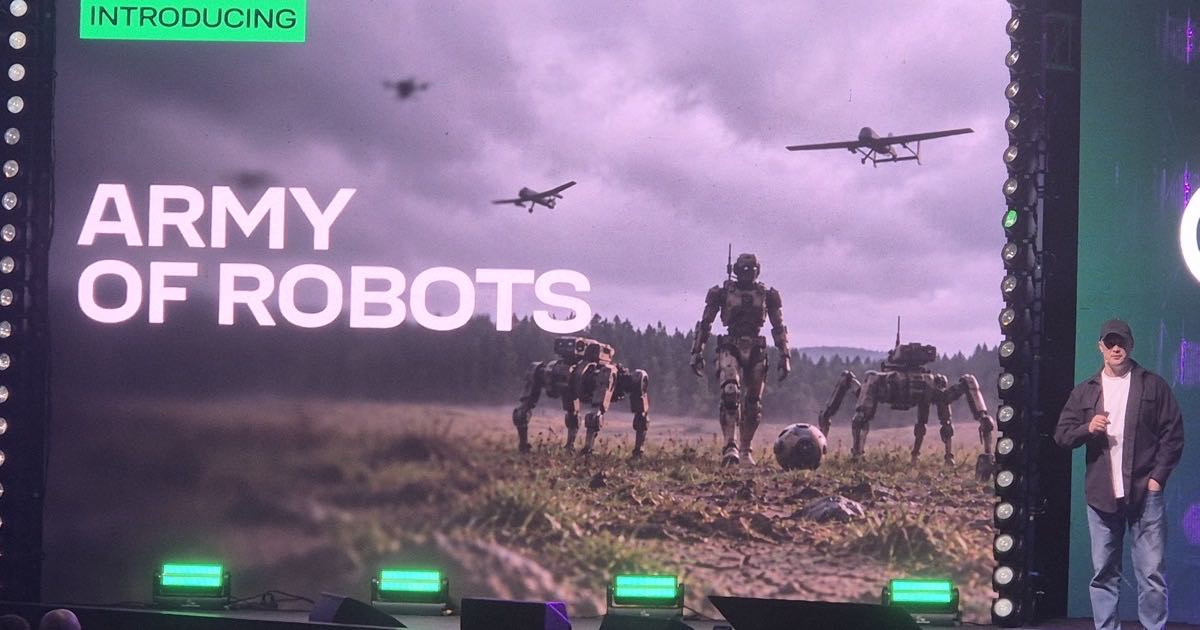
For three years, Ukraine’s battlefield-technology story has been an air story. Mykhailo Fedorov, the country’s former defence minister and the politician most identified with its drone buildout, now wants to give it a ground component. In a social media post reported by Interesting Engineering and detailed by LIGA.net, Fedorov has unveiled an initiative called the “Army of Robots” — a plan to move the same rapid-iteration model that produced Ukraine’s drone industry into humanoid and ground robotics, taking over frontline tasks he argues should no longer be done by people at all.
The framing will be familiar to anyone who followed the Army of Drones. Fedorov describes the robot programme as the “next stage” of the same approach: an ecosystem rather than a single company, combining private defence-tech firms, investment, R&D capability and military testing, scaling “as quickly as possible whatever proves effective on the battlefield.” Where the drone push produced more than 700 UAV manufacturers — and, by Fedorov’s count, more than 95 percent of Ukraine’s strikes — the goal now is to replicate that experiment-driven production culture in physical AI and autonomous ground systems.
What the robots are being asked to do
The task list is more logistics than terminator, at least on paper. Per LIGA.net’s reporting, the aim is to replace humans on “the most dangerous tasks on the front lines”: reloading weapons, swapping batteries, installing sensors, delivering ammunition, evacuating wounded personnel, laying and clearing mines, reconnaissance and position defence. The concept explicitly reaches beyond the wheeled and tracked unmanned ground vehicles already working near Ukrainian trenches — Fedorov wants humanoid robots in the mix, operating alongside drones through shared software.
Then there is the target that has drawn the headlines. According to Ukrainska Pravda’s report, cited by Interesting Engineering, the programme’s first objective is for a humanoid robot to kill a Russian soldier within six months of launch, with a first combined robots-and-drones operation targeted inside the first year. Lethal autonomy would not be arriving in a vacuum — the first reported autonomous drone kill already put machines in the lethal decision loop earlier this year — but a humanoid chassis is new ground. The claim carries a strong caveat at source: Ukrainska Pravda’s own page was inaccessible to us at publication (its reporting reached us via IE’s citation), and it is a stated ambition by a political entrepreneur rather than a capability demonstration. But even as aspiration, it marks a shift — from “robots that carry things” to “robots that shoot people” as an explicitly stated, dated objective.
The context behind the announcement
Fedorov’s position matters for reading this. He left the defence portfolio earlier this year and has since announced a private defence-technology company with Palantir chief executive Alex Karp as its first major backer, alongside a Kyiv-based venture fund for Ukrainian defence startups. The Army of Robots is the connective tissue between that private venture and the military-testing ecosystem he built in government — a pipeline that starts at his own firm and ends at the front line. His own words in the announcement post frame the urgency: Russia “has learned to rapidly copy and scale military technologies,” he wrote, so “we must constantly create the next technology cycle before the enemy does.”
Russian and pro-Russian outlets have taken notice too — TopWar’s English edition covered the announcement within hours, a small sign of how closely Moscow watches Ukrainian defence-tech signalling.
The gap between the target and the hardware
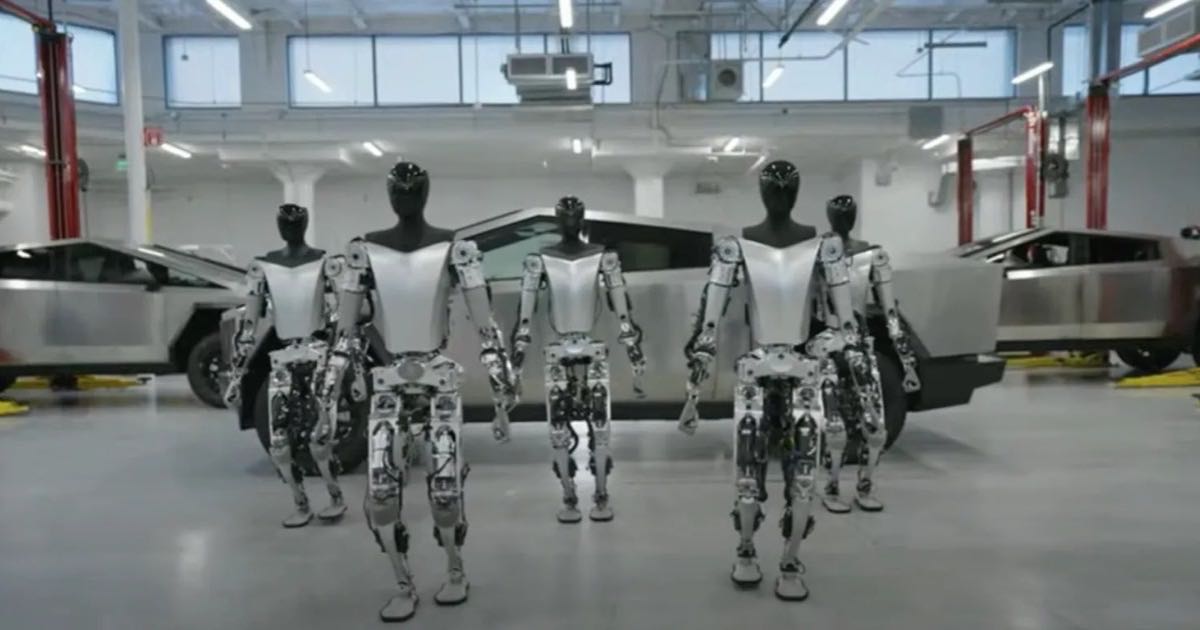
China has talked about humanoid soldiers on a five-to-ten-year horizon. Fedorov’s timetable compresses that to months, and the gap between those two claims is where the scepticism lives. Commercial humanoids — Tesla’s Optimus, Figure’s machines, Unitree’s platforms — still struggle with unstructured warehouse work, as our second story today, on Optimus’s generalisation wall, underlines. Reloading a weapon under artillery fire, dragging a wounded soldier off a position, or conducting a combat patrol are harder by orders of magnitude: adversarial environments, degraded communications, mud, shrapnel and an enemy actively trying to break the machine.
Two readings fit the facts, and both are worth holding. The charitable one: the six-month target is a recruiting pitch — deliberately aggressive language aimed at pulling engineers, companies and investors into an ecosystem that Fedorov admits is at an early stage, with actual fielding measured in years. The darker one: “humanoid robot” in Ukrainian service will initially mean something narrower than the Boston Dynamics image — teleoperated or heavily supervised machines with autonomy bolted onto specific tasks, where the human is a radio link away rather than absent. Neither reading requires the headline number to be true for the programme to matter. The drone war started the same way, with improvised machines doing narrow jobs until the narrow jobs compounded into something strategic.
The rules vacuum this lands in
The deeper story is regulatory. Autonomous weapons have been debated at the UN’s Convention on Certain Conventional Weapons for a decade without producing a binding instrument, and battlefield robots have so far meant rovers that drive supplies forward — not machines that decide to use a weapon. A stated national objective to put lethal autonomy in a humanoid chassis within months stresses that vacuum in a new way: the debate has mostly assumed air and loitering munitions, where the human makes the final engagement decision at the end of a video link. A humanoid combatant raises the harder question of what the human’s role is when the machine is walking the trench instead of flying over it.
New Zealand sits far from this battlefield but inside the same argument. This country has backed calls for binding rules on autonomous weapons at the UN, has no combat troops in Ukraine, and its defence-industrial ambitions run to surveillance and maritime technology rather than lethal autonomy. The relevant lesson for Wellington is not about Ukraine at all — it is that the technology-over-match iteration loop Fedorov is formalising is now a template any mid-sized country’s defence establishment can study, and the international rules governing what those systems may do are being written, in effect, by whoever fields them first.
What we still don’t know
No hardware partners are named. No funding figures are attached beyond the venture structures already reported. No timeline exists beyond the two headline targets, and no prototype has been shown doing any of the listed tasks. As of publication, the six-month objective has not been independently reported beyond Ukrainska Pravda’s original report and the outlets citing it. What is verifiable is the ecosystem pitch and the political intent behind it — and after the Army of Drones, nobody should assume that intent translates into nothing.