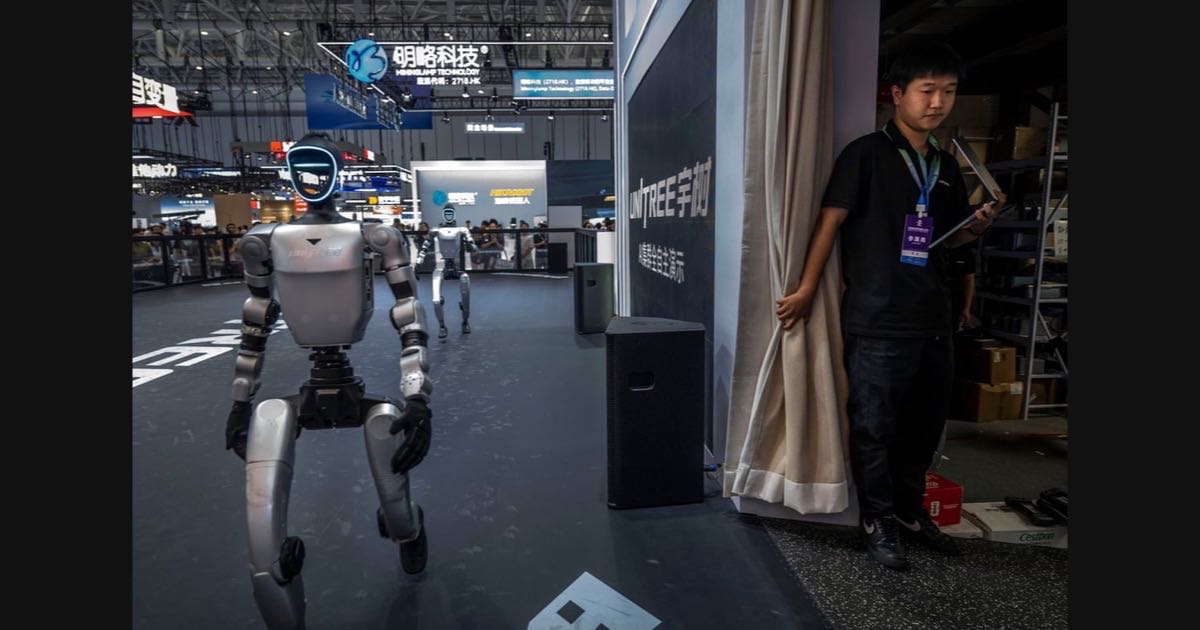
How long before humanoid robots carry weapons? At the World Humanoid Robot Games in Beijing, a Shanghai-based robotics engineer gave CBS News a surprisingly specific answer: five to ten years.
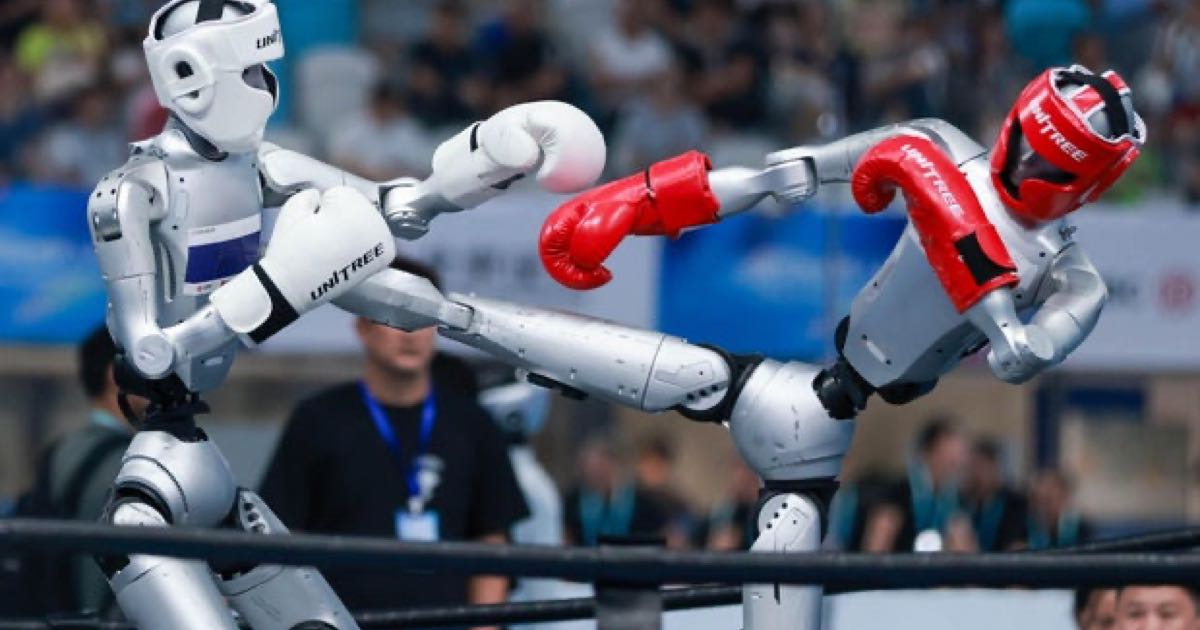
Yang Kun, who works for AG BOT and developed the “A3” humanoid that competed in kickboxing at the games, told CBS that building robot soldiers is “what we really want to do.” His framing was deterrence, not aggression: “We will use the robots to show the power of a country like China that will ensure no other country would attack. This will prevent war.”
When CBS asked whether robots could become dangerous — the Terminator comparison — Yang shook his head. “Robots don’t have emotion, only humans. It all depends on who controls them and who makes them.”
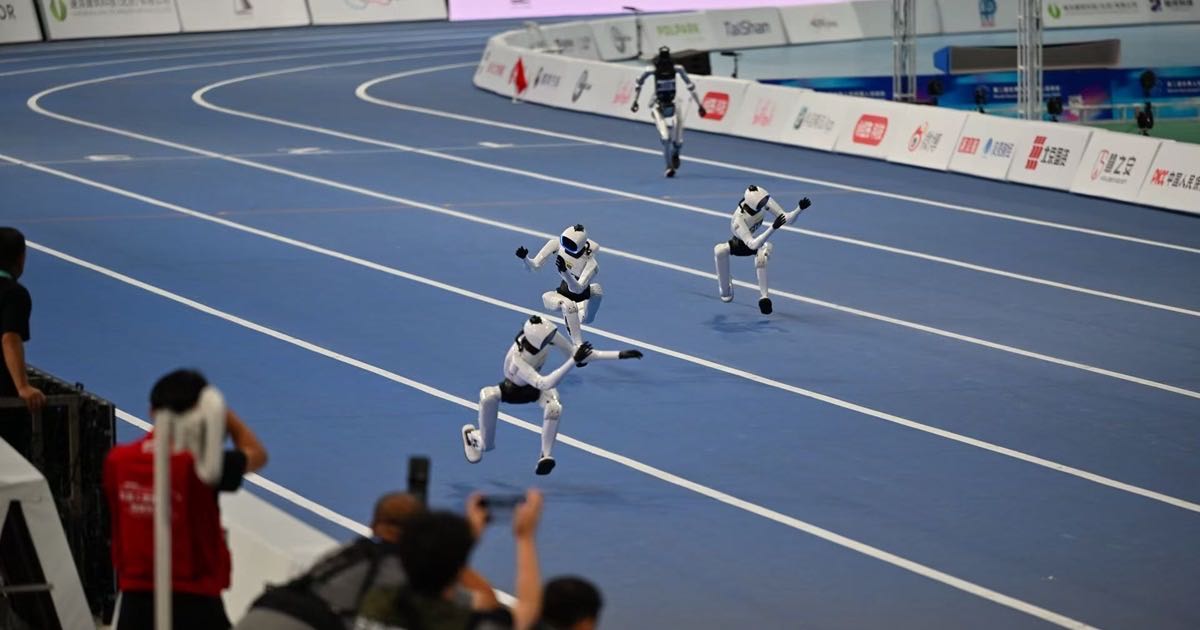
The interview aired on 24 August, day three of the five-day competition at Beijing’s National Speed Skating Oval, where more than 2,000 robots from 600 teams across 16 countries competed in sprinting, kickboxing, gymnastics, soccer, and household tasks. The games have generated viral footage of robots breaking Usain Bolt’s 100-metre record and, less flatteringly, crashing into barriers and catching fire at the finish line.
What the Games Actually Showed
The athletic feats at the World Humanoid Robot Games are real but narrow. A robot beat Bolt’s 100-metre record by running in a straight line on a flat track — and then couldn’t stop, slamming into safety barriers. As Ars Technica reported, the running robots were engineered for one task only. Some companies brought different robots for different events, each optimised for a single competition.
Dipam Patel, a PhD candidate at Purdue University and research assistant at the US Army DevCom Army Research Lab, told Ars that the games demonstrate “significant progress in robotic whole-body control” but stressed the machines are “still very far from general-purpose autonomous robots.” The household task events — washing laundry, hanging clothes — showed robots lagging well behind typical human working speeds.
That gap matters for the soldier question. Sprinting in a straight line is not clearing a building. Kickboxing in a controlled ring is not navigating rubble. The physical capabilities on display in Beijing are impressive, but they’re single-task demonstrations, not the kind of adaptable autonomy that military deployment would require.
The Policy Vacuum
Yang’s timeline — five to ten years — is plausible for the hardware side. China’s humanoid robotics industry shipped roughly 19,100 units in the first half of 2026, up 272 per cent year-over-year. Companies like Unitree just went public at a $53 billion valuation. The Trump administration banned sales of new foreign-made robotics in July, citing national security concerns.
What’s missing is any international framework for autonomous weapons that includes humanoid robots. The existing debate around lethal autonomous weapons systems (LAWS) at the United Nations has stalled for years. It focuses on drones and automated targeting systems, not bipedal robots that look like people and can punch each other in a ring. The World Humanoid Robot Games just demonstrated that the hardware is advancing faster than the policy conversation about what it should be allowed to do.
Yang’s claim that robots “don’t have emotion” and that safety depends on who controls them is technically accurate but sidesteps the harder question: what happens when control is distributed, automated, or delegated to AI systems that make targeting decisions faster than humans can intervene? That’s not a hypothetical. It’s already the active debate in drone warfare.
China’s Strategic Positioning
The games themselves are part of China’s broader push to dominate humanoid robotics. President Xi Jinping has made AI and robotics a national priority, and the event — hosted by Chinese state media and the Beijing city government — was as much a trade showcase as a competition. The World Robot Conference ran concurrently, with 300-plus companies demonstrating robots for real-world tasks.
CBS noted that Chinese officials see the games as proof that Beijing’s investment in humanoid R&D is paying off. Whether that extends to military applications in five to ten years depends on factors Yang didn’t address: reliability under adversarial conditions, energy autonomy in the field, secure communications, and the political decision to deploy — all of which are harder than running fast in a straight line.
❓ FAQ
What did the Chinese robotics engineer tell CBS News? Yang Kun, a robotics engineer at Shanghai-based AG BOT, told CBS News that humanoid robot soldiers are likely five to ten years away. He said building them is “what we really want to do” and framed the goal as deterrence.
Were the robots at the Beijing games military-ready? No. The robots demonstrated impressive but narrow athletic capabilities — sprinting, kickboxing, gymnastics — in controlled environments. Most were engineered for single tasks and could not adapt to new situations. Household task events showed robots struggling with basic chores.
Is there an international policy on autonomous weapons? The United Nations has debated lethal autonomous weapons systems for years, but no binding international framework exists. Current discussions focus on drones and automated targeting, not humanoid robots specifically.
How is China’s humanoid robotics industry performing? Chinese companies shipped approximately 19,100 humanoid robots in the first half of 2026, up 272 per cent year-over-year. Unitree Robotics recently went public at a $53 billion valuation, and the Chinese government has made AI and robotics a national priority.