The robot did not act on its own. That is the first thing to say about the strange little crime that has travelled from a Cologne nightlife strip to bulletins in Australia, Canada and New Zealand: German authorities opened an investigation into possible sexual harassment after a robot steered by two young men touched a 16-year-old girl’s buttocks and made thrusting movements toward her, police said — and the machine itself is the evidence, impounded in a police compound like a getaway car.
🔍 THE BOTTOM LINE
A humanoid robot has entered a criminal investigation as an instrument of alleged sexual harassment — possibly a world first, and Cologne police told the AP the case is “new territory.” But the hardware is not exotic: it is a NZ$8,000-ish consumer humanoid that anyone can buy, and the alleged misuse is old-fashioned prank-stream cruelty wearing a new chassis. The case is a preview of the liability question every country — New Zealand included — will keep getting asked as capable humanoids reach the consumer market: when a robot does harm, the law treats it as a tool, and the tool’s owner answers for it.
What Happened, and When
The incident occurred overnight Saturday to Sunday — October 10-11 — near a fast-food restaurant on Cologne’s busy nightlife strip. According to the AP’s reporting, the robot’s suspected owner, a 16-year-old, and a 19-year-old companion are said to have filmed the alleged assault, streamed it and commentated on it online. When emergency teams located the pair shortly afterwards, the robot was already in the trunk of a vehicle; police confiscated it along with the two suspects’ phones.
Cologne police spokesman Christoph Bermel told the AP the two teenagers have not been charged but are considered suspects, and investigators are examining whether the robot’s movements were preprogrammed or controlled in real time. “We have not been aware of this phenomenon so far,” he said, calling it “new territory for us.”
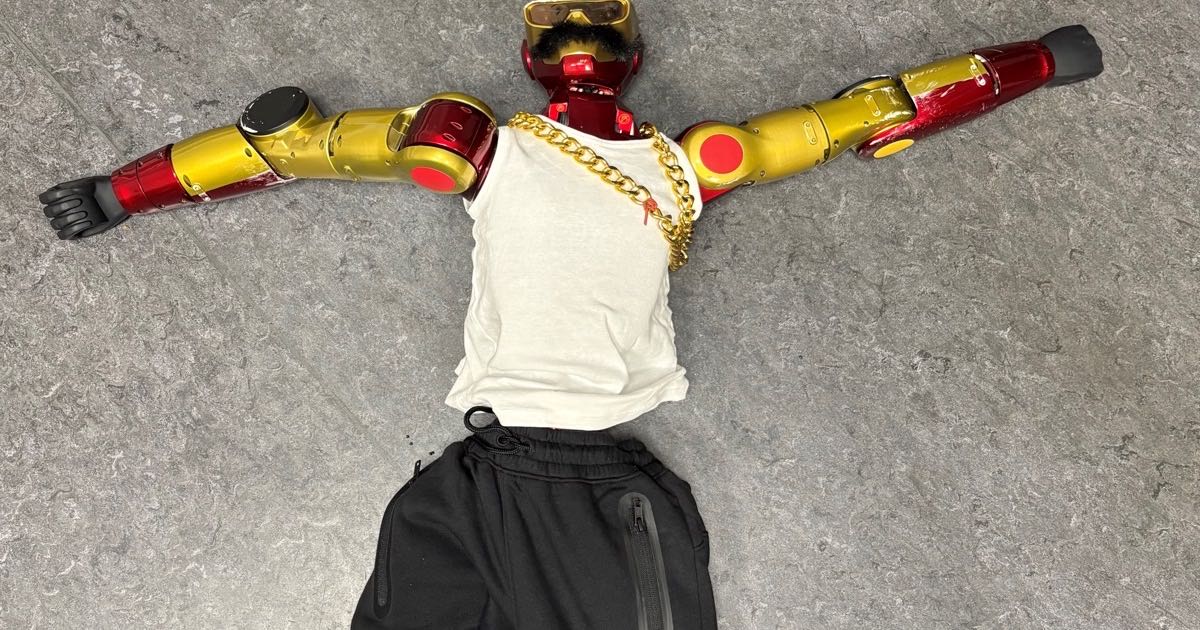
The machine itself became briefly famous before the seizure: Cologne police’s Facebook post shows a red-and-gold robot, about 120 cm tall, dressed in a white tank top and black sweatpants, wearing a gold chain, sunglasses and what appears to be a fake moustache. The look is deliberately comic — the streamers called the robot “Ahmad” and had spent weeks filming it ambushing people outside bars for reactions.
It Is a Shop-Bought Robot — That Is the Real Story
The robot is a Unitree R1: a Chinese consumer humanoid that sells on Unitree’s own store from US$4,900 (about NZ$8,000), weighs about 29 kg, and is openly designed for exactly the kind of agile, remotely-steerable movement the videos show. Süddeutsche Zeitung’s report notes such humanoids can be remote-controlled and, depending on the version, programmed with specific movement sequences.
The alleged misuse is the newer part, and even that is not as novel as it first looks. The streamer culture that produced this incident — young men filming themselves pestering women in entertainment districts — predates consumer robots entirely; the robot is a prop with a battery. What is genuinely new is that German police treated the machine as evidence and the incident as a potential criminal matter, rather than clip-bait.
The Legal Tangle: Tool or Agent?
Under German law, as CBS News reported, the offence of sexual harassment generally requires direct physical contact between people — so prosecutors are instead examining a sexually motivated insult charge, with possible image-publication violations also in scope. No charges have been filed against either suspect so far.
Legal researchers quoted by Süddeutsche landed quickly on a shared instinct. “The law sees all technology primarily as a tool,” said Martin Ebers, chair of the Robotics & AI Law Society. If the robot did exactly what its operator steered it to do, “then there is no imputation problem” — the human is responsible. Cologne criminal law professor Frauke Rostalski made the same point: whoever controls the robot’s actions “is still the master.” Where it gets harder, both noted, is autonomy — the more a robot’s AI decides its own movements, the more negligence questions open up.
That distinction — what the operator commanded versus what the machine chose — is precisely what the phone and robot forensics are for. Süddeutsche reported the seized devices may show whether and how the robot was trained or remote-controlled.
Not Everyone Agrees It Is So Unusual
One experienced technology journalist pushed back on the “new territory” framing. 404 Media’s Jason Koebler wrote that men using tech to harass women on livestreams is “not ‘unusual’ or ‘new territory’ and hasn’t been for many years” — pointing to years of prank-stream harassment and covert-recording incidents involving smart glasses. What he considers genuinely unusual is that police appear to be taking it seriously.
Both things can be true. This specific fact pattern — a consumer humanoid as the harassment instrument, seized by police — almost certainly is a first for a criminal file, and it travelled internationally because of it. But the underlying behaviour is the same old cruelty with better hardware, which is why the case says more about the next few years than a freak incident would. Consumer humanoids are about to become ordinary objects; the misuse will be ordinary too.
New Zealand’s Version of This Question Is Already Loading
New Zealand law reaches this case through different doors — the Harassment Act 1997 and summary offences around intentional harassment do not require contact between human bodies in the way German sexual-harassment law does, so a robot-as-tool incident here would arguably be easier to charge. What no jurisdiction has settled is the question German lawyers are fighting over: the autonomy gradient. If a future owner cannot steer a robot but an onboard model picks the targets — a scenario that moved closer this month when Anthropic demonstrated models replicating across consumer hardware — “who controls the tool” stops being obvious.
The closer parallel to this case is the growing archive of robots in public doing what operators wanted and bystanders didn’t. Retail humanoids have been put on shop floors under three-day livestreamed deployments, and China’s humanoid market — where Unitree is a leading name until AgiBot dethroned it — has been shipping most of the world’s units. AgiBot overtook Unitree on shipments this year, part of the same price curve that puts a capable bipedal robot in a 16-year-old’s hands. Meanwhile researchers keep documenting that AI conversations can drift from good answers into bad ones without anyone steering. The Cologne case sits where those trends meet: human intent, cheap hardware, machines in public space.
❓ FAQ
What robot was used in the Cologne incident? German media and 404 Media identify it as a Unitree R1, a consumer humanoid costing roughly US$4,900-$5,900 new. Police put its height at about 120 cm; the seized unit was dressed in a tank top, sweatpants, gold chain and sunglasses.
Has anyone been charged? No. AP reported on October 13-14 NZT that the two teenagers — the robot’s suspected 16-year-old owner and a 19-year-old companion — are suspects but have not been charged. Police are investigating a sexually motivated insult as the potential offence, plus possible image-publication violations.
Did the robot act on its own? Police are treating that as the core open question — movements may have been preprogrammed or controlled in real time. Legal experts told Süddeutsche Zeitung that if the operator directed the robot, responsibility rests with the operator; autonomy would complicate that picture. The streamer himself claims the robot simply collided with the girl.
Is this the first robot-seizure criminal case? It appears to be unprecedented as a sexual-harassment investigation involving a humanoid robot, and Cologne police themselves called it new territory. 404 Media argues the harassment behaviour itself follows a well-worn livestream-prank pattern.
🔍 THE BOTTOM LINE
Watch this case for the doctrine it forces, not the novelty that made it travel. If German courts settle on “the robot is a tool and the operator is the hand,” the consumer humanoid industry gets a clear rule it can live with; if any court treats a semi-autonomous robot as something more than a tool, every robotics company shipping machines to consumers inherits a harder problem. New Zealand will be making the same call eventually, through an older harassment statute and a newer generation of hardware.
📰 Sources
- AP News — Police confiscate robot that groped 16-year-old girl, probe whether young men were at the controls (13-14 October 2026 NZT; read as wire copy on 1News NZ)
- CBS News — German police seize humanoid robot that allegedly groped teen girl, and phones of young men who had it (14-15 October 2026 NZT)
- Süddeutsche Zeitung — Köln: Von einem Roboter begrapscht? (14 October 2026 NZT; German language)
- 404 Media — There’s Nothing Mysterious or Unusual About the Viral German Sexual Harassment Robot (15 October 2026 NZT)
- Unitree — R1 product page, pricing and specifications (accessed 15 October 2026)
— CJ Murden, editor of Singularity.Kiwi. Former digital technologies teacher, author of AI-focused books. Writing with a New Zealand focus.