A 14-second video went viral on X this week: a line of metallic-silver humanoid robots riding electric scooters through Broadway and Prince Street in Manhattan, wearing the branded bags of DoorDash, Uber Eats, Domino’s, UPS and DHL. The caption ran to the familiar register — 2.1 million delivery drivers watching their replacement roll past, tourists clapping, “which side of the sidewalk are you on?” It collected 1,600 likes in a day.
It is AI-generated. We pulled the video and examined the frames: the “Uber Eats” branding smears into overlapping letters, the scooter logo renders as reversed gibberish, the robots’ legs float off the decks in postures no real machine holds, one figure’s arm merges into its delivery box. The chrome-humanoid-on-a-scooter aesthetic is precisely what current video models produce when asked for “robots.” No company named in the video operates a humanoid scooter rider anywhere on Earth. Snopes debunked an identical genre fake last month — an AI clip of an “Amazon delivery robot” driving off a pier.
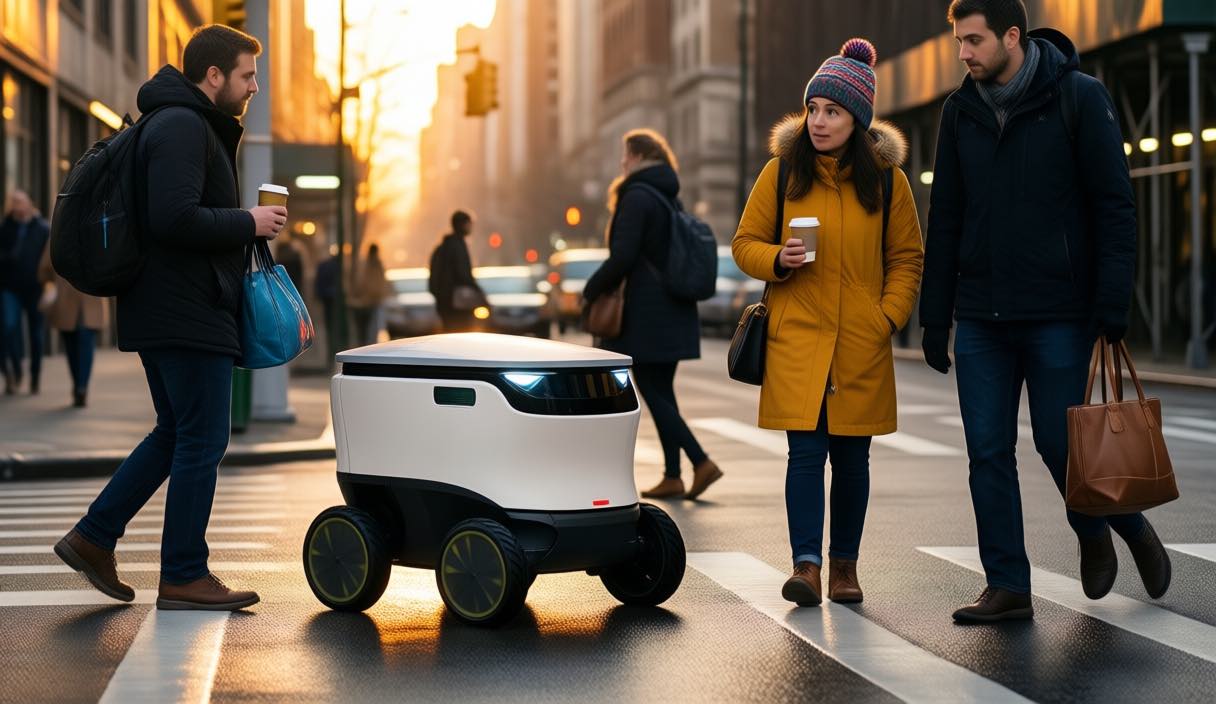
The video is fake. Here is the part that should hold your attention: the future it fakes is closer than most people think — and it is already operating, at scale, on sidewalks most readers walk past without noticing. It just doesn’t look like iRobot. It looks like a cooler on six wheels.
🔍 THE BOTTOM LINE
Autonomous delivery passed its proof-of-concept phase years ago and is now in its scale-up phase. Starship Technologies — the fleet leader — passed 10 million autonomous deliveries in April 2026, with 3,000+ robots across 300+ locations in eight countries, 22 million autonomous kilometres driven, and about 125,000 road crossings per day — roughly two per second — at Level 4 autonomy without active supervision. In the past month alone: DoorDash announced a US partnership with Serve Robotics (which already completes Uber Eats orders in five cities and is targeting 2,000 bots), DoorDash’s in-house robot “Dot” was unveiled, and Hoboken, New Jersey launched a 12-month municipal pilot serving Uber Eats, DoorDash and Grubhub simultaneously. The sci-fi version — humanoid machines dashing through city canyons — is what fakes show us. The real version is quieter, boxier, and further along than the fake implies. Asimov’s New York of robots weaving through crowds is arriving, but its first citizens are knee-high boxes with lids, and the transition is happening in delivery app updates rather than film premieres.
The real fleet, by the numbers
Starship’s April 2026 milestone is the anchor fact: 10 million deliveries completed, by a fleet of over 3,000 robots operating commercially in the US, UK, Germany, Finland, Estonia and elsewhere. Its robots have driven 22 million autonomous kilometres and made roughly 200 million road crossings. That is not a pilot. That is infrastructure. The company raised US$50 million in October 2025, bringing total funding past US$280 million, and doubles down on grocery delivery — the highest-frequency, most weather-proof segment — in both EU and US markets.
Serve Robotics, the Uber-linked fleet, already completes orders in five major US cities and is deploying toward a 2,000-robot target. Last week it gained a second headline customer: DoorDash, which also announced its own in-house robot, “Dot” — meaning the largest US delivery platform is pursuing both rented and owned autonomy at once, the same portfolio logic enterprises are applying to AI models themselves.
Transforma Insights projects 4.7 million active urban delivery robots by 2032, a 64% compound annual growth rate. If that curve holds, the delivery robot population goes from tens of thousands today to millions within six years — at which point “a robot made my delivery” stops being a novelty story at all, which is, of course, how every infrastructure transition actually completes.
Why the cities are saying yes
Follow the permits and the pattern is clear. Hoboken’s pilot, launched 3 September, is a 12-month program covering three delivery platforms at once — a municipal government deciding to learn the technology before it arrives uninvited. San Jose moved earlier this year to let delivery robots operate before writing comprehensive rules — a gap we flagged in our August coverage. New Mexico is the current lobbying front: DoorDash wants state-level deployment authority that would pre-empt local robot regulation, and at least one state senator is pushing back on exactly that pre-emption. The governance question — who writes the rules, city or state or company — is now being argued in legislative sessions, not thought experiments.
The appeal for platforms is arithmetic. A sidewalk robot is a one-time capital cost of a few thousand dollars, no wage, no tips, no insurance premiums, no attrition, running errands at 6 km/h on electricity that costs cents. The appeal for cities is quieter: fewer delivery vans blocking kerbs, fewer emissions, deliveries that arrive regardless of labour shortages. The open questions — sidewalk access for wheelchairs and prams, what happens when a blocked robot stops a footpath, who is liable when one clips a toddler’s scooter — are being worked out jurisdiction by jurisdiction, which is exactly why pilots like Hoboken’s matter more than any press release.
The Asimov question: how far is the movie version?
Isaac Asimov’s New York — and the “I, Robot” city of humanoid machines moving through crowds — is the image the fake video borrowed. The honest answer about the gap between that image and reality has two parts.
The part that is genuinely close: autonomous mobile robots in shared urban space, at scale, mixed with pedestrians. That is not speculation — two road crossings per second are already happening in eight countries. The “robots dashing in all directions” city is being built incrementally, sidewalk by sidewalk, and the pace is accelerating: Serve’s fleet doubled its headcount target in a year, Starship’s crossing count compounds daily, and the platform money (Uber, DoorDash, Just Eat, Grubhub) has stopped hedging. Robot.com’s seven-year Sodexo deal — the longest runway in sidewalk delivery — shows the contract horizon extending to years-long infrastructure commitments, not month-to-month pilots. The hospital variant is already routine: Moxi robots deliver medications in American hospitals as part of standard operations, a pattern we covered alongside Serve’s Grubhub expansion.
The part that remains distant: the general-purpose humanoid. A machine that can ride a scooter through Manhattan traffic, climb apartment stairs, carry a week of groceries and pick the right doorbell is a different order of problem — one the humanoid industry is spending billions to close, with real progress on the stairs-and-doors part and nothing deployable at delivery scale. The chrome-and-scooter fantasy compresses a decade-plus of engineering into a render. That compression is precisely what makes the fake video go viral: it shows the endpoint and skips the trajectory.
The trajectory, not the endpoint, is the story. Delivery robots are the first wave of robots that live permanently among us — not in factories behind fences, not in demos behind handlers, but unaccompanied on public footpaths, negotiating with pedestrians, dogs and double-parked cars. Every hard problem that matters for a robot-filled city — right-of-way norms, pedestrian trust, failure behaviour in public, municipal liability — is being solved first, at low speed and low stakes, by six-wheeled coolers. When the humanoids are finally ready for public streets, the rulebook, the norms and the civic muscle memory will already exist, written by the boxes.
The misinformation coda
One more reason to write this piece: the fake video outperformed most of the real news. A 1,037-follower account got 1,600 likes and hundreds of reposts with an AI clip inside a day, while Starship’s 10-million-delivery milestone — an objectively larger story about the same subject — got a press release and a handful of trade write-ups. The economics are now brutal: manufacturing a fake labour panic costs a video-generation subscription; reporting the real deployment data costs a week of verification. The fake wins on reach because it wins on emotion, and the gap widens every month the video models improve.
The defence is unglamorous and works: check whether the machine in the clip matches anything that actually exists, whether the brands’ logos render correctly, whether the physics of the legs make sense. AI video still fails on text, on contact physics and on limb articulation — the three things this clip failed on. And when a fake is this viral, the real numbers are the antidote: no render can make 200 million real road crossings more or less real than they already are.
What this means for New Zealand
New Zealand’s cities are ideal early terrain for this technology — dense walkable centres, mild climate, high delivery costs driven by distance and wages, and a regulatory environment small enough to run a proper pilot without a decade of committee meetings. Auckland and Wellington foot-traffic volumes are comparable to the secondary US and UK cities where Starship and Serve already operate routinely. The question is not whether the technology will be ready; it is whether our city councils will have written sidewalk rules before the platforms arrive to negotiate them individually — the San Jose lesson, and the New Mexico fight, are the cautionary tales. The future almost being here is the one thing the viral video got right. The chrome humanoids were the lie. The boxes are already at the kerb.
❓ FAQ
Was the viral Manhattan robot video real? No. It is AI-generated. The branding is garbled, the robots’ limbs move in physically impossible ways, and none of the named companies operate humanoid scooter-riding delivery robots. Snopes recently debunked a similar AI clip of an “Amazon delivery robot” driving into the ocean.
Are delivery robots actually operating at scale? Yes. Starship Technologies passed 10 million autonomous deliveries in April 2026, with 3,000+ robots in eight countries making around 125,000 road crossings per day. Serve Robotics is expanding toward a 2,000-robot fleet, now serving both Uber Eats and DoorDash.
How far away are humanoid delivery robots? The multi-purpose humanoid that can navigate streets, stairs and doors at delivery scale remains years away. What is arriving first is the environment for them: robots already share sidewalks with pedestrians in eight countries, and the rules being written now will govern the humanoids later.
Could this happen in New Zealand? The conditions are favourable — dense walkable centres, mild weather, high delivery costs. The open question is regulatory readiness: councils that write sidewalk-robot rules before platforms arrive will get better outcomes than those negotiating under pressure, as the San Jose and New Mexico episodes show.
— CJ Murden, editor of Singularity.Kiwi. Former digital technologies teacher, author of AI-focused books. Writing with a New Zealand focus.