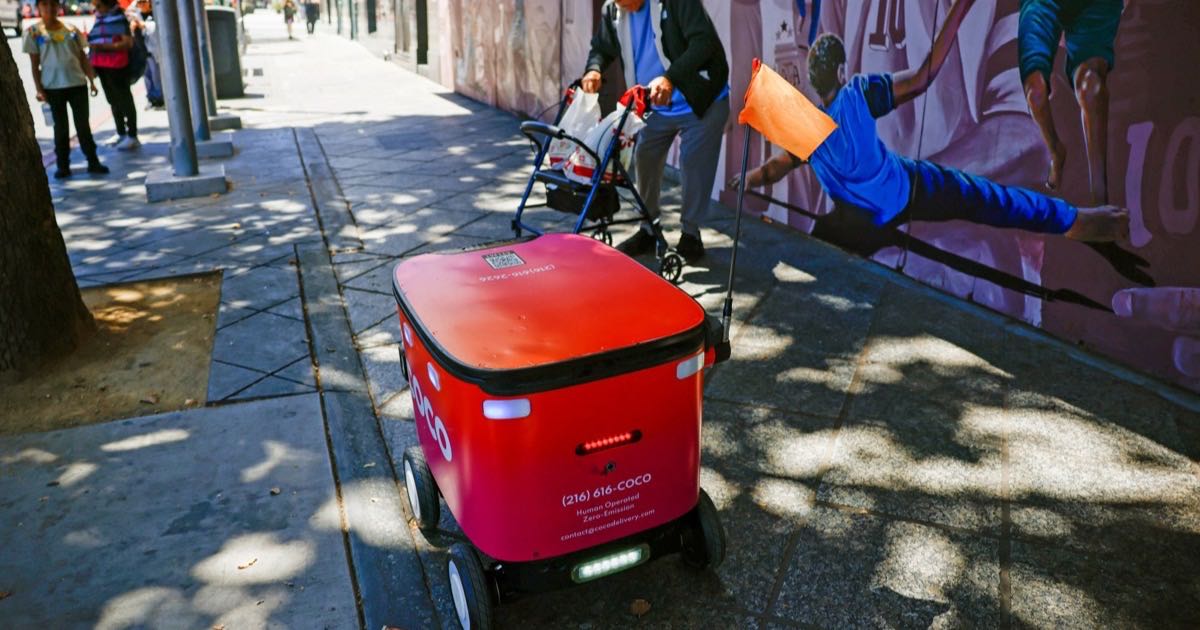
A pink-and-red robot the size of a beer cooler rolls up to a downtown San Jose intersection, pauses for the light, and crosses with the crowd. It’s carrying someone’s dinner. There are no formal rules governing its presence on the sidewalk. There’s no permit, no written agreement, no regulatory framework. The city hasn’t finished writing one yet.
That’s the situation in California’s third-largest city, where autonomous delivery robots are already operating under what officials call “informal operating understandings” — a phrase that does a lot of work. Two companies, Coco Robotics and Serve Robotics, have roughly 35 robots between them ferrying Uber Eats and DoorDash orders around downtown. The city has no robot-specific system for penalising companies if their devices obstruct curb ramps, pedestrian pathways, or bus boarding zones.
The 350-pound question
What comes next is what makes this more than a quirky local story. DoorDash plans to deploy 350-pound robots — called “Dot” — in San Jose’s bike lanes, likely as soon as this autumn. At 350 pounds, they weigh more than twice as much as either Coco’s 100-pound sidewalk bots or Serve’s 161-pound machines. They can travel up to 20 mph, though DoorDash says they’ll typically run slower. The city determined that 20 mph was too slow for traffic lanes, so the robots are headed for bike lanes instead.
Cyclists have questions. Amie Ashton, former board chair of the Silicon Valley Bicycle Coalition, told the Mercury News she could see it going “very well or very poorly.” Her concern: a slow or malfunctioning robot in a narrow, barrier-protected bike lane where passing is impossible. “Why not put them in car lanes?” she asked.
It’s a fair question that nobody has answered. The city’s transportation department says rules for bike-lane robots would include restrictions based on the speeds of cyclists traveling in front of and behind them. Those rules don’t exist yet.
Rules after the robots
The regulations expected this autumn would establish a permit system with annual fees of $200 to $250 per robot, caps on numbers if operations substantially interfere with public access, and fines or permit revocations for violations. Companies would need to provide proof of insurance and agree to cover the city’s legal costs. Until then, San Jose is relying on the companies’ good faith.
This isn’t a hypothetical concern. Arizona resident Trudy Perez has sued Starship Technologies, alleging one of its delivery robots knocked her down at an Arizona State University parking garage in 2023 and caused a spinal fracture. Starship denied liability and argued Perez’s injuries resulted from her own negligence. The company no longer operates in the Bay Area.
San Francisco, just 50 miles north, took the opposite approach. After concerns about sidewalk access, the Board of Supervisors enacted strict regulations in 2017 — limiting robot numbers, restricting testing to industrial areas, and capping speeds at 3 mph. Delivery robots remain a rare sight in San Francisco. San Jose’s philosophy, as transportation manager Ramses Madou put it, is to “be open to new entrants and new technologies.”
The deployment-before-regulation pattern
What’s striking about San Jose’s approach is the sequence. The robots are already making deliveries — five times a day at Punjab Cafe on East Santa Clara Street, according to owner Bobby Saini. At La Victoria Taqueria nearby, workers found a Coco robot flipped on its back a month ago. (“Some people,” said cashier Marta Alejandre, “they don’t like the robot.”) The city’s response to this operating period has been to call it “a learning period to gain insight into public perception, operational impacts.”
That’s a pattern the robotics industry has followed elsewhere. Waymo’s autonomous taxis hit Phoenix streets before comprehensive robotaxi regulations existed. Starship tested in Bay Area cities before withdrawing. San Mateo County began issuing humanoid robot permits only after companies were already operating there. The industry’s default mode is deploy first, regulate second.
Whether that’s a problem depends on your perspective. Coco CEO Zach Rash calls it “fundamentally the cheapest way to move goods around the city” and says 18 of his robots fit in a single parking space. DoorDash declined to say how many human deliveries its robots could replace or whether it would pass savings to consumers. Uber Eats did not respond to questions.
The 5 mph sidewalk speed limit the city cites as a current informal rule — journalists from the Mercury News reported having to jog to keep up with Coco robots in practice. Harvard Medical School puts typical walking speed at about 2.7 mph.
What this means
San Jose is running a real-time experiment in what happens when a city lets robots onto its sidewalks and bike lanes before writing the rules. The outcomes will be watched by every other city grappling with the same questions. Fremont is next — DoorDash expects to begin Dot deliveries there in September under an encroachment permit with a 16 mph speed limit and $1 million insurance requirement.
This connects to our wider coverage of autonomous delivery going mainstream: Serve Robotics expanding with Grubhub, and the broader Waymo robotaxi rollout and its regulatory growing pains. The pattern is the same: companies deploy, cities scramble to catch up, and the public becomes the testing ground.