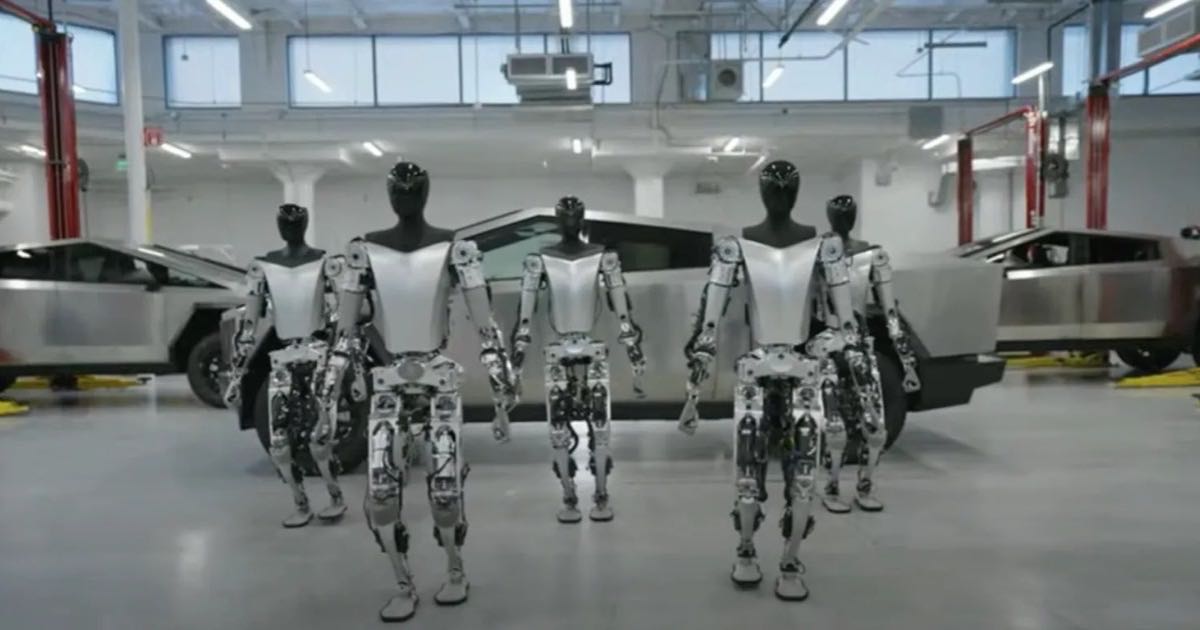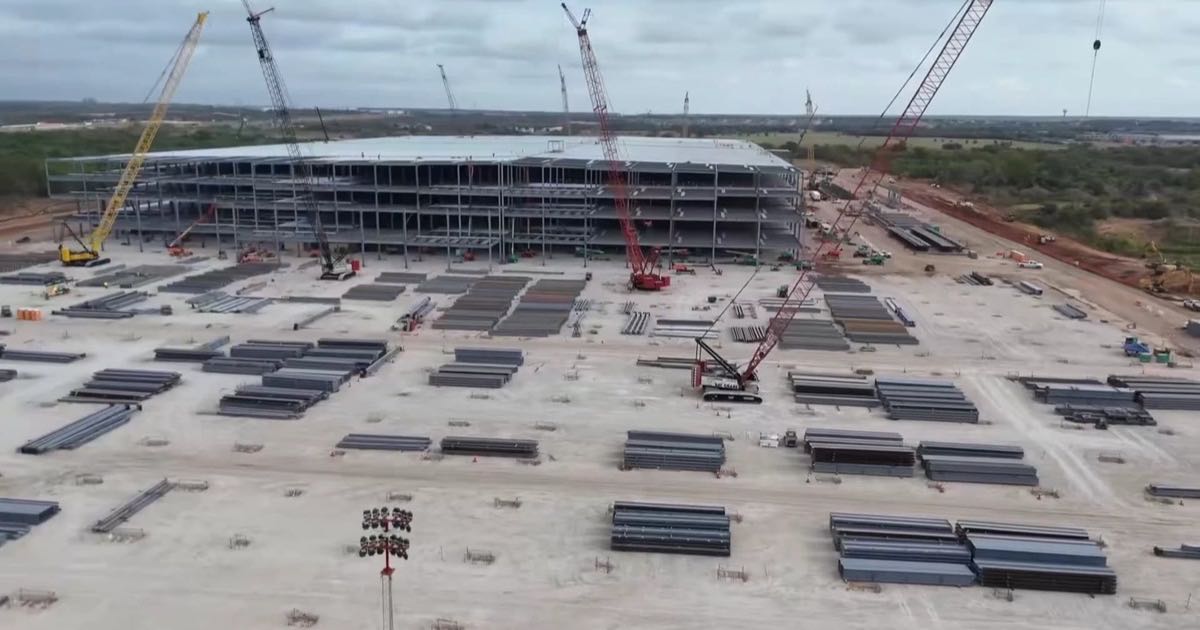
Tesla’s mass-production play for Optimus is starting to look like an actual factory. Drone observer Joe Tegtmeyer’s October 1 flyover of Giga Texas puts roughly 40% of the basic steel structure of the dedicated Optimus plant in place — a figure worth reading carefully, because it measures the skeleton, not the factory.
That caveat matters, and Humanoids Daily’s October 3 write-up flags it directly: Tegtmeyer estimates around 40% of the basic steel structure assembled, and “this is not a measure of overall factory completion.” The same post, published on X with a wide aerial circuit plus closer passes over the steelwork, shows why the distinction is easy to miss from a distance: one wing of the building is racing ahead with upper-floor concrete decks already poured, while other sections are still at foundation level with no steel above them at all. Utilities, enclosure work and production-equipment installation are all still ahead — the building remains what it is, a construction project.
Aerial progress estimates come with their own fuzz. Tegtmeyer’s percentages are eyeball readings of a moving site, not Tesla numbers, and Tesla has published no timeline for first-line Optimus production at this facility. Treating 40% as “a third to a half, depending on what he can see” is probably the honest calibration. The direction of travel is solid; the decimal places are not.
Here’s the earlier milestone, for context: the site crossed into visible steel-frame territory weeks ago, which Humanoids Daily’s earlier piece on the frame milestone documented as the first sign the plant had graduated from slab to skeleton.
A steel schedule is a robot schedule. Tesla’s published Optimus targets have always leaned on a claim most observers treat as the real bottleneck: Musk’s stated goal of a million units a year lives or dies on manufacturing, not on the hand or the forearm demo. The company’s own messaging has wobbled between “line by end of 2026” and much softer internal guidance, which is precisely why walls and cranes are the most verifiable Optimus datapoint anyone gets in a given month. A drone flyover cannot spin.
Two readings of the same steel, then. The optimistic one: Tesla is spending capital on a purpose-built humanoid plant while competitors — Unitree, UBTECH, AgiBot — are still producing humanoids in converted or shared facilities, and getting a dedicated building right is how you get from five-figure to six-figure annual runs. The pessimistic one: 40% of structure on a site with zero production equipment installed makes volume claims for 2026 physically impossible, and the plant’s real contribution to Optimus output is a 2027 story.
Both can be true. What the frame does confirm is sequencing: Tesla committed to the plant before it solved the brain-side bottleneck the site covered last month, and it is building supply-chain depth — largely Chinese components, as we mapped in September — in parallel with the walls. Physical capacity is the easy-to-verify half of the Optimus equation. The first thousand deployed units already show the hard half is intelligence, not steel.
Sources: Humanoids Daily (Oct 3, 2026); Joe Tegtmeyer drone updates via X (Oct 1, 2026); Humanoids Daily steel-frame milestone piece. Aerial completion estimates are Tegtmeyer’s, not Tesla’s.