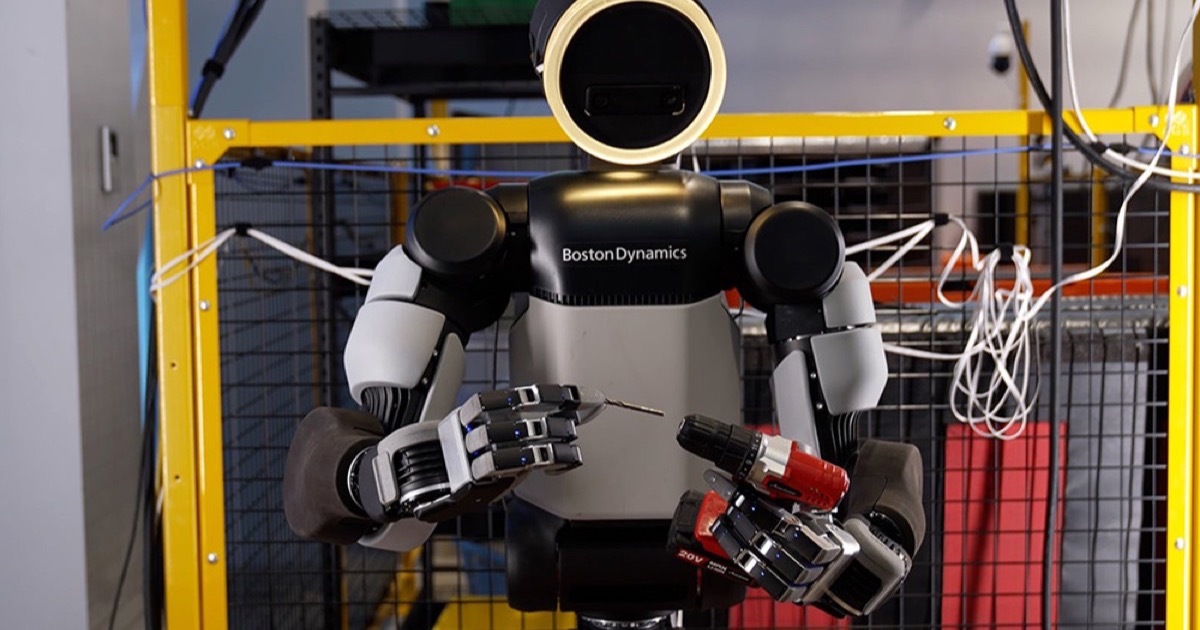
Boston Dynamics unveiled a new hand for its Atlas humanoid, and the strangest thing about it is what isn’t there. Four fingers. No pinky. Thirteen degrees of freedom, direct-driven, all running on a single actuator type — and per The Robot Report, which first covered the launch, the team arrived at that configuration partly through one of the more charming experiments in recent robotics: every engineer on the hand team spent a day with their pinky and ring finger taped together, then reported on what they couldn’t do. The answer, apparently, was not much. So the pinky went.
That’s an unusual way to make an engineering decision, but it fits the company’s stated philosophy. Alberto Rodriguez, who directs robot behavior for Atlas, told reporters that the team considered designs with one thumb, two thumbs, and various finger counts before landing on the four-finger arrangement. In Boston Dynamics’ own blog post on the hand architecture, the framing is blunt: the goal was never to replicate a human hand. It was to build a reliable tool-user.
Built for sim first, tools second
The technical choices here are pointed. Where previous Atlas hands had seven degrees of freedom aimed at grasping a wide variety of objects, the new hand shifts emphasis to manipulating them after the grasp — in-hand reorientation, recovering from a slipped grip, sliding the thumb along each fingertip, and triggered tool grasps. The Robot Report’s writeup lists drills, torque drivers, grinders, nail guns and welding torches among the tools the hand demonstrated at launch, with Boston Dynamics showing Atlas slotting a drill bit into the drill in its launch imagery.
Three design details stand out:
- Sim-to-real is the priority. The hand was explicitly built for high-fidelity simulation so reinforcement-learning policies trained in sim can carry over to hardware. That’s a bet that RL, not teleoperation, will produce the manipulation skills that matter — a different route from companies that emphasize large-scale human teleop data.
- Direct actuation throughout. Every joint is driven directly by one actuator type, encapsulated like Atlas’ body actuators, with no cables crossing joints. Boston Dynamics is trading the compactness of tendon-driven hands for reliability and manufacturability.
- No pinky, at 13 DOF. Three extra degrees of freedom would have bought a fifth finger — more complexity, more mass, more power draw, one more failure point per hand, all duplicated across two hands on every robot.
The pinky debate is really a manufacturing debate
It’s worth noticing who else has gone the four-finger route. China’s dexterous-hand sector, which we covered when four local hand makers hit mass production, has several top vendors building four-finger designs too, for the same reason: three fewer actuators means cheaper hands that can actually be produced at volume. Humanoid startups pricing their first thousand units, rather than their demo units, keep converging on the same math. Boston Dynamics — with Hyundai’s backing and a training facility inside Hyundai’s Georgia Metaplant preparing Atlas for automotive work — has now publicly joined that camp.
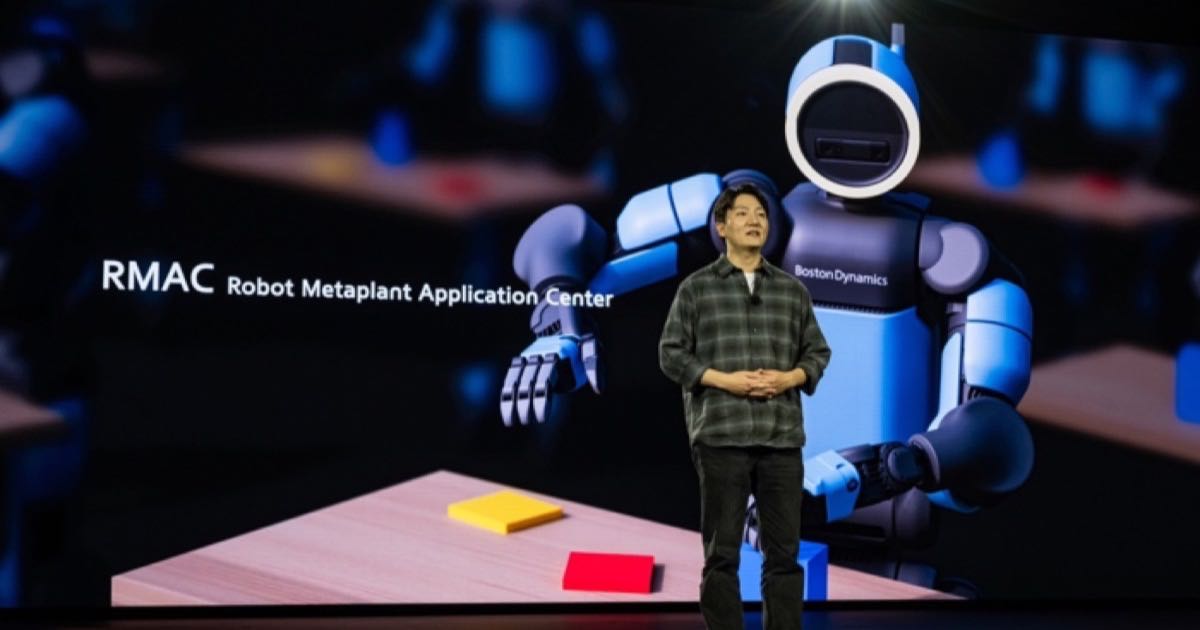
The timing is not incidental. The new hand landed a week after that Metaplant application center opened, and IEEE Spectrum’s coverage frames the hand the same way we read it: engineered for mass production, not for a spec sheet. A humanoid that will spend its days passing tools around a car line needs hands that survive thousands of drill insertions, not hands that can play Chopin.
There’s a counterpoint, though, and the robotics community made it quickly: tool use is exactly where five fingers earn their keep. Pen-spinning tricks, keyboard typing, fine assemblies — none of those are on Atlas’ near-term punch list, so the loss is bounded. But if Atlas ever pivots toward unstructured human environments, the team has to unwind a design decision made for a factory. Boston Dynamics seems comfortable with that trade; the whole point is that Atlas is being built for Hyundai’s plants, not our kitchens.
New Zealand reads of this story will be mostly indirect — Boston Dynamics isn’t hiring here, and Hyundai ships New Zealand cars rather than making them. The signal that matters is the industry-wide one: dexterous manipulation is moving from research demos toward manufacturable components, the same progression that took lidar from $75,000 spinners to $500 pucks. Watch what a four-finger hand does to robot hand pricing over the next year.