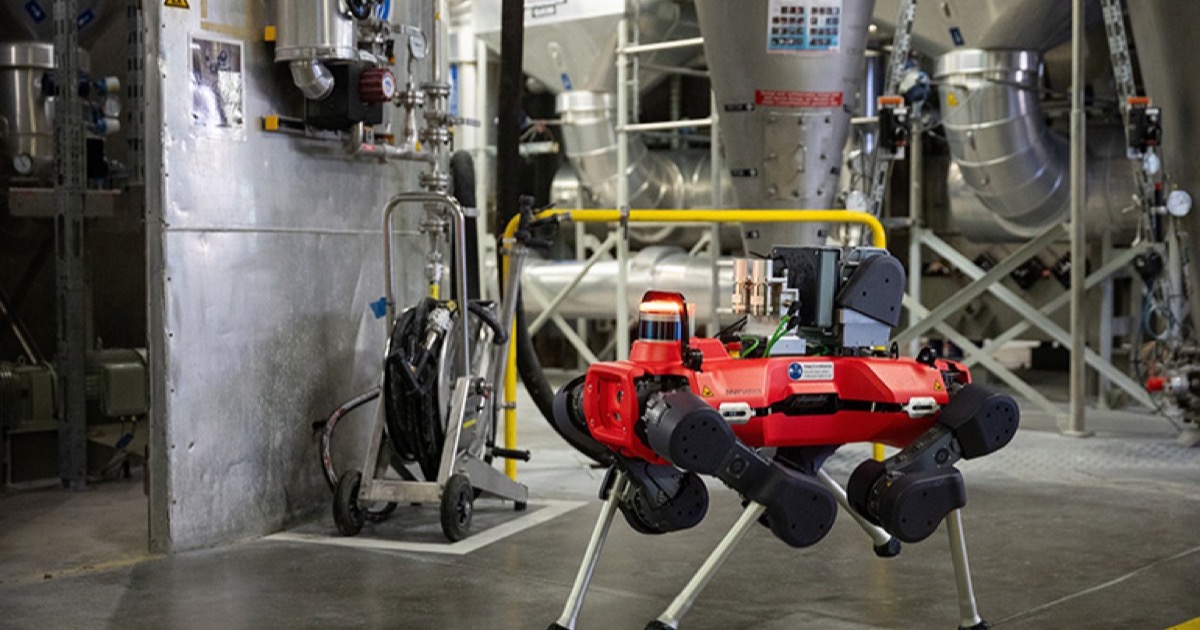
ANYbotics, the Zurich company behind the ANYmal quadruped, launched a software platform called Shift — and the interesting part is less what the robots do than where the data ends up. Announced 1 October 2026 and reported the same day by The Robot Report, Shift is a cloud platform that wraps fleet scheduling, inspection analytics and enterprise integration into four modules, replacing the company’s older Data Navigator product, whose own newsroom describes the transition as automatic.
The pitch is grounded in a number ANYbotics cites: undetected industrial failures cost the world’s 500 largest companies an estimated $1.4 trillion a year in downtime, with a single hour of outage averaging $250,000. Those figures come from the company itself, so read them as marketing’s framing of the problem — but the underlying dynamic is real and unremarkable. A bearing that overheats on a Tuesday is cheap to fix. Let it seize on Saturday and the whole line stops.
What Shift actually does
The four modules split the problem cleanly:
- Shift Fleet schedules and monitors multi-robot missions across a plant, and can be triggered directly by a plant’s distributed control system. Reliability engineers stop dispatching robots and start reviewing findings.
- Shift Insight fuses thermal, acoustic, visual and gas readings with operating context — motor speed, load, ambient temperature — so a reading only flags as an anomaly when the context says it should. The same motor temperature means different things at idle and at full load.
- Shift Connect is the load-bearing module: confirmed anomalies become work orders inside customers’ existing software — SAP, IBM Maximo, GE Vernova APM, Yokogawa DCS, Cognite and Oracle digital twins — via productized connectors and REST APIs. It runs bi-directionally, so a process threshold rising can automatically schedule another robot inspection round.
- Shift Maps builds a live digital twin of the plant, keyed to asset IDs so every reading lands on the right piece of equipment.
CEO Péter Fankhauser’s framing to The Robot Report: robotic inspection delivers value “when field data flows directly into maintenance action.” That sentence is the product. ANYbotics isn’t selling robots-with-a-dashboard anymore; it’s selling the last mile between a robot’s camera and a maintenance crew’s queue, which is where most inspection pilots historically stalled.
Why the enterprise plumbing is the story
The robotics press tends to cover launches like this as software footnotes. We think it’s the reverse: the robots are becoming commodities, and the platform layer is where inspection robotics will be won. ANYmal now has well-funded quadruped competitors — Ghost Robotics, Unitree’s industrial line, Boston Dynamics Spot with its own deployments — so the durable moat is a decade of accumulated refinery failure signatures, the trained models that read them, and the SAP integrations that make the findings actionable. Software data accrued over years doesn’t transfer to a cheaper robot the way hardware specs do.
There’s also a subtle strategic shift worth naming. By making Shift work “out of the box” with no enterprise integration required, as ANYbotics product head Jacob Euler-Rolle told The Robot Report, the company lowers the entry barrier from enterprise project to plug-in appliance — the same land-grab logic that cloud vendors used. Get the robots paying for themselves on day one, then upsell the integrations. Expect Spot’s answer, and a Chinese equivalent, within quarters.
The angle for New Zealand readers is direct, unlike most robotics stories: this is a blueprint local industry could copy today. New Zealand’s food processing, pulp and paper, and geothermal power plants run exactly the kind of round-the-clock equipment that benefits from condition monitoring, and our geothermal operators already deploy sensor-based inspection. A Shift-style setup — robots or even fixed sensors feeding a work-order pipeline — fits a small country’s maintenance economics well, because the platform cost is trivial against a single avoided outage at, say, a dairy processing plant. The barrier here isn’t technology. It’s that few NZ plants staff a reliability engineer whose job is reading robot findings — a skills gap worth watching as these platforms get cheaper.