Every large language model learned to talk by drinking from an internet-sized ocean of text. Robots get no such inheritance: the physical world has no crawlable corpus, so every dataset of a gripper picking up a cup has to be created, one teleoperation session or mocap take at a time. Innodata Inc. (Nasdaq: INOD), a data engineering company that has been quietly doing unglamorous dataset work since 1988, announced on 30 September that it has opened an R&D laboratory in New Jersey to attack exactly that bottleneck — as The Robot Report reports, the lab generates training data for humanoids, industrial robots and other physical AI, and independently validates the performance data robots produce internally. Reuters carried the announcement the same day, and the company’s own release on AccessNewswire fills in the spec sheet.
“Physical AI is growing faster than any other segment in AI, but every robotics team hits the same wall: There isn’t enough real-world interaction data, and what exists is expensive and slow to produce. This facility removes that wall,” said Rahul Singhal, Innodata’s CEO, in the announcement. The claim that robotics data is expensive is well earned: collecting it means either teleoperated demonstration hours or instrumenting real environments, and The Robot Report’s interview with Franklin Tanner, Innodata’s VP of robotics and physical AI, makes the cost plain. “As much as possible, we collect data of an actor or a robot doing something in the wild. I think that’s the gold standard. However, that’s super expensive,” Tanner said. “Physical AI has to earn its tokens one interaction at a time, and they have to be deliberate.”
Why the cameras matter
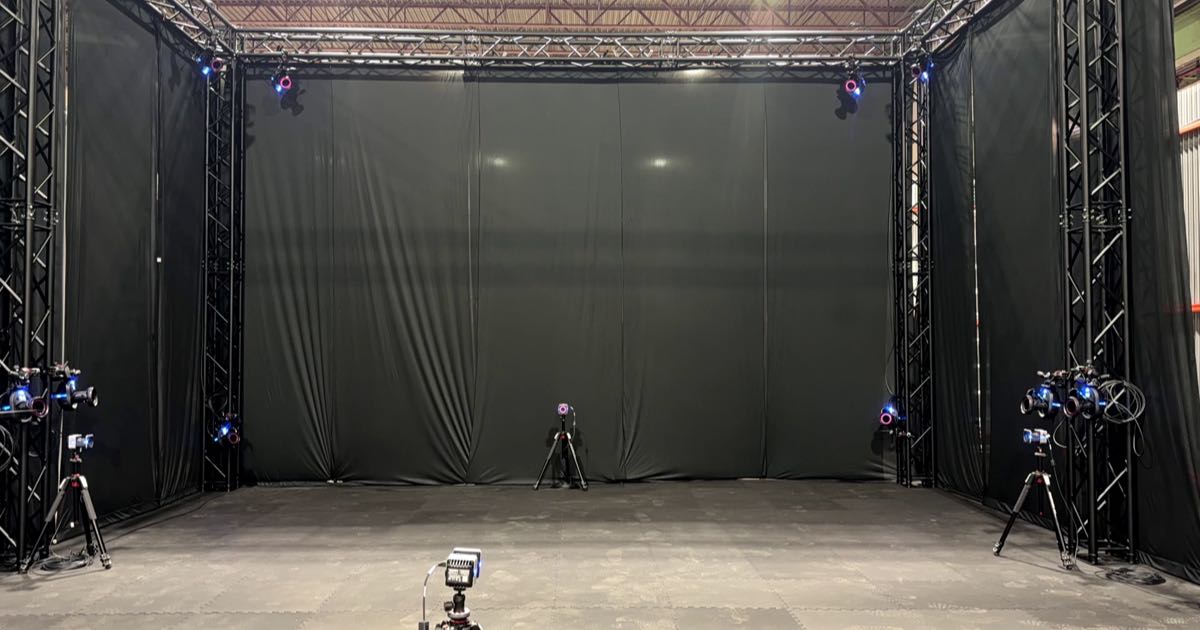
The differentiator Innodata is claiming is measurement precision. The lab was developed with Vicon, the optical motion-capture company behind professional filming rigs and biomechanics systems, and uses high-precision, low-latency infrared tracking cameras that measure movement to the sub-millimetre level. Where other data providers infer 3D motion by analysing 2D video, this setup captures 3D data directly from the bodies themselves — human or mechanical. Tanner’s argument for why that matters is disarmingly physical: “When you’re training a humanoid that weighs almost 200 lb. [90.7 kg], your readings can’t be in the ballpark. They need to be precise.”
There’s a second capability in the announcement that deserves more attention than the training-data side: validation. Because the lab’s calibrated cameras observe robots from the outside, they provide an external — “exocentric” in Innodata’s phrasing — check on a robot’s internal, often noisy telemetry. Customers can send in their robots for evaluation against scripted scenarios, including ones where robots and people interact. In a market where humanoid makers publish their own success rates, an independent referee with sub-millimetre eyes is a genuinely new offer. “That gives you independent ground truth, not an estimate,” said Andrew Knox, Vicon’s managing director. “Plenty of motion-capture companies have discovered humanoid robotics lately… But the teams building the most capable robots keep reaching the same conclusion: if the training data is approximate, the robot will be too.”
The mug problem
Tanner’s example of what current datasets are missing is worth retelling. Tell a robot to pick up a mug: most humans pick it up by the handle, but grabbing the base isn’t wrong — unless the mug is full of hot liquid. That context isn’t encoded in even the datasets that exist today, he said. It’s a sharp illustration of why physical-AI data isn’t just “more videos”: the label a humanoid needs isn’t the pixel frame, it’s the physics and intent behind it. Innodata says it supports teleoperation, wearable rigs, sensor setups and UMI grippers, and that captured data can feed digital twins so simulators can permute edge cases — with Tanner name-checking NVIDIA’s Cosmos as an environment getting “really good” at real-to-sim translation.
Innodata also plans to work on something almost nobody has data for: humans and robots interacting with each other, instrumented so multiple agents can be captured in the same space. And Tanner is openly sceptical of brute-force data collection — customers asking for “a million hours” of egocentric data would be throwing out, by his metrics, 80% of it. “Why don’t you just want the 200,000 hours that’s actually going to be useful for your VLA?” he asked. That’s a data-quality argument arriving just as the industry’s biggest labs are racing for data volume.
The India data-production story is the volume play — paying thousands of workers to film manipulation footage at scale; this lab is the precision play on the same constraint.
Our take: this is the picks-and-shovels phase of the humanoid buildout, and it’s a healthier market signal than another demo video. When a 38-year-old data company with healthcare, finance and government clients decides robot training data is worth a dedicated lab, it’s reading the same demand curve as everyone else — the robot foundation-model race and the push for dexterous manipulation in real factories both stall on data, not hardware. The edge-AI compute layer is commoditising fast; the datasets are not. The open question is whether Innodata’s customers will let it publish the validation results — an independent benchmark that said “this humanoid does not perform as advertised” would do more for the industry’s credibility than any shipment leaderboard. And for a country of 5 million people who can’t staff a warehouse shift, the interesting part isn’t the lab in New Jersey — it’s that robot training data is becoming a purchasable commodity at all, which is what makes capable robots affordable outside China and the US.