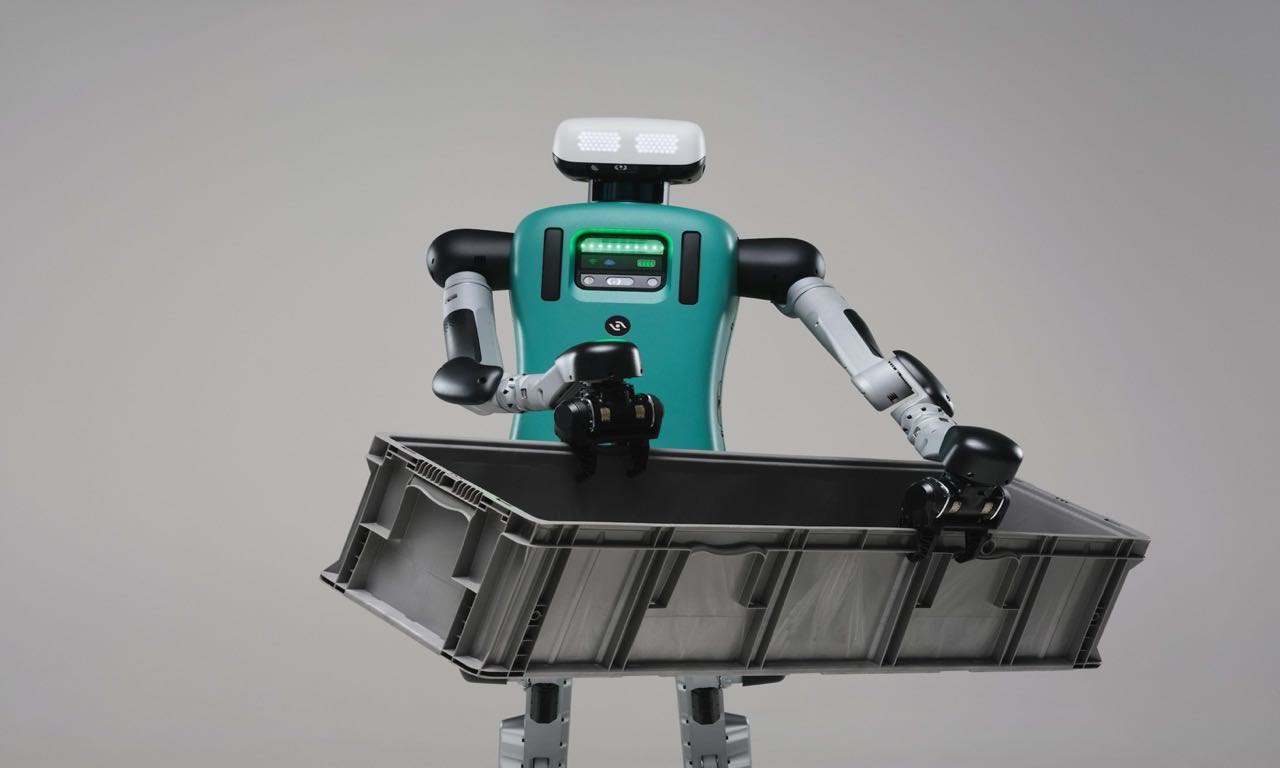
Agility Robotics began trading on Nasdaq on November 5 under the ticker AGLT, becoming the first US company whose entire business is humanoid robots to reach the public markets. The listing, completed through the SPAC Churchill Capital Corp XI, delivered roughly $465 million in gross capital before transaction expenses — and, within five minutes, a reality check: shares slipped below the $10 merger price almost immediately, touching $8.40 in early trade and trading near $9.40 by mid-session after a brief run to $11.49, as tracked by AI Stock Wire’s market desk.
The debut was a year in the making. In November 2025, rival Figure CEO Brett Adcock predicted Agility would be “bankrupt in under 12 months” — as TechCrunch recounted on debut day. Instead, Oregon’s oldest humanoid maker converted a $2.5 billion pre-money merger, announced in June, into a listed company backed by Nvidia, Amazon, Foxconn, SoftBank Vision Fund 2 and Schaeffler.
The numbers Wall Street actually read
The tension in AGLT is between what Agility has built and what it currently earns. Digit robots operate in nine customer environments — Schaeffler, GXO, Toyota Motor Manufacturing Canada and Mercado Libre among them — with more than 65,000 hours of commercial operation logged, per the company’s own announcement. But per TechCrunch’s deep-dive on the company’s finances, first-half 2026 revenue was just $174,000, much of it from related parties, against a net loss of $362 million. MarketWatch’s debut-day coverage flagged the steep losses as the central red flag for public investors.
What the optimists buy is the pipeline. Agility says it holds more than $300 million in committed multi-year orders for Digit 5, its next-generation robot, from over 30 customers — orders that remain contingent on the new robot hitting undisclosed throughput, uptime and accuracy targets. Digit 5 prototypes have not been shown publicly — our October coverage of Digit 5’s cageless safety design has more on what the new generation is meant to unlock — with the demonstration planned for CES 2027 and wide availability at the end of that year. CEO Peggy Johnson’s pitch is that the robot-as-a-service model saves customers roughly $100,000 a year on the repetitive manual work — tote moving, line feeding, materials handling — that warehouses struggle to staff.
What a listed humanoid maker changes
Until now, the humanoid sector’s financial evidence has been private: Figure and 1X raising at valuations nobody outside the round can audit, Tesla folding Optimus into a captive conglomerate. AGLT is the first time the market gets to price a pure-play humanoid business continuously — orders, milestones, and quarterly losses all marked to market. The SPAC context cuts both ways: when the $465 million closing package was confirmed in October, the trust account had already shed most of its cash to redemptions. Churchill Capital’s earlier deals produced Lucid and Oklo, both of which spent years far below their de-SPAC prices, which is one reason investors read debut-day weakness as signal rather than noise.
The bear case is arithmetic: $174,000 of first-half revenue cannot amortise the burn, so the $465 million raise is runway, not validation. The bull case is that Agility under-promised for a decade — as Johnson told TechCrunch, “You don’t see a lot of dancing robots or backflipping robots from Agility” — while quietly assembling the only western humanoid company with years of real customer deployments, a domestic supply chain sourcing about 75 per cent of Digit’s parts in the US, and RoboFab, a factory rated for 10,000 robots a year.
For New Zealand, the interesting part is less the ticker than the template. A listed humanoid maker must now disclose quarterly what pilots actually earn, and those numbers will either discipline the sector’s $2.5 billion-style valuations or prove the demand curve is real. Every private humanoid pitch — including the ones Kiwi manufacturers are being shown — now has a public yardstick, and for the moment it trades at a roughly 14,000-to-1 price-to-sales ratio.
❓ FAQ
Why a SPAC instead of a traditional IPO? SPACs set a fixed valuation and closing date, which suited a company that needed capital on a schedule and had strategic investors (Foxconn led the PIPE) willing to commit at $10. Traditional IPOs price late against unpredictable demand — a risk for a company with minimal current revenue.
Is Agility actually making money on those $300 million in orders? Not yet. The Digit 5 orders are committed multi-year contracts contingent on milestone targets for throughput, uptime and placement accuracy, and the current-generation Digit business earned only $174,000 in the first half of 2026.
Who are the other humanoid makers to watch on public markets? Tesla embeds Optimus in a conglomerate, and Chinese makers are largely listed via diversified groups. Agility’s listing was the first pure-play vehicle; Figure, 1X, Apptronik and Unitree remain private — Figure most recently raised at a $39 billion valuation.