The scoop lands with an asterisk attached. Meta has built a working prototype humanoid robot with Chinese robotics maker Fourier and has already started on a second version, The Information reported on Saturday, citing people familiar with the project. The build reportedly took about three months, and the robot carries the internal name “Max.” Reuters relayed the report the same day with a caveat that matters: it could not independently verify the claim, and neither Meta nor Fourier has published anything about the machine — no press release, no spec sheet, no video.
The unverified colour comes from secondary reporting. Crypto Briefing wrote up the claim that Max weighs about 106 pounds (roughly 48 kg) — then went looking for receipts and found none. Its verdict: “the claim lives on social media and nowhere else,” with no confirmation from either company. That makes Max a name and a weight attached to a timeline nobody outside the project has confirmed. What no one disputes is that both companies have been moving toward this for a while, and that the report, if it holds, changes the shape of the consumer humanoid race.
Who Fourier is, and what three months would actually mean
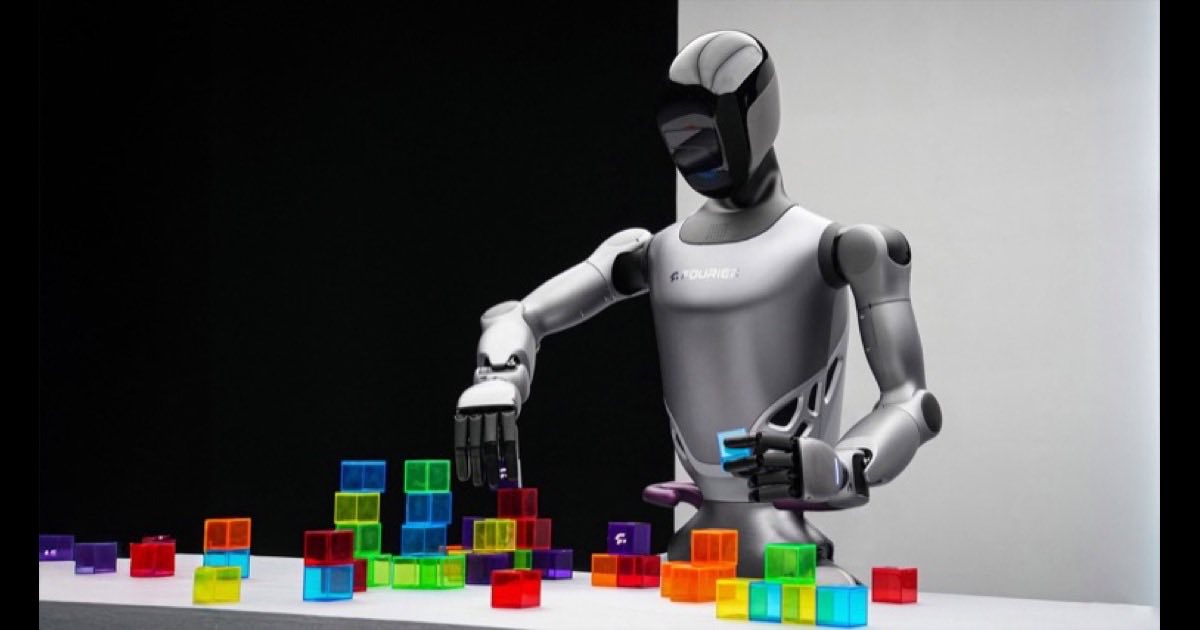
Fourier Intelligence is a Shanghai robot maker founded in 2015, and it is not a newcomer playing at humanoids. The company started in rehabilitation robotics — the field that taught it actuator design and human-contact safety — and moved into general-purpose humanoids in 2019. Its GR-1 debuted in 2023, the GR-2 landed in 2024 with 53 degrees of freedom at 63 kg, and the GR-3 care-bot followed with 55. Backers reportedly include IDG Capital and Saudi Aramco, and Xi Jinping inspected the company during a Shanghai tour in December 2023 — the kind of political profile that gets a partnership read carefully in Washington.
For Meta, the logic is simple. Bodies are cheap in China right now and improving fast; Meta’s edge is in models. A three-month prototype only works if the hardware partner already has a mature platform, which is exactly what Fourier’s GR line is. Meta telegraphed every step of this. A February 2025 internal memo reported by Reuters put a robotics group inside Reality Labs under CTO Andrew Bosworth, aimed at consumer humanoids powered by Llama models. In May 2026 Meta quietly acquired Assured Robot Intelligence, whose co-founders were building humanoid foundation models, and moved them into Meta Superintelligence Labs. The Gizmodo coverage of that deal framed it as Meta finally stepping onto the humanoid playing field. The Fourier prototype, if real, is the body stage of a brains-first strategy Meta has been assembling in plain sight for nearly two years.
The awkward part: the import ban exists
Here is the wrinkle the prototype runs straight into. In late July 2026, the Trump administration banned new imports of humanoid and quadruped robots from foreign manufacturers, citing national security risks — coverage The Information’s peers noted does not cover already-approved models. The ban targets commercial imports, not research collaborations, so a US lab building a research prototype with a Shanghai partner is not automatically in violation. But the two facts sit badly together. A platform company that wants to ship consumer robots eventually needs a supply chain, and the obvious one — actuators, precision gearing, batteries, mature assembly — sits largely in China. The imported robots question had already put US tariffs and Chinese humanoid dominance in the same sentence in October. Congress will ask where Max’s parts came from, which models run on it, and whether any Fourier-built unit crosses a border.
There is also a timing wrinkle inside Meta itself. The company is reportedly weighing a $95B equity raise to fund an AI buildout with a capex bill climbing toward $145B. A robotics program is exactly the kind of long, expensive bet you either fund quietly or partner your way through — and partnering is what this report describes. Meta reportedly told The Information it has no plans to sell these units. That keeps the work classified as research, at least for now.
What it means
Treat the specifics — the name, the weight, the timeline — as unconfirmed until a second outlet or the companies themselves confirm them. But the strategic read survives skepticism. The Chinese robotics industry shipped roughly 97% of the ~19,100 humanoids the world bought in the first half of 2026, by startup Fortune’s figures. If a US AI company wants a capable body quickly, the nearest supplier is often Chinese, and no amount of policy friction changes that arithmetic. Meta, Tesla, Figure and the rest are all converging on the same conclusion from different directions: the brains are being built in California, and the bodies are coming from Shanghai. A Meta-Fourier prototype — even an unverified one — is what that looks like when it stops being a conference talking point and becomes a machine on a lab floor.
As of publication, Meta and Fourier have not responded to requests for comment, and no second outlet has independently confirmed the prototype’s existence.