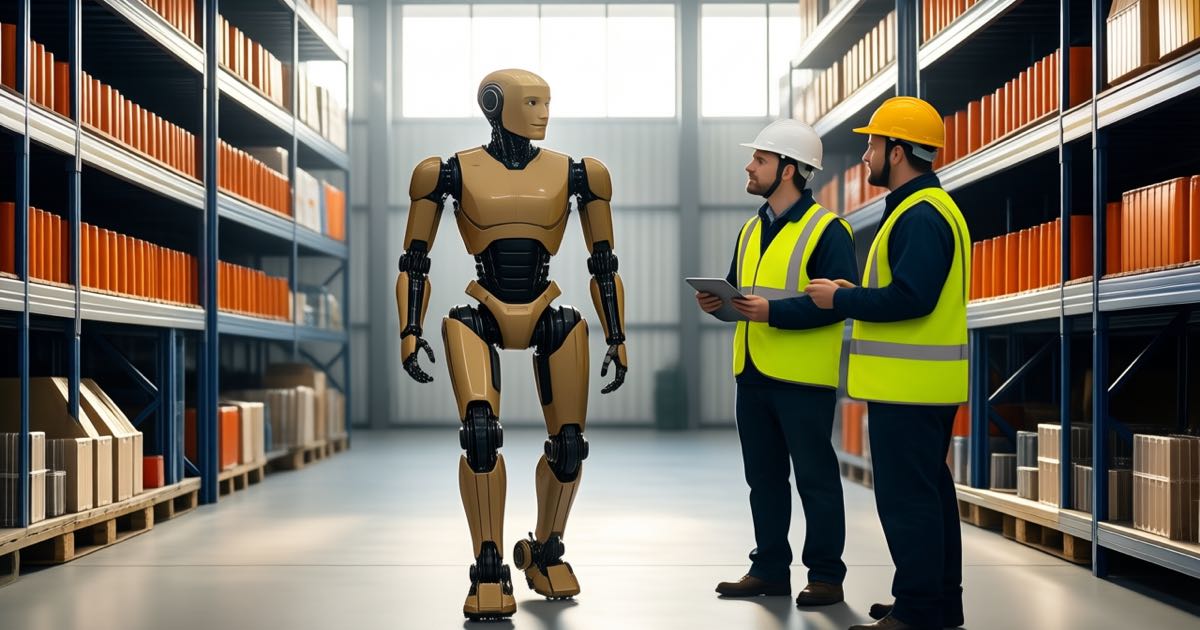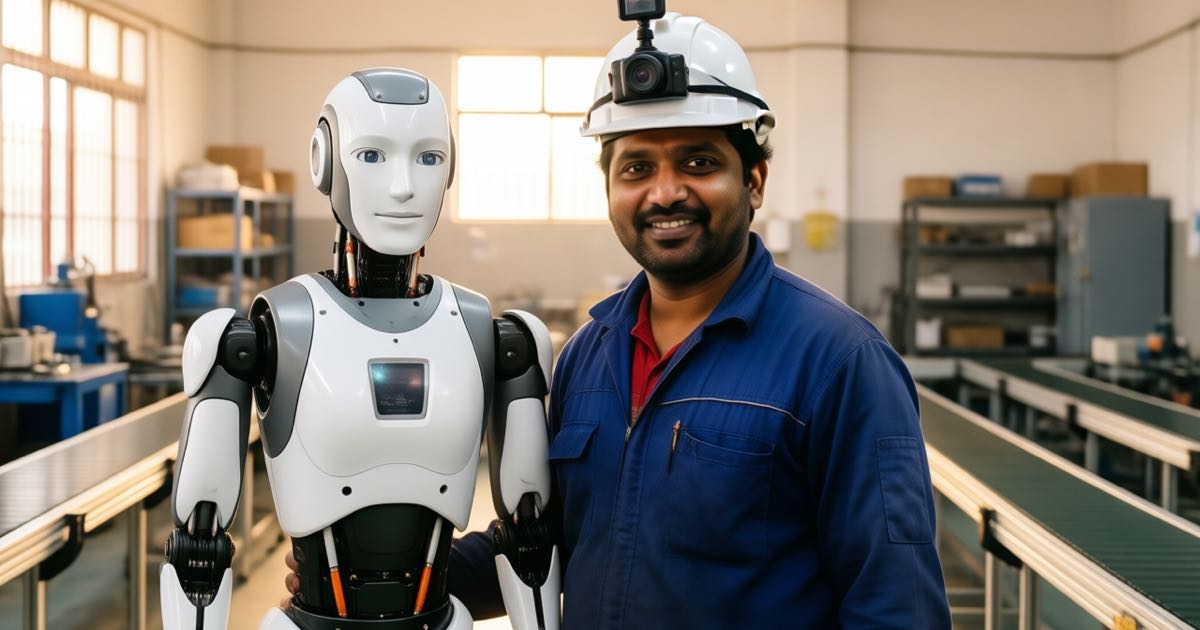
Bloomberg’s Big Take Asia podcast published a new episode overnight NZ time asking how India is training the robots of the future. The short version, per the episode’s description: tens of thousands of workers in India are wearing head-mounted cameras to record their every move, generating the footage used to help train humanoid robots to perform everyday human tasks.
If the framing sounds familiar, that’s because the underlying practice has been building quietly all year. A Bloomberg investigation reported in August — picked up by WION, Al Jazeera and others — found workers filming their own labour with head-mounted phones at around US$2.62 an hour, roughly 250 rupees. The workers’ movements become first-person training data for robotics firms. Many, the earlier reporting said, weren’t told what the footage would be used for.
Why robot companies are buying video of people doing chores
Humanoid robots learn tasks the way the rest of modern AI learns language: by imitation at scale. A model that can load a dishwasher or fold laundry needs to see thousands of humans actually doing it, from the viewpoint of the person doing the work — which is why the cameras are strapped to heads rather than mounted on walls. Egocentric footage captures not just what a hand does but where the person was looking and why, and that context is what separates a robot that can repeat a motion from one that can handle a kitchen it has never seen.
The bottlenecks in robotics are hardware, batteries — and data. It’s the rarest of the three. Labs can buy actuators, but they can’t buy hours of authentic human work at scale anywhere except where human labour is cheap. That’s the arbitrage: the same task that costs a US teleoperation lab $20-30 an hour to collect costs $2.62 in India. The economics are irresistible, which is exactly why the consent question keeps being skipped.
The uncomfortable loop, stated plainly
The headline everyone reaches for — workers training their own replacements — is too neat, because there’s no robot on the market today that can do most of the jobs being filmed. The realistic near-term outcome is that the data outlives any one job: footage of a cook in Tamil Nadu becomes a policy module that runs in restaurants in three countries, and the person who generated it sees none of that value. The wage was paid once, for the video, not for what the video turned into.
There’s also a quieter supply-chain point that reaches well beyond India. As the year’s coverage has shown — from XDOF’s Series B raise for robot training data to Xiaomi putting humanoid robots through factory training ahead of its WRC showcase — the humanoid industry’s real production line in 2026 is human demonstration data. Whoever collects it cheapest sets the pace of the entire field, and right now that’s a workforce earning about 250 rupees an hour, often without being told what their footage is for. Robotics firms fixed the hardware problem in public and are solving the data problem in private. The second one has people in it.