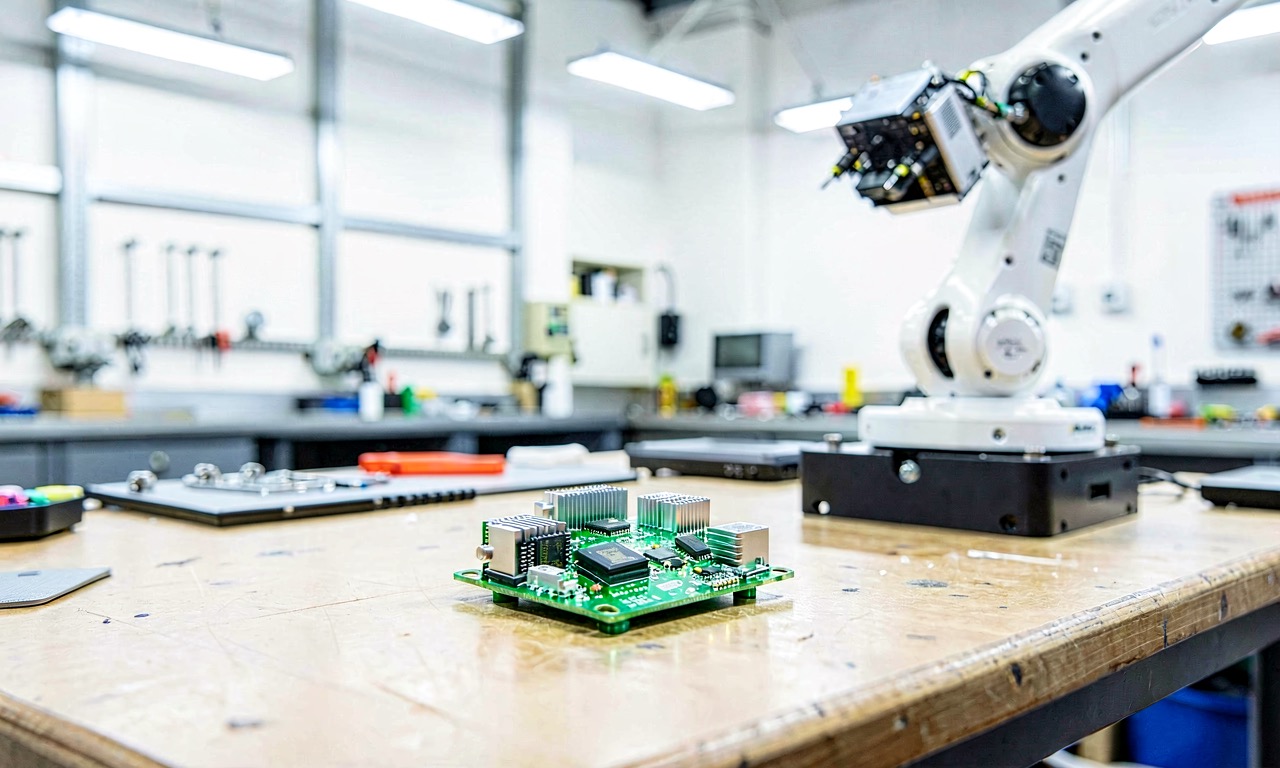
NVIDIA has introduced two new Jetson Thor modules — the T3000 and T2000 — designed to bring mass-market robotics and edge AI out of the research lab and into production. The T3000 delivers 865 FP4 teraflops in a package roughly half the size and power of the flagship T5000, while the T2000 offers 400 teraflops as an entry point for lighter edge workloads.
🔍 THE BOTTOM LINE
NVIDIA is compressing its Thor architecture downmarket to capture the robotics wave before it crests. The T3000 gives humanoid robot makers near-flagship inference at half the cost, the T2000 widens the aperture to industrial and retail use cases, and the new Cosmos 3 Edge model puts a 4-billion-parameter world model on-device. The strategy is vertical: NVIDIA sells the chip, the foundation model, and the agent optimization layer.
What the T3000 Actually Delivers
The Jetson T3000 combines a Blackwell GPU, an eight-core Neoverse Arm CPU, 32GB of LPDDR5X memory, and 273GB/s of memory bandwidth with 25 GbE connectivity. Despite the smaller footprint, it achieves inference performance similar to the T5000 for multimodal workloads — large language models, vision-language models, vision-language action models, and world foundation models.
The key economic argument: with HBM memory prices still elevated, the T3000 lets robot manufacturers migrate down from the 64GB T5000 without compromising on the models they need to run. NVIDIA cites partners including 1X, Agile Robots, Amazon Robotics, Boston Dynamics, FANUC, Hitachi, and Techman Robot as already building on the Jetson AGX Thor platform.
The IGX T3000 variant adds integrated functional safety, running NVIDIA’s Halos for Robotics full-stack safety system — critical for robots operating alongside humans on factory floors.
The T2000: Going Wide
The T2000 brings the Thor architecture to a broader range of edge AI systems. With 400 FP4 teraflops and 16GB of memory, it targets visual AI agents, autonomous mobile robots, industrial manipulators, and other intelligent machines that do not need the T3000’s full horsepower.
Together, the new modules give NVIDIA a scalable edge AI platform spanning from 70 TOPS to 2,000 teraflops — covering virtually any edge AI workload from smart cameras to full humanoid robots.
Cosmos 3 Edge: World Models On-Device
Alongside the hardware, NVIDIA announced Cosmos 3 Edge, a 4-billion-parameter lightweight model from the Cosmos frontier world foundation model family, optimized for Thor platforms. Cosmos 3 Edge lets embodied systems see the world, reason over it in real time, and predict and generate actions through on-device inference.
Using the open Cosmos framework, developers can post-train Cosmos 3 Edge for specific embodiments and sensors in about a day — closing the sim-to-real gap that has been one of the biggest bottlenecks in robotics deployment. The model then deploys on Jetson Thor for real-time vision analysis and on-device robot policy execution.
Agent Skills for Memory Optimization
NVIDIA also released new Jetson agent skills that automate memory optimization across the Jetson portfolio. The results are concrete: UBTech and Agile Robots reduced memory usage by up to 15GB, enabling migration from 64GB to 32GB modules. SandStar cut 4GB, enabling deployment on 8GB instead of 16GB configurations. NoTraffic reduced memory by 30% on older Jetson TX2 NX hardware.
This matters because memory is the single most expensive component in edge AI systems. Every gigabyte saved is a direct reduction in per-unit cost for a robot shipping at scale. NVIDIA is effectively selling software that makes its cheaper hardware viable — a classic platform play.
The Robotics Market Context
The announcement comes as NVIDIA expands its Toyota AI partnership beyond autonomous vehicles into smart cities, traffic intelligence, and carmaking factories. The Toyota deal broadens a decade-long relationship and signals that NVIDIA sees its automotive and robotics businesses converging — the same Thor modules that power a humanoid robot on a factory floor can also power the factory’s autonomous systems.
The enterprise agent orchestration market is consolidating fast, with Anthropic’s Claude leading at 40% of deployments. But that survey covers software agents in enterprise environments — physical AI, where NVIDIA’s hardware advantage is overwhelming, is a different market entirely. NVIDIA is positioning Thor as the compute backbone for the physical world the way Claude is becoming the backbone for the digital one.
NZ Angle
New Zealand’s robotics sector — concentrated in agricultural automation, manufacturing, and the growing defence technology corridor — is a natural customer for edge AI modules. The T2000’s 400 teraflops at 16GB puts genuine AI inference within reach of NZ’s SME-heavy robotics ecosystem, where per-unit cost is the binding constraint. The agent skills memory optimization is particularly relevant: NZ firms building agricultural robots often work with tight memory budgets due to the need for ruggedized, lower-power configurations in field deployments.
❓ FAQ
When can I actually buy these? T3000 emulation mode is available later this month with JetPack 7.2.1. T2000 emulation follows in a future release. Physical modules ship in Q1 2027. Developers can start with the Jetson AGX Thor developer kit available now through channel partners.
What’s the price gap between T3000 and T5000? NVIDIA hasn’t published pricing yet, but the pitch is clear: similar inference performance at roughly half the size and power, with a lower memory SKU. For high-volume robotics deployments, the BOM savings could be significant.
Does Cosmos 3 Edge work on older Jetson modules? Cosmos 3 Edge is specifically designed for Thor platforms. Older Jetson Orin modules can still run many of the same workloads, but the Cosmos 3 Edge optimization is Thor-specific. The agent skills, however, support the entire Jetson portfolio including Orin.
How does this compare to what Qualcomm or AMD offer for edge AI? NVIDIA’s advantage is the full stack — CUDA, Isaac, Cosmos, JetPack, and now agent skills. Qualcomm and AMD compete on individual components but lack the integrated software ecosystem. For robotics developers who want to move fast, NVIDIA’s vertical integration is the path of least resistance, which is exactly the moat NVIDIA is deepening with this release.
🔍 THE BOTTOM LINE
NVIDIA is not selling chips. It is selling the entire robotics development pipeline — from simulation (Isaac) to foundation models (Cosmos 3 Edge) to on-device compute (Thor T3000/T2000) to memory optimization (agent skills). Every layer is NVIDIA. The strategy is the same one that made CUDA insurmountable in data centers: make the platform so comprehensive that leaving it costs more than staying.