Hyundai Motor Group is acquiring SoftBank Group’s remaining stake in Boston Dynamics, making the US robotics pioneer a wholly owned subsidiary as it prepares to deploy the Atlas humanoid robot on factory floors. The deal, worth approximately 500 billion won ($335 million) according to local media reports, was triggered by SoftBank exercising a put option agreed at the time of the original 2020 sale.
🔍 THE BOTTOM LINE
This isn’t a strategic acquisition — it’s a contractual obligation completing a process started in 2021. But the timing matters. Hyundai is consolidating control of Boston Dynamics at the exact moment the humanoid robotics race is exploding, with Atlas having just delivered the match ball at a World Cup round-of-16 match and factory deployment scheduled for 2028. Full ownership means faster decision-making, clearer governance for a potential US IPO, and a single chain of command for the physical AI strategy.
How the Deal Works
The mechanics are straightforward. SoftBank held a put option (the right to sell its shares) on its Boston Dynamics equity, agreed when Hyundai acquired the company in 2021. According to Chosun Biz, SoftBank exercised that option this month, triggering Hyundai’s obligation to buy. The remaining stake was approximately 9.65%, bringing Hyundai Motor Group and Chair Chung Eui-sun from 90.35% to 100% ownership.
The shareholding structure post-deal: Hyundai Motor holds 28%, Kia 17.2%, Hyundai Mobis 11.3%, Hyundai Glovis 11.25%, and Chair Chung Eui-sun personally holds 22.6%. The acquisition price was set at the time the original contract was signed in 2020 — this isn’t a negotiation, it’s a predetermined transaction executing on schedule.
Atlas: From World Cup to Factory Floor
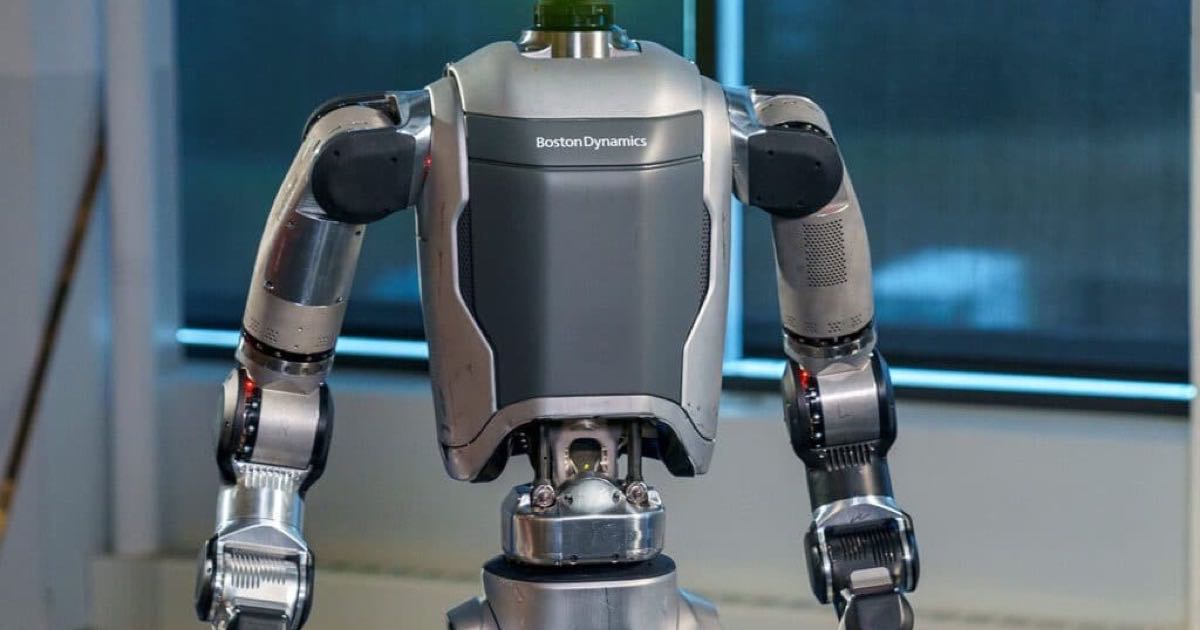
Boston Dynamics’ humanoid robot Atlas has been having a moment. On July 5, Atlas delivered the match ball to the referee during halftime of the Brazil vs. Norway round-of-16 match at the 2026 FIFA World Cup at MetLife Stadium in New Jersey, performing various goal celebrations modelled after football players. Earlier in May, it demonstrated the ability to lift a compact refrigerator weighing 23 kilograms and transfer it stably to a table — proof of both full-body control and object manipulation.
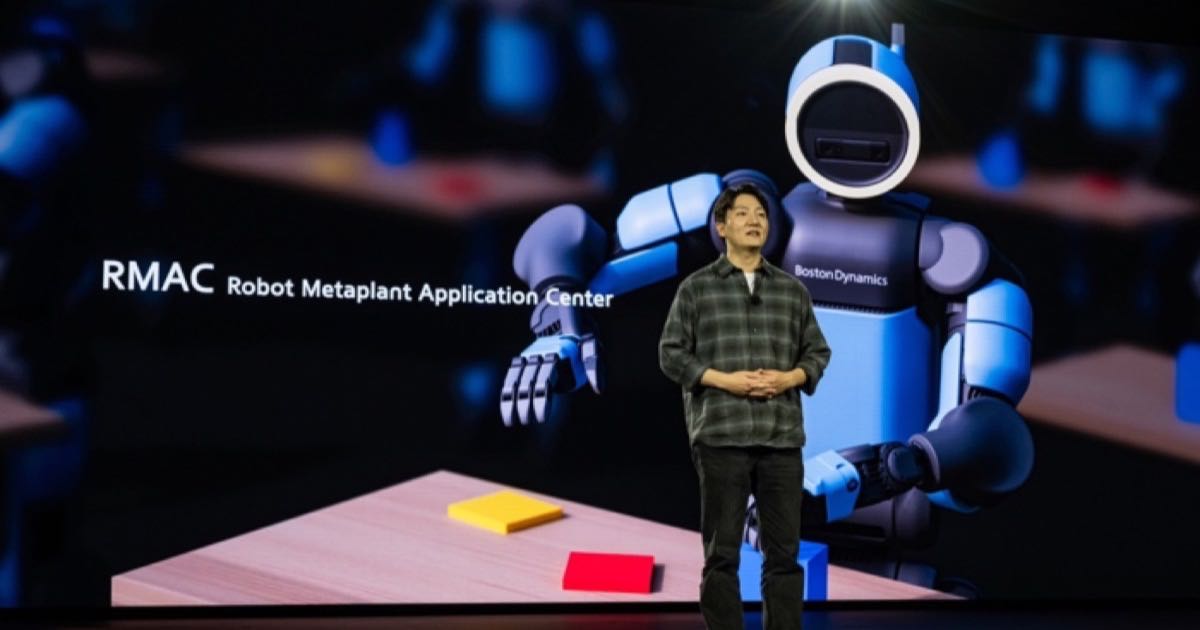
The factory deployment timeline is concrete. Starting in 2028, Atlas will be deployed at Hyundai Motor Group Metaplant America (HMGMA) in Georgia, initially handling parts sequencing and classification tasks. From 2030, the scope expands to component assembly. Hyundai Motor Company has set a target of producing 30,000 Atlas units per year within two years, and has begun building a parts supply base in Guangzhou, China.
Why Full Ownership Matters Now
The difference between 90% and 100% ownership seems marginal, but in corporate governance it’s the difference between a subsidiary and a division. With SoftBank’s minority stake removed, Boston Dynamics operates under a single ownership structure with no external board representation to negotiate with. For a company trying to move from research lab to manufacturing operation, that speed advantage is real.
According to MK Korea, the consolidation is also expected to accelerate Boston Dynamics’ planned US IPO. Hyundai Glovis estimated Boston Dynamics’ corporate value at 30 trillion won in its annual report — making the 9.65% stake worth nearly 3 trillion won under that valuation, though the actual transaction price of 500 billion won reflects the predetermined put-option terms. Chair Chung may sell part of his personal stake during the IPO to fund a broader Hyundai Motor Group governance restructuring.
The Physical AI Competitive Landscape
Hyundai isn’t the only automaker betting on humanoid robotics. The field has fragmented into several camps:
- Tesla is building Optimus, its humanoid robot, with plans for volume production
- Figure AI has partnerships with BMW and Mercedes-Benz
- Apptronik is working with Mercedes on assembly-line robots
- China’s Unitree and UBTECH are producing lower-cost humanoids for the domestic market
What sets Hyundai apart is that it owns the robotics company outright. Tesla builds its own robots in-house. Figure and Apptronik are independent companies that automakers partner with. Hyundai’s vertical integration — owning both the car factory and the robot maker — is the most committed position in the industry.
This matters because the humanoid robot race is shifting from demos to deployment. The World Cup ball delivery was a publicity moment. The 2028 Georgia factory deployment is the real test: can Atlas do useful work, reliably, in a production environment, at a cost that justifies the investment?
The SoftBank Side
For SoftBank, exercising the put option is a clean exit from a position it’s been winding down since 2021. The Japanese conglomerate originally acquired Boston Dynamics from Google in 2017, then sold 80% to Hyundai in 2021 while retaining a minority stake and the put option. SoftBank has since pivoted its robotics strategy toward acquiring ABB’s robotics unit for $5.4 billion — a deal that gives it industrial robot arms rather than humanoid platforms.
The Boston Dynamics exit also comes as SoftBank deepens its own Japanese sovereign AI and robotics push, partnering with Nvidia on domestic AI infrastructure. The company is concentrating its robotics portfolio on industrial automation rather than the more speculative humanoid space — a pragmatic split that lets Hyundai carry the humanoid risk while SoftBank owns the proven industrial robot market.
NZ Angle
New Zealand has no domestic humanoid robotics industry and no major automaker to drive deployment. But the Hyundai-Boston Dynamics consolidation matters indirectly: as humanoid robots enter factory production in 2028-2030, the manufacturing productivity gap between countries that adopt them and those that don’t will widen. NZ’s manufacturing sector — already small and export-dependent — faces the same automation pressure as Japan’s, without the domestic robotics ecosystem to respond. The NZ manufacturing AI consortium is the closest domestic signal, but it’s focused on aerospace components, not general factory automation.
❓ FAQ
Why is SoftBank selling now? SoftBank exercised a put option — a contractual right to sell at a predetermined price — that was agreed when Hyundai bought Boston Dynamics in 2021. The option was approaching expiration. This isn’t a strategic decision to dump the asset; it’s a predetermined financial transaction executing on schedule.
What does Boston Dynamics actually do that’s worth $335M for a 10% stake? Boston Dynamics makes Atlas (humanoid), Spot (quadruped), and Stretch (warehouse robot). The implied total valuation of ~$3.4 billion (based on the 9.65% stake price) is modest compared to Figure AI’s $2.6 billion valuation or Tesla’s Optimus program. The value is in the proven robotics platform and the patent portfolio, not current revenue.
When will Atlas robots actually be working in factories? Hyundai’s stated timeline: 2028 for initial parts sequencing deployment at the Georgia metaplant, 2030 for expanded assembly work. These are corporate targets, not guarantees — the history of robotics in manufacturing is littered with deployment timelines that slipped by years.
Is this related to Japan’s Nvidia Rubin chip purchase? Not directly, but they’re part of the same trend. Both stories are about countries and companies betting that AI-powered robotics is the next industrial revolution. Japan is buying the chips to train the models; Hyundai is buying the robot company to deploy them. The full stack — AI training infrastructure, foundation models, and physical robots — is converging.
🔍 THE BOTTOM LINE
Hyundai’s Boston Dynamics buyout is a governance cleanup that happens to coincide with the most important moment in humanoid robotics history. Atlas went from YouTube curiosity to World Cup performer to scheduled factory deployment in under three years. Whether it can actually do useful work on an assembly line in 2028 is the multi-billion-dollar question — and Hyundai just made sure it won’t have to ask a SoftBank representative for permission to find out.
📰 Sources
- Channel News Asia — Hyundai Motor Group to make Boston Dynamics wholly owned
- Chosun Biz — Hyundai Motor Group takes full control of Boston Dynamics
- Asia Business Daily — Hyundai Motor Group Acquires SoftBank’s Stake
- MK Korea — Hyundai Motor to Take Full Control of Boston Dynamics
- Bloomberg Technology — Hyundai to Buy SoftBank Boston Dynamics Stake