Alexandre LeBrun, CEO of AMI Labs, the world-model startup founded by Meta’s former AI chief Yann LeCun, has a simple answer to the frontier-lab obsession with “AGI” and “superintelligence”: the words don’t mean anything useful, and he’d rather build something that works in the physical world than chase a label.
“We never used the word AGI. And I just noticed that nobody is using it anymore; they switched to superintelligence,” LeBrun told TechCrunch at the International Conference on Machine Learning in Seoul. “Next time we’ll switch to something else. There’s no good definition. What is superintelligence? I don’t know. It’s not a very useful word.”
🔍 THE BOTTOM LINE
The sharpest critique of the 2026 AI race isn’t coming from a regulator or an ethicist — it’s coming from the CEO of a $1.03 billion-funded startup who is building the thing the rest of the industry is still naming. LeBrun’s refusal to adopt the “AGI” or “superintelligence” framing, and his blunt admission that “robots are not safe right now,” cuts through the marketing fog around frontier model labs that have declared AGI achieved while their systems still cannot navigate a household kitchen.
Why the Label Matters — and Why LeBrun Won’t Take It
The superintelligence framing has hardened into an industry-wide positioning tool. When Sequoia Capital declared AGI achieved, and when Demis Hassabis published his world-models AGI timeline, the message was clear: the frontier is behind us, the next phase is governance and scaling. LeBrun’s response is the counter-position. The frontier isn’t behind us, he argues — we haven’t even reached it, because the systems that get called “AGI” today don’t understand the physical world at all.
A large language model predicts the next word. A world model predicts the next state — nudge a glass off a table and you know it will tip and spill. That intuition, LeBrun argues, is what an AI system needs to operate in the real world, and it is precisely what current systems lack. He is careful not to claim world models are better than LLMs. The two are “complementary, not replaceable.” LLMs will remain the most efficient tools for processing language. World models provide context and real-world understanding. The point isn’t superiority — it’s that the AGI label is being awarded to systems that only cover half the problem.
The Robot With No Brain
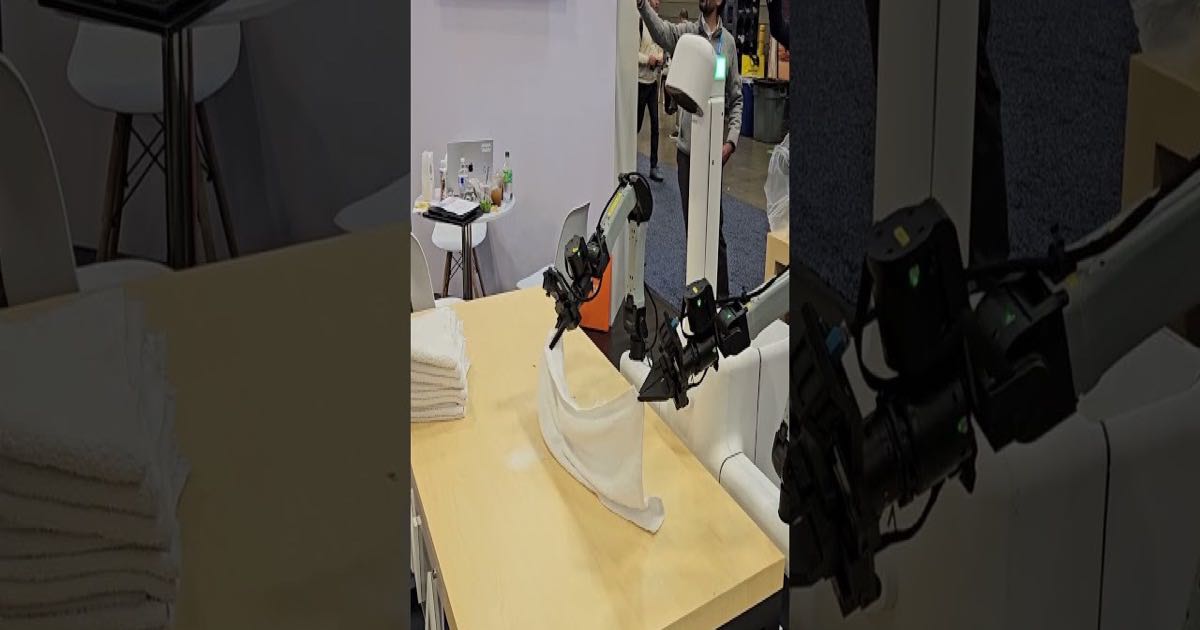
LeBrun’s most pointed critique lands on robotics. Today’s factory robots are “completely static,” running fixed routines. The hardware has advanced enormously — “progress in hardware in the last few months is incredible” — but “there’s no brain.” He cites a specific example: a robot dancing and doing kung fu at a public event that approached and kicked a child. Even making a robot “aware of the context” of its environment, he says, “would mark a very big difference for the world.”
This is not a hypothetical concern. Companies like Tesla are targeting a million humanoid robots annually, Hyundai has bought a stake in Boston Dynamics, and the rise of humanoid robots has been one of the defining stories of 2026. LeBrun’s point is that the deployment curve is running ahead of the capability curve. “Robots are not safe right now. There’s no solution for that today,” he said.
Why AMI Labs Is in Korea
AMI Labs is still pre-product. LeBrun was in Seoul scouting for industrial partners — robotics, manufacturing, electronics — because a world model “can’t be built inside a lab.” To train on reality, the company needs access to real environments. Korea has advanced industries in the exact hardware-heavy sectors the first wave of AI barely touched: semiconductors, manufacturing, robotics. The pull toward Asia is structural. That is where the robots, chips, and factories actually are.
The strategy is the opposite of the frontier-lab playbook. Where OpenAI and Anthropic build in San Francisco and announce capabilities, AMI Labs is building partnerships in Seoul and looking for the physical environments where its models can learn. The company raised a record $1.03 billion seed in March 2026. The bet is that the next phase of AI isn’t a bigger language model — it’s a model that understands what happens when you push a glass off a table.
The Healthcare Framing
LeBrun, whose previous company was the AI health startup Nabla, offered a concrete analogy. Today’s AI systems in medicine are like a doctor trained only on textbooks, with no residency. LLMs cover “only 1% of healthcare.” The rest depends on real-world experience — the kind of embodied, context-rich learning that world models are designed to capture. It’s a useful framing because it makes the limitation tangible: you would not trust a doctor who had only read books. The frontier-lab AGI declarations, by implication, are the equivalent of certifying that doctor anyway.
NZ Angle
For New Zealand, the AMI Labs trajectory matters in two ways. First, the pull toward Asia for physical-world AI partnerships reinforces a pattern already visible in Japan’s sovereign AI build with Nvidia Rubin chips — the next wave of AI infrastructure is being built in the Asia-Pacific region, not in California. Second, if world models become the foundation for safe robotics, the safety gap LeBrun identifies (“robots are not safe right now”) is a regulatory question NZ will face as humanoid robots enter workplaces here. The country’s agentic AI governance frameworks will need to account for physical-world AI, not just software agents.
❓ FAQ
Why does LeBrun refuse the AGI label? Because there is no agreed definition. “Superintelligence” replaced “AGI” without anyone specifying what either term actually means. LeBrun argues the labels are marketing, not measurement, and that the systems they describe don’t understand the physical world.
Are world models a replacement for LLMs? No. LeBrun explicitly says they are “complementary, not replaceable.” LLMs process language efficiently; world models provide physical context and prediction. AMI Labs is not building a competing language model.
What makes robots unsafe today? LeBrun says current robots lack contextual awareness — they execute fixed routines without understanding their environment. The example he cites is a robot at a public event that kicked a child because it had no sense of context. “There’s no solution for that today.”
Why is AMI Labs focused on Asia? Because world models need real-world training data, and the physical infrastructure — robots, factories, semiconductor fabs — is concentrated in Korea and Japan. The company cannot build the model in a lab; it needs industrial partners.
How does this differ from what OpenAI or Anthropic are doing? Frontier labs are scaling language models and declaring AGI milestones. AMI Labs is building a model that predicts physical-world states and is seeking manufacturing partners. The two approaches target different halves of the intelligence problem.
🔍 THE BOTTOM LINE
The industry’s loudest AGI declarations are coming from companies whose models cannot safely navigate a kitchen. LeBrun’s refusal to join the naming game is not modesty — it’s a bet that the next frontier is physical, not linguistic, and that the companies building world models will be the ones who actually deliver safe autonomous systems. The $1.03 billion says he’s not the only one making that bet.