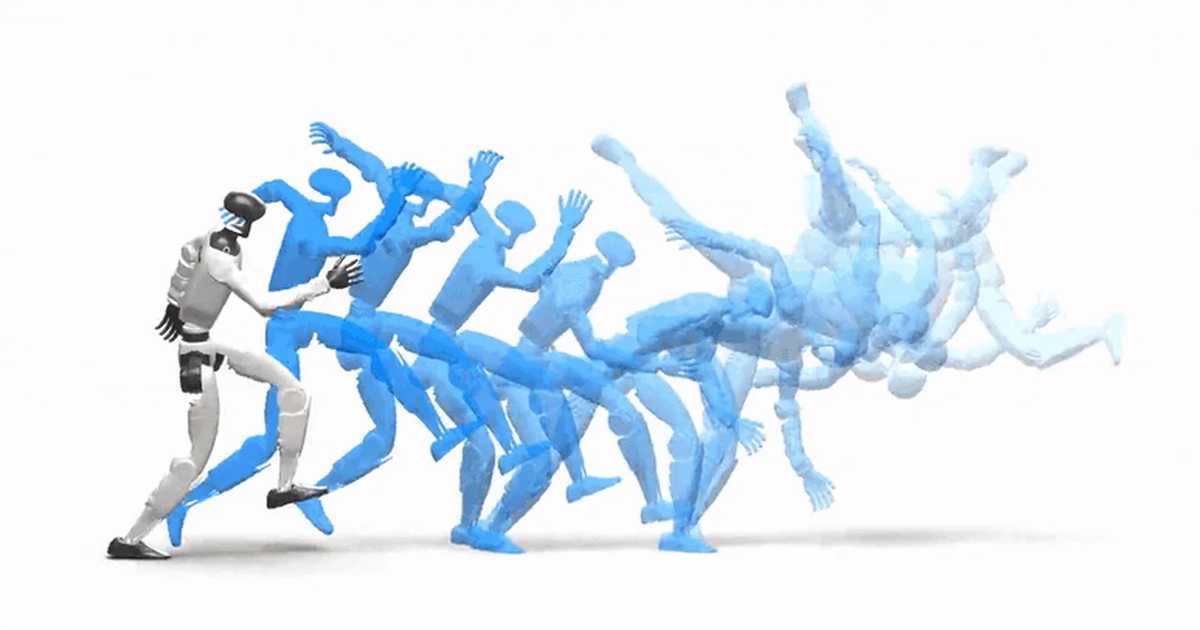
The expensive part of teaching a humanoid robot to move has quietly collapsed. SuperMimic, a paper from UC Berkeley’s Hybrid Robotics group, trains a whole-body motion controller for a Unitree G1 in 3 hours on a single GPU — and by the authors’ own comparison, that 3-hour run exceeds the performance of a state-of-the-art tracker trained for 7 days on 128 GPUs. That is a reduction of more than 1,000 GPU-hours, reported in the paper’s abstract on arXiv and summarised by Humanoids Daily.
The benchmark numbers are almost as stark as the headline. Across a test set of 129,514 motions, SuperMimic fails on 25. The cluster-trained baseline it is compared against fails on 179. Given a little more time — 9.8 hours on two GPUs — SuperMimic’s failure count drops to zero. Per the abstract, the policy “transfers to a physical Unitree G1 across diverse and acrobatic motions,” which is the part that matters: this is not a simulation-only result.
Ros Shinkle, founder of Tuesday Labs and formerly a staff roboticist at Boston Dynamics, put the shift bluntly on X: “Before October 20 it took 1 week to train a whole body controller (ie robot walking model) on 128 GPUs. Now it takes 3 minutes on 1 GPU.” She was not describing the paper alone. She was describing what happened after it.
The chain reaction
SuperMimic was posted to arXiv on October 20 by Qiayuan Liao, Yiyang Shao, Junfeng Long, Kevin Zakka, Roberto Horowitz, Pieter Abbeel and Koushil Sreenath. It shipped without code. Within a day, Eth Zürich’s Chong Zhang had published an unofficial reimplementation, and the follow-ups stacked on top of each other: InstantTrack, BlinkMimic and XMimic each took the previous project’s code and made it faster. Per Humanoids Daily’s writeup, BlinkMimic now trains a tracker in 3.4 minutes on one RTX 4090; XMimic hits 0.86 minutes on four H100s, on a 40-clip benchmark. The caveat worth holding onto: none of the community reimplementations reports a real-robot test — that still belongs to the original paper.
Official code finally landed on GitHub around November 10 under an Apache-2.0 licence, and the repo has already collected more than 1,500 stars. A community index, awesome-supermimic, tracks dozens of reimplementations. What began as one paper is now a small open-source ecosystem, less than a month old.
Why it worked: stop fighting the physics engine
The trick is a change of learning method, not scale. Conventional humanoid trackers — including NVIDIA’s SONIC — use model-free reinforcement learning, where the policy learns by brute force over enormous numbers of simulated trials and the physics engine is a black box. Per the paper, SuperMimic instead trains a differentiable world model of the robot’s shared dynamics, fit from logged transitions of an ordinary rigid-body simulator, then improves the tracking policy by backpropagating through short imagined rollouts. The world model and the policy train together in one loop. Analytic gradients replace lottery-ticket sampling, and the compute bill falls off a cliff. The paper also reports that the world model’s prediction error stays stable as the motion dataset grows from 1 to 264 hours, which is what makes “scaling law” claims plausible rather than aspirational.
The irony is that this lands in the same season as the biggest training clusters in robotics. When Meta spun Pi up as an independent company and OpenAI wound down its own standalone robotics team, the assumption baked into both stories was that general humanoid competence is something you buy with scale — clusters, fleet data, capital. SuperMimic points the other way: at least for locomotion, the binding constraint is method, not machines. A lab with a single GPU and good motion data can now buy its way to a walking controller in an afternoon, and the official repo proves the recipe is reproducible.
That has a specific meaning for small markets like New Zealand. If whole-body control collapses to consumer-hardware cost, the barrier to building a capable robot stops being the training run and becomes everything around it — hardware integration, safety cases, task data, deployment. Those are exactly the things a small team with a workshop and no datacentre can plausibly do. The country keeps watching robotics prices the way our pricing tracker follows model prices; this is the same shape of story one layer down the stack. A week of cluster time turning into minutes on one GPU is a price collapse, and price collapses are what move capability out of labs and into garages.
Sources: arXiv (SuperMimic paper) · Humanoids Daily · GitHub / Berkeley Hybrid Robotics · Project site · Robotics Weekly. Paper and reimplementation numbers as reported by the respective projects; community reimplementations have not yet published real-robot results.