The numbers behind stroke treatment are grim in a way that does not usually make funding announcements. Mechanical thrombectomy — threading a catheter into the brain and pulling out the clot causing an ischaemic stroke — is the gold-standard treatment. It also happens, by most estimates, for only about one in ten of the patients who would qualify for one, because the procedure needs a specialist interventional neuroradiologist, a dedicated angiography suite, and a hospital that happens to have both. Time kills neurons at a rate of roughly 1.9 million per minute, and most people are not having their stroke inside one of those hospitals.
Remedy Robotics, a 25-person San Francisco company, is betting that a robot can close that distance. On November 16, 2026, it announced a US$62 million Series B to push its N1 System — an AI-enabled robotic platform that physically drives the catheter while a surgeon controls it from a console, either in the next room or thousands of kilometres away — through clinical trials and toward regulators.
The round, and who is in it
DCVC led the Series B. The new money includes UC Investments, the University of California’s own investment office, plus Skip Capital and Hostplus, one of Australia’s largest pension funds. Existing backers — Build Collective (Tony Fadell’s vehicle), Blackbird, Divergent Capital and KdT Ventures — doubled down, according to the company’s announcement carried by PR Newswire and Unite.AI.
The investor list is doing more than adding zeros. The money funds a planned pivotal clinical trial held across the UC health network — the same institution whose investment office is writing part of the cheque, and whose clinical experts Remedy has worked with since 2021. Australian superfund money, separately, tracks where Remedy sees its first real-world deployments: the company has run a strategic partnership with the Australian Stroke Alliance since October 2025, and Financial Standard reports that HESTA is also in the consortium.
What the round buys, per the company: the pivotal trial, advancement toward US FDA clearance for neurovascular intervention, prototype N1 deployments across its clinical-partner network (including SVIN Mission Thrombectomy in the US), and continued development of the system’s autonomy functions. Remedy says it now works with more than 100 hospitals worldwide and holds 48 patents, including foundational ones in machine learning applied to surgical robotics.
What the N1 actually does
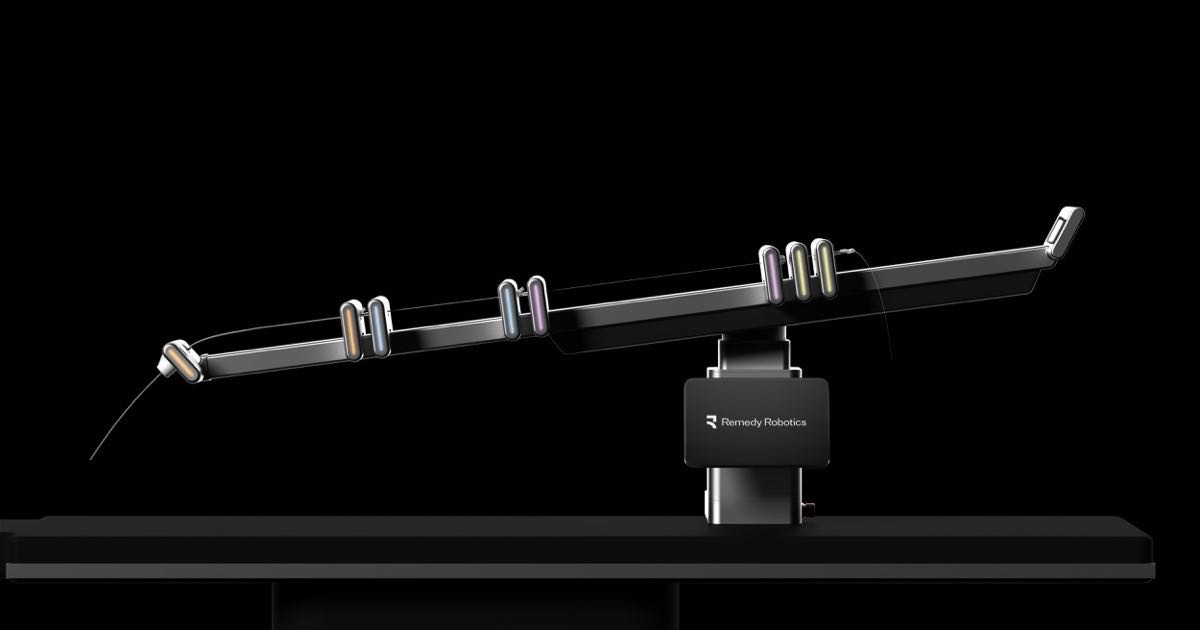
The machine is a motorised catheter driver. Outside the patient, a robotic arm advances a thin steerable catheter while wires at its tip pull it left, right, up and through the branching vasculature; the surgeon watches a live X-ray feed and drives from a console that IEEE Spectrum’s hardware writer compared, favourably, to an Xbox controller. Machine-learning software analyses preoperative imaging, simulates the procedure in advance, and performs real-time registration of 3D scans against the 2D fluoroscopy feed during the operation, per the company’s own description.
The design target is “supervised autonomy” — the AI handles tool positioning and image alignment while a human keeps judgement and control. Remote operation packages connectivity, audio and video without third-party integrations, which matters more than it sounds: a stroke robot that needs a hospital IT department’s blessing to phone home is a stroke robot that never leaves the big city.
N1 is investigational. It is not approved for sale or clinical use anywhere in the world, and Remedy says so plainly on its own website footer. That honesty is worth noting because the funding-announcement genre usually buries it. It is also a bet consistent with where medical robotics money has been going all year — Intuitive’s corner of the market keeps consolidating (Medtronic’s $700M Cornerstone bet, Enovis buying Ecential, Mendaera coupling its robotic platform to Butterfly’s handheld ultrasound) — and Remedy’s twist is that the procedure itself, not just the assist, is what gets automated.
The timeline, and the thing that isn’t the flashy part
IEEE Spectrum’s report on the company, published November 16 alongside the funding news, lays out the sequence: clinical studies start within a year at the UC system, beginning with on-site elective procedures such as treating unruptured aneurysms. Remote surgeries — in Australia or within the UC network — are targeted for near the end of 2027. The world’s first fully remote neurointerventional procedures happened in October 2025 between two Toronto hospitals using N1, so the telemetry has precedent; what nobody has is regulatory approval, and no patient has ever been operated on remotely in the United States.
The interesting part of Spectrum’s piece is what CTO and co-founder Jake Sganga says about the remote promise itself. The remote capability is “very flashy, it’s very obvious what that patient need is,” he told the magazine, “but in order to get there, we believe you have to solve a meaningful problem on-premise. Otherwise, doctors simply won’t use the system.” Translation: the robot has to earn its place in the angiography suite first, on ordinary in-room cases, before anyone trusts it to carry a stroke patient’s outcome across an ocean of latency. Bell’s framing is blunter: smoothness and precision, he says, “are not clinical outcomes.”
Sganga and Bell — a former cardiac-surgery trainee from Australia and a bioengineer who once built pathfinding algorithms for FDA-approved bronchoscopes — built the first prototype in a lead-lined rented garage in Southern California, driving a catheter through silicone arteries from a laptop hundreds of kilometres away. The company calls the milestone “initial sign of life.”
NZ angle: the geography problem is ours too
New Zealand already runs one of the more ambitious distributed thrombectomy systems in the world — the hub-and-spoke network centred on Auckland, which by 2026 has treated over 2,180 patients across a decade, with 63.8 percent of them requiring interhospital transfer and nearly a third arriving by air ambulance, according to a recent national cohort study. Outcomes match international benchmarks. But the published numbers also show the strain: in 2024, 12.0 percent of ischaemic stroke patients in metropolitan Auckland received EVT, against 6.5 percent for patients helicoptered in from Northland and the Midland region. The authors flag that Waikato may one day get its own EVT service to close the gap — and that is precisely the gap a teleoperated robot claims it can close without building a second neurosurgical service from scratch. A district hospital that keeps its angio suite but borrows the specialist by satellite would change the arithmetic for Whangārei or Taupō. That is speculative by definition — N1 has no regulatory approval anywhere — but it is the first plausible version of this idea, and the money now exists to find out.
Telesurgery has a history of underdelivering. The 2001 Lindbergh Operation proved a surgeon in New York could remove a gallbladder in Strasbourg, and the field then spent two decades quietly deciding same-room robots were the better business — today Intuitive’s da Vinci alone assists in over 2 million surgeries a year. WhetherRemedy breaks that pattern depends on whether “the robot is good even when the surgeon is in the room” turns out to be true. The $62 million says its investors think the answer is knowable by 2028.