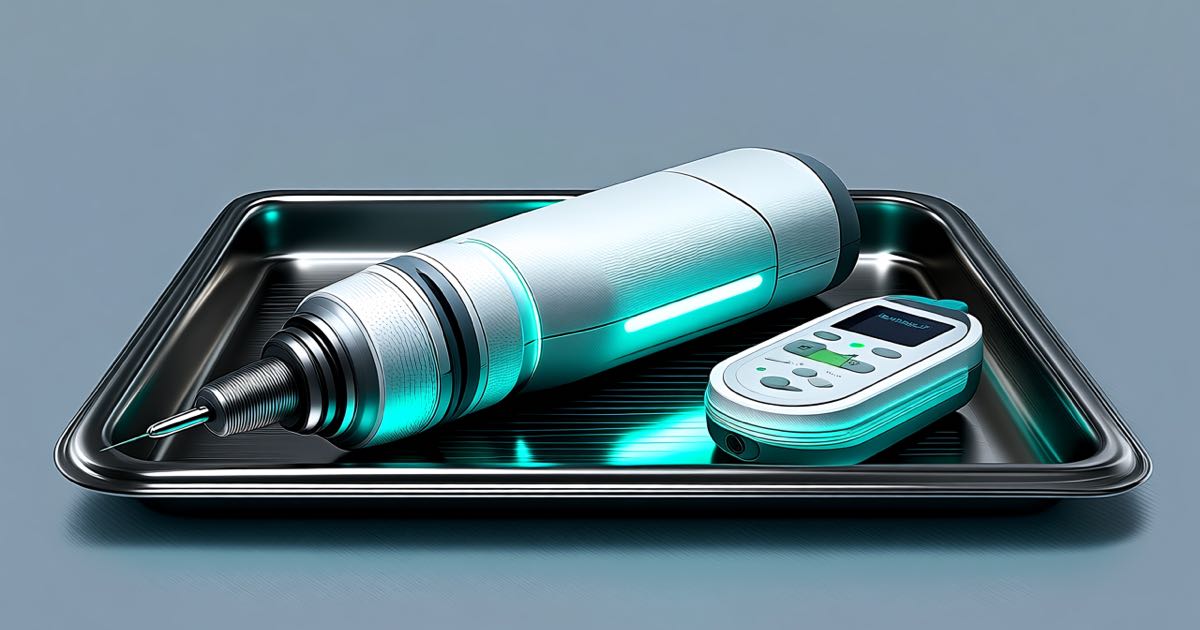
Medical robotics tends to announce itself in millions of funding dollars and years-away timelines, so it is worth pausing on a quieter kind of milestone: a device that is actually for sale. Mendaera’s Focalist — a handheld robot that steadies and guides clinicians’ needles for IV lines, nerve blocks and organ access — is now available paired with Butterfly Network’s chip-based iQ3 ultrasound probe, a combination announced by Butterfly Network on 1 October and picked up by trade outlets including MassDevice the following day. The milestone inside the milestone: Mendaera is the first partner in Butterfly’s Embedded licensing program to reach the market, a program the two companies have been quietly building since their collaboration was first announced in December 2023.
The setup is a sensible division of labour. Ultrasound is how a needle robot sees; the iQ3 is a laptop-adjacent probe that turns imaging into software rather than bespoke optics, so the pairing replaces a fixed camera-and-cart stack with two devices a clinician can carry into a normal exam room. “Ultrasound is fundamental to how Focalist sees and guides intervention, and Butterfly gives us a uniquely digital and programmable imaging platform to build on,” said Mendaera co-founder and CEO Josh DeFonzo in the announcement — adding that the software-defined architecture “opens a path toward AI-enabled image interpretation and robotic action.” Butterfly’s CEO Joseph DeVivo framed it as expanding access “while reducing reliance on a limited group of highly specialized expertise.”
That access argument has history behind it. Focalist received US FDA 510(k) clearance in July 2025 for guiding needle placement relative to the ultrasound image — as covered at the time by The Robot Report — and the San Mateo company had already raised a $73 million Series B in September 2024 led by Threshold Ventures, with Lux Capital and Intuitive Surgical founder Fred Moll among the backers. First procedures done under that clearance included kidney-stone removal via minimally invasive nephrolithotomy. None of that guarantees uptake: adoption will be decided in hospital procurement committees, not press releases, and “compatible” is not the same as “clinically proven better.” But the pieces on the table are real — cleared device, shipping partner hardware, revenue shared on every combined unit per the companies’ commercial arrangement.
The reason this pairing matters beyond one product line sits in the quotes both CEOs chose. Both are describing a robot as a software platform first: DeFonzo’s “AI-enabled image interpretation and robotic action,” DeVivo’s software-defined imaging, the probe as a programmable peripheral rather than a sealed instrument. If ultrasound becomes software and the robot becomes its actuator, the upgrade cycle shifts from replacing hardware to shipping models — and the moat moves to whoever accumulates procedure data fastest. That is the same wager the broader surgical-robotics consolidation is making: Medtronic’s $700 million Cornerstone purchase bought an ecosystem bet, and Enovis buying Ecential Robotics did the same for orthopaedics. Mendaera and Butterfly are running the identical playbook from the bottom of the market up — handheld, cheap, and aimed at the procedures that actually happen millions of times a day.
For New Zealand’s public system the relevance is narrower but real: image-guided procedures concentrate on a small pool of experienced specialists, and the pitch here is explicitly about not needing one in the room. Whether the DHB procurement machinery can buy handheld robotics at all is a separate question — but devices like this are what that conversation will start from.
Sources: Butterfly Network press release (1 Oct 2026); Mendaera press release (mendaera.com, 1 Oct 2026); MassDevice (2 Oct 2026, site restricts automated access); The Robot Report (8 Jul 2025). Performance and commercial-terms claims come from the companies’ joint announcement.