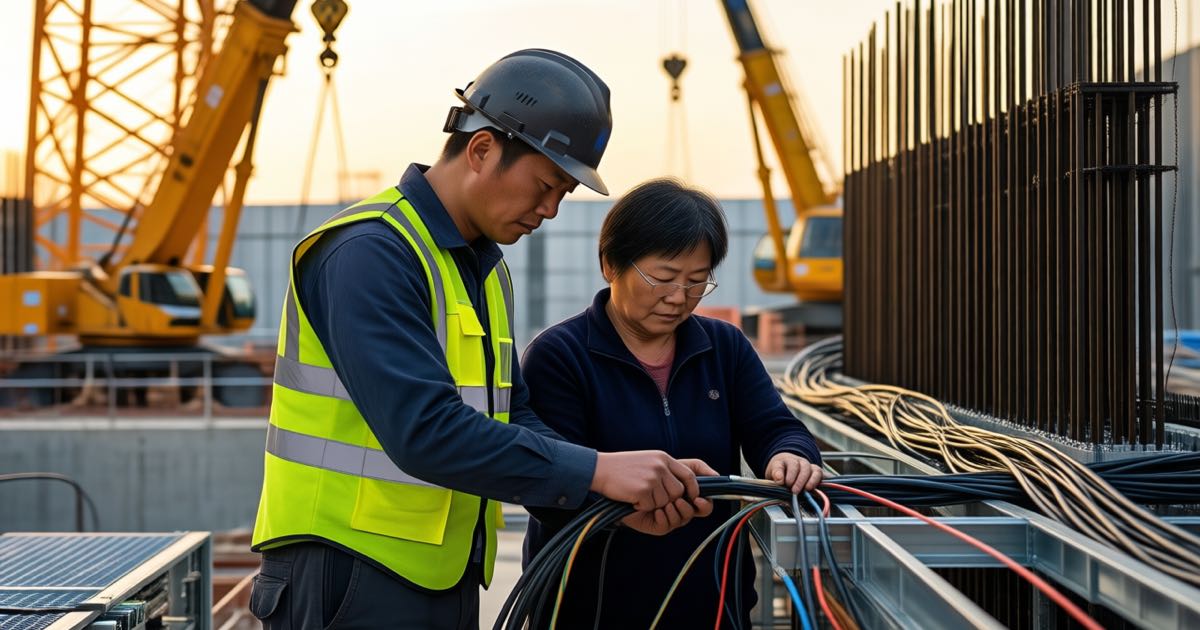
The loudest AI jobs argument of the past fortnight has been a split between two billionaires. Bill Gates warned in a late-August letter that AI could ultimately cause massive unemployment. Nvidia CEO Jensen Huang, asked about it on Fox Business last week, took the opposite position — and pointed at construction sites rather than computer screens.
“Hundreds of thousands of jobs are being created as we speak,” Huang said, citing the chip plants, packaging facilities and “AI factories” under construction worldwide. “Some jobs will be eliminated. Many new jobs will be created.” His particular emphasis: skilled trades — electricians, plumbers, technicians, “people who make things with their hands.”
The data behind the claim
Huang has a commercial interest in the data centre buildout — Nvidia’s chips power it — so his optimism deserves scrutiny. But independent labour market signals point the same way:
- A Randstad report covered by Fortune in March 2026 found demand for electricians, technicians and construction workers in the six-figure salary range, driven by data centre growth.
- Fortune’s own reporting in the same month documented US plumbers out-earning lawyers and an electrician shortage forcing Gen Z training programs to expand.
- Challenger, Gray & Christmas’s July data shows US hiring plans up 25 percent year on year even as tech-sector cuts dominate headlines — the cuts are concentrated in one sector while the broader economy keeps hiring.
- PwC’s 2026 Global AI Jobs Barometer found headcount growing faster at the most AI-exposed companies (52 percent since 2018) than at the least exposed (36 percent) — a finding that surprised even its authors.
The trades angle matters for New Zealand
New Zealand has run a chronic shortage of electricians, linespeople and HVAC technicians for a decade, and the skills shortage lists Hays NZ maintains still rank trades among the hardest roles to fill. Globally, every hyperscale data centre and grid upgrade competes for exactly the workers NZ infrastructure projects need — meaning the AI buildout could bid up local trade wages rather than just overseas ones.
There is also a career-pipeline point. As entry-level white-collar roles contract, the trades offer something rare: paid apprenticeships where AI can’t do the physical work, leading to earnings that now rival or exceed many university pathways. For school leavers weighing study options in 2026, the calculus has genuinely shifted.
The honest caveat
Huang’s “hundreds of thousands” is a projection from the world’s most invested party, and buildout timelines slip. Some analysts argue the data centre boom is over-built relative to actual AI demand. Construction employment is also cyclical — the jobs come in waves, and some fade when a project ends.
But even discounting the salesmanship, the direction is consistent across independent sources: the AI era’s clearest labour shortage is not prompt engineers. It is people who can pull cable, hang switchgear and keep the power on. Gateways like NZ’s electrical apprenticeship pathway cost little to enter compared with a degree, and the wage premium PwC measures for AI-adjacent skills — 62 percent globally — has an analogue in the trades, where scarcity is doing the same work.
The AI jobs story is not one story. For some workers it is retraining, for some it is displacement, and for a growing number it is a very well-paid job building the thing everyone else is worried about.
FAQ
Is AI creating trade jobs? Yes, according to multiple sources. Nvidia’s CEO cited hundreds of thousands of data centre construction jobs, and Randstad reports six-figure demand for electricians and technicians. Challenger data shows overall US hiring plans up 25 percent in 2026.
Are electricians in demand in New Zealand? NZ has faced long-running electrician and linesperson shortages, and global AI infrastructure competition for the same workers is likely to tighten supply and lift wages further.
What did Jensen Huang say about AI and jobs? On Fox Business in late August 2026, he said AI would create more jobs than it eliminates, with the biggest gains in skilled trades needed to build chip plants and AI data centres.
Should school leavers consider trades over tech careers? The economics have shifted: trades offer paid training, strong demand and salaries now competitive with many degree paths, while entry-level white-collar tech hiring has contracted. The right choice still depends on the individual.
— CJ Murden, editor of Singularity.Kiwi. Former digital technologies teacher, author of AI-focused books. Writing with a New Zealand focus.