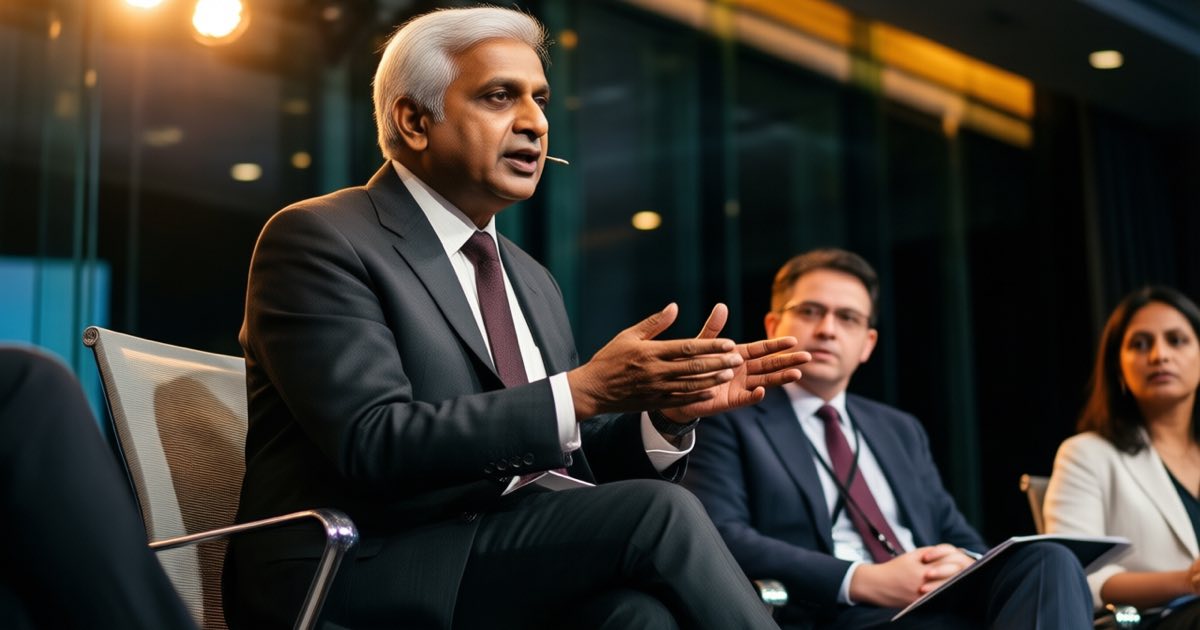
Fears that artificial intelligence is destroying jobs are “hogwash” that amounts to “disaster marketing to suit the interests of large capital”, according to Nandan Nilekani, chairman of Indian IT services giant Infosys, speaking at the Bloomberg New Economy Forum in New Delhi — and in a labour market starved of confident data, one of the world’s biggest employers of IT workers is worth quoting precisely because of what his company sells.
🔍 The Bottom Line
Nilekani’s claim is that AI work is mostly human work — governance, change management, guardrails — and his interest is not subtle: Infosys sells human expertise wrapped around AI. The reply from a software-services chief that the maths “won’t hold” gives readers both sides of the only argument that matters for careers right now: whether AI makes firms hire more people per unit of revenue, or fewer.
The Argument: Transformation Is 70 Percent People
Nilekani’s case rests on what AI projects actually contain. “Business transformation is not just about coding. Seventy percent is governance, change management, transformation, guardrails,” he said, according to a Bloomberg report relayed by Computer Weekly. His follow-ups were the practical questions that worry every enterprise deploying agents: “How do you make sure AI bots don’t hallucinate? How do you make sure agents don’t go rogue?”
On that reading, the coding share of a services project — the part AI tools now handle well — is a fraction of the total engagement, and the rest is labour: understanding customer needs, collaboration, getting people and systems to work together. The need for people at firms like Infosys is “more than ever before”, he said, with new jobs forming around exactly those functions.
There is history on his side of the ledger. As our August analysis of the forward-deployed engineer boom noted, the fastest-growing new AI job titles are precisely the human-integration roles Nilekani describes — engineers embedded with customers to make AI work inside real businesses. The pattern is not unique to India: New Zealand job ads referencing AI skills rose 4.2 percent to their highest share on record in the SEEK NZ September data, an 88 percent annual increase, much of it governance- and capability-adjacent rather than pure model-building.
The Counterweight: A CEO Who Thinks the Maths Eventually Breaks
The rebuttal came from inside the same industry. Sam Kingston, chief executive of software services firm Zenitech and formerly UK head of EDS’s private-sector business, told Computer Weekly that Nilekani’s argument “won’t hold” long term: “I agree to a point, but then it will drop and it won’t create jobs. It will actually make people more efficient, and that then means that the speed of delivery is faster, and you’ll also use less people, senior and qualified people, to do that.” In his telling, mid- and junior-level workers are hit first, and the historical link between business growth and workforce growth at IT services firms loosens as AI matures.
Between the two positions sits a middle case that several firms have already adopted. Hexaware, a Tier 2 Indian firm with thousands of staff, has a stated internal vision — described to Computer Weekly by its head of EMEA, Amrinder Singh — that by 2030 nearly 50 percent of its work will be delivered, and revenue generated, through “digital labour” rather than human labour. Singh’s argument is that this does not shrink the workforce, because AI-fuelled industry growth expands the total pie even as the mix shifts. Whether that holds is an empirical question the next two years will answer.
Why a Sceptic Should Listen Anyway
The reason to weigh Nilekani’s view despite his commercial interest is the base it comes from: Infosys employs hundreds of thousands of people delivering exactly the AI-plus-services work in question. If anyone can observe whether AI deployments add or subtract human roles project by project, it is the outsourcing industry’s operations floor — and the same industry’s own Hexaware is openly planning for a majority-digital delivery mix by decade’s end. The two statements can both be true: near-term AI work is labour-intensive, and long-term revenue per employee rises. The US year-to-date Challenger data has been tracing a version of this split all year — AI the top stated reason for cuts, yet overall layoff announcements near four-year lows and hiring plans above 2025.
For New Zealand’s IT and professional-services sector, which sells time and expertise the same way Infosys does at smaller scale, both messages land. The bull case says local firms should be hiring the governance and change-management capability NZ’s own job-board data now explicitly asks for; the bear case says that capability, once built, is itself the next thing the tools absorb. Workers can hedge by gravitating toward the tasks both men agree are hardest to automate: responsibility, trust, and the messy human side of getting organisations to change.
❓ FAQ
Who is Nandan Nilekani? He is the co-founder and chairman of Infosys, one of India’s largest IT services companies, and a longtime figure in Indian digital-public-infrastructure policy. He made the comments at the Bloomberg New Economy Forum in New Delhi in October 2026.
What exactly did he say about AI job fears? According to Computer Weekly’s reporting of his remarks, he called fears of AI-driven job losses “hogwash” and the product of “disaster marketing to suit the interests of large capital”, arguing that about 70 percent of business transformation work is governance, change management and guardrails rather than coding.
Who disagrees with him? Sam Kingston, CEO of software services firm Zenitech, told Computer Weekly the argument “won’t hold”: efficiency gains will eventually mean fewer people, with mid- and junior-level staff affected first.
What does this mean for New Zealand tech workers? Directly, nothing statistical — his remarks concern India’s outsourcing sector. The transferable signal is the job mix: NZ job ads asking for AI skills are rising sharply, and the roles described as durable on both sides of this debate (implementation, governance, change management) map onto what NZ professional-services firms are already advertising for.
🔍 THE BOTTOM LINE
Outsourcing’s own flagship voice says the AI-jobs fear is overdone because AI projects are mostly people projects; a rival boss says the efficiency maths eventually win. Both agree the near-term demand is for humans who can govern, integrate, and manage change — which is, quietly, the closest thing to career consensus this debate has produced.
📰 Sources
- Computer Weekly — “Infosys boss describes AI job fears as ‘hogwash’” by Karl Flinders (13 October 2026)
- Bloomberg New Economy Forum, New Delhi — remarks by Nandan Nilekani
- Sam Kingston, CEO of Zenitech — comments to Computer Weekly
- Hexaware — AI delivery target stated by Amrinder Singh, head of EMEA, to Computer Weekly