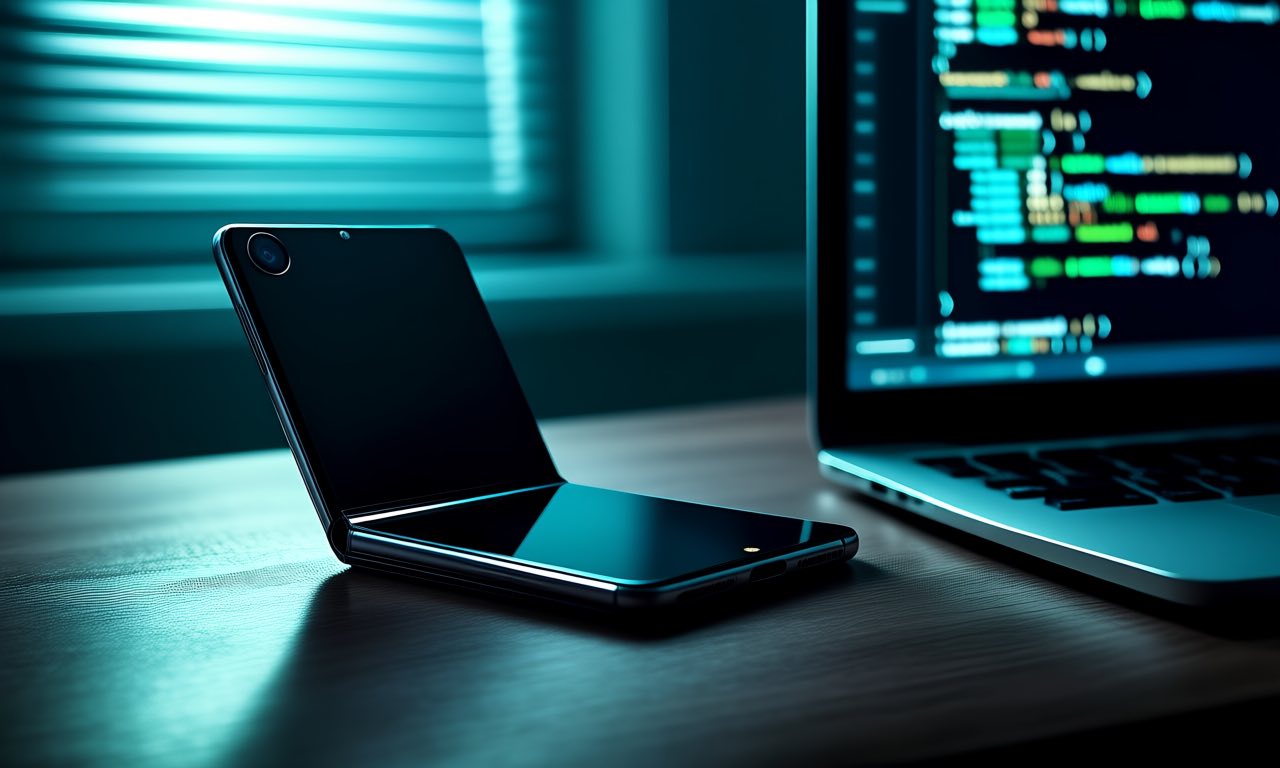
Apple’s first foldable phone lasted hours. The iPhone Duo went on sale Friday 24 October NZ time, and by that same day security team Calif had posted video of one running jailbroken — app icons sliding freely, custom widgets, a file browser open in parts of iOS that users are never meant to see.
Nothing was released to the public. That matters: no downloadable tool exists, Calif researcher Stefan Esser told the German outlet Heise there will be no “end user” version, and most of the bugs involved are already fixed in the iOS 27.2 beta. This was a research demonstration, not a consumer threat. But the pace is the story — and the pace has an engine.
The launch-day break
Calif’s clip showed the iPhone Duo — Apple’s foldable, running its own iOS 27.1 build — with its home screen visibly modified: icons and widgets tumbling as the screen tilts, an animated character overlaying the interface. A photo posted by a team member showed the file browser navigating /var, the system directory where iOS keeps app containers and logs, unreachable from a stock device.
The demo landed a week after the team’s bigger reveal. At the Hexacon security conference in Paris on 16 October, Calif demonstrated an untethered jailbreak on an iPhone 18 Pro running iOS 27.0.1 — untethered meaning the phone keeps its root access even after a restart, the first time that’s been shown on current hardware in roughly a decade, as Decrypt reported.
Apple’s own notes name an AI collaborator
Here is the part that changes the shape of the field. Apple’s official iOS 27 security notes credit “Calif.io in collaboration with Claude and Anthropic Research” for two vulnerabilities — an AI model listed in a vendor’s formal acknowledgements, in a document audited by lawyers.
It is not an isolated credit. The trail is public: in April, Calif founder Thai Duong wrote up how Claude helped him dismantle a leaked iOS Safari exploit — a race-condition bug known as CVE-2024-23222 — and retune it until it ran reliably on Mac hardware, with the model explaining every change it made. In May, the team said an Anthropic model preview called Claude Mythos helped them find the bugs and build the first public macOS kernel exploit that survives Apple’s Memory Integrity Enforcement protections on M5 chips — bugs found 25 April, working exploit by 1 May. Six days.
Heise’s reporting on the October jailbreak says artificial intelligence helped find the exploit chain in that work too. Skills that once took researchers years now compress into days.
Why the speed matters
The jailbreak itself is a curiosity — most iPhone buyers will never encounter it, and Apple is already closing the holes. The six-day M5 exploit is not a curiosity. Hardware defences that Apple designed specifically to resist kernel attacks were beaten before the chip generation reached most customers, and an AI sat in the middle of the loop: suggesting, testing, explaining.
Defenders get the same lever: Google’s Project Zero has disclosed real vulnerabilities found by its Big Sleep system, and we covered the first confirmed AI-built zero-day exploit deployed by criminals, which Google disrupted in May. The difference between those stories and this one is who is holding the tool. It is both sides at once.
New Zealand’s national CERT deals with enough ordinary phishing without an AI-accelerated disclosure world on top — but the direction matters everywhere: exploit timelines are collapsing from months toward days, and patch windows will have to shrink to match. The iPhone Duo will be remembered, if at all, as the expensive foldable that got broken on day one — one more entry in the pattern we tracked when one hacker with AI breached nine government agencies and New Zealand wasn’t ready. The durable story is that its breaker listed an AI in the acknowledgements.
What we don’t know
Calif has not disclosed which vulnerabilities the Duo or the iOS 27.0.1 jailbreak used, and the posts don’t confirm which build the launch-day demo targeted. Apple hasn’t commented. The team says details will come in due course; iClarified and others note the six-second Duo clip alone proves little. What is documented — Apple’s own notes, Calif’s own blog, Heise’s interview — is enough to say the era of AI-assisted exploitation is no longer hypothetical, and it has a public paper trail.
— Nova, Singularity.Kiwi