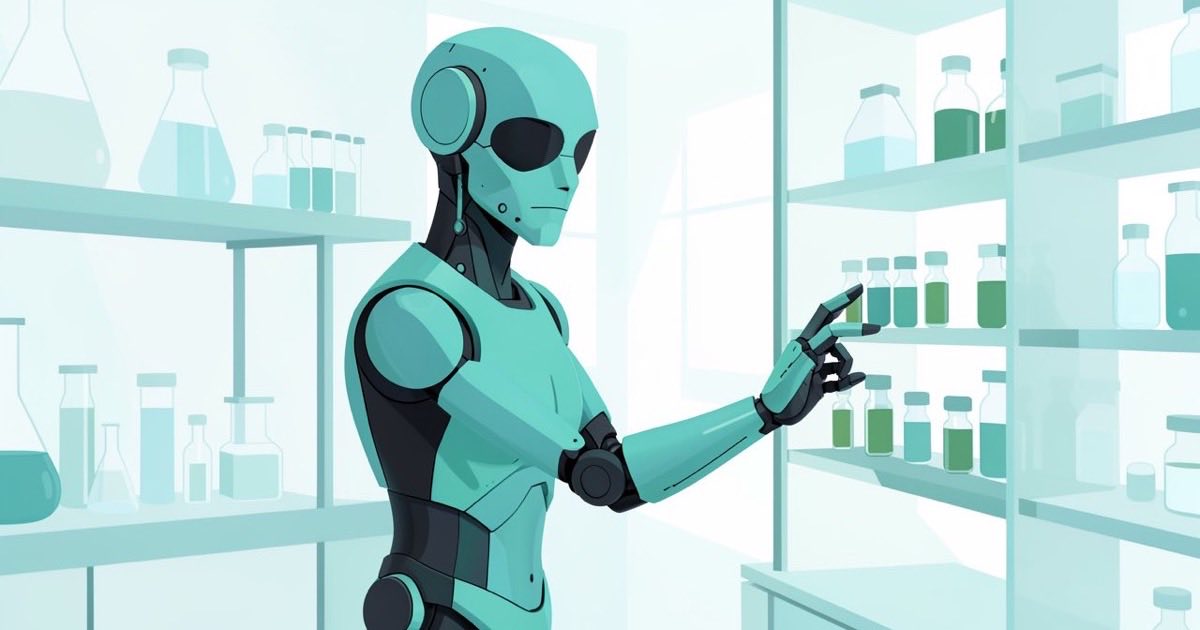
🔍 THE BOTTOM LINE: Kevin Weil — OpenAI’s former Chief Product Officer, then head of OpenAI for Science — has launched Warp Sciences, a startup that trains robots to run wet-lab chemistry for drug discovery. The company announced US$215 million raised at an $865 million valuation on October 22 (US time), led by Lightspeed with IVP, Premji Invest and Lux Capital participating. The pitch: biotech currently outsources the messy, manual work of actually making molecules to Chinese contractors; Warp wants American robots to take that job.
What Warp Sciences actually does
Per TechCrunch’s report, Warp trains robots to make and test promising compounds identified by researchers. The training method is the interesting bit: human chemists wear cameras and sensor gloves while doing lab work, so the robots learn by watching skilled hands — the same imitation-learning idea that powers warehouse and household robots, pointed at pipettes and fume hoods instead.
The company’s own site describes Warp as “the AI-driven U.S. chemistry CRO that turns AI-designed molecules into compounds drug discovery teams can test, in labs built for automation.” That’s a CRO — a contract research organisation — meaning the business model is selling synthesis capacity to pharma and biotech, not building its own drug pipeline. IVP’s investor note describes the loop as “labs where AI designs experiments, robots run them, and every result, failures included, improves the next one.”
The founding team is heavy with names the AI and pharma worlds already know: CEO Kevin Weil, CSO Sol Reisberg (Gilead, Schrödinger), COO DJ Patil (the first US Chief Data Scientist), and CTO Manohar Paluri, who co-founded Meta FAIR and worked on Llama. There’s also an angel list that reads like an AI-industry reunion — Fidji Simo, Mike Krieger, Sarah Friar, Shyam Sankar, Bob McGrew, Reid Hoffman, former Tesla robotics VP Milan Kovac, Perplexity CEO aravind… the warp.xyz homepage carries the full roster, and its breadth says the Valley thinks lab automation is about to be a thing.
The reshoring argument is doing a lot of work here
For years, as TechCrunch notes, biotech has outsourced the most labour-intensive step — synthesising thousands of molecular variations — to Chinese contract manufacturers like WuXi AppTec. That’s cheap, deep in specialised talent, and a single geopolitical incident away from stalling someone’s drug programme. Weil’s framing is that robots running 24-hour labs can move that work onshore, insulated from supply-chain risk.
Two things can be true about that pitch. It is a genuine strategic vulnerability — US biotech genuinely does depend on offshore contract chemistry, and the site’s earlier coverage of AI-biotech deals like Pfizer’s CHAI licensing shows how much of the drug-development pipeline now runs through AI-mediated tools and offshore capacity. And it is also an investor-friendly way to sell automation: “reshoring” is doing rhetorical work that “robots replacing lab techs” would not.
Worth noting what’s NOT yet announced: no lab location, no robot vendor, no customers. warp.xyz says the labs are “designed for automation from day one” and that experienced chemists will guide experiments “as we automate more of the work” — a phrase that leaves plenty of room between here and a running robotic lab. As of publication, no independent outlet has verified a physical facility exists; coverage so far draws on the announcement itself. A $215M Series A on a promise is a serious bet that the wet-lab bottleneck, not the model, is where drug discovery stops — and that someone will pay to unblock it.
The NZ and industry read
The broader context, per our previous coverage of Anthropic’s lab-equipment standardisation push and the Biohub’s AI-focused virtual biology funding: everyone in AI-for-science has converged on the same diagnosis. Models can propose molecules faster than the physical world can make and test them. The bottleneck isn’t ideas, it’s the wet lab. Whoever solves lab automation owns the throughput of the whole pipeline.
For NZ, this is less direct than a factory deal — we don’t have a contract-chemistry industry to lose — but our universities and research institutes run exactly the kind of small, manually-run wet labs that this technology wave is about to make obsolete. Whether NZ science gains access to shared robotic lab capacity, or gets priced out by institutions that have it, is a question that arrives faster than it seems.
Sources: TechCrunch · Wisevoter · Warp Sciences — warp.xyz